
Perseid Meteor Shower Adds to the Celestial Spectacle
Coinciding with today’s total solar eclipse, the Perseid meteor shower offers another thrilling skywatching opportunity. This meteor shower, renowned for its annual display, has been active since mid-July and reaches its peak overnight from Wednesday into Thursday.
For those in regions where they can witness the eclipse at sunset, meteors may become visible during the phase of totality. Under optimal conditions, such as clear and dark skies away from city lights, the Perseids have the potential to yield up to 100 shooting stars per hour. The display is also noted for producing fireballs, which are bright meteors that leave glowing trails as they burn up.
Catch the Eclipse Online
For those not in the path of totality or facing cloudy skies, virtual viewing options are available. Various organizations will provide an online broadcast of the eclipse. NASA plans a livestream starting at 1:15 p.m. ET, while the European Space Agency will offer a live broadcast on YouTube beginning at 1:30 p.m. ET (7:30 p.m. CEST).
Understanding Solar Eclipses
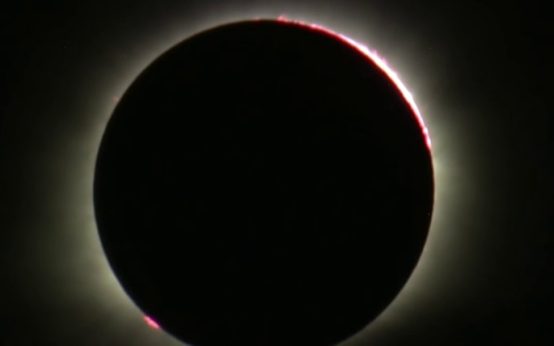
A solar eclipse occurs when the sun, moon, and Earth align, causing the moon to block the sun’s light. During a total solar eclipse, the moon completely obscures the sun, and the sky turns dark as though it were dawn or dusk. With favorable weather, the sun’s outer atmosphere becomes visible during these moments of totality.
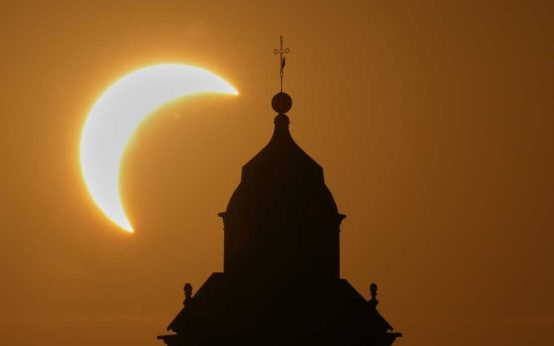
In a partial solar eclipse, the moon blocks only a portion of the sun, creating a visual effect as if a bite has been taken from it. Alternatively, an annular solar eclipse happens when the moon is near its farthest point from Earth in the alignment. Consequently, the moon doesn’t fully cover the sun, leading to a ring of light known as a ‘ring of fire’ surrounding the moon.
Preparations in Spain for the Eclipse
In Villalibado, Spain, preparations for broadcasting the eclipse are in full swing. Photos show NASA staff overseeing helium cylinders and visitors setting up telescopes in readiness for the event. The anticipation is high as people gear up to capture and broadcast this celestial occurrence.
Eclipse Fever Sweeps Europe
Tourism in Spain is experiencing a boost with around 450,000 visitors expected to arrive, seeking the best vantage spots to witness the eclipse. This will be the first total solar eclipse visible from mainland Europe since 1999. The path of totality, where the sun is entirely obscured by the moon, will traverse Greenland, certain parts of Iceland, and finally northern Spain.
Spain anticipates significant economic benefits, with an estimated revenue of 347 million euros, approximately $400 million, from eclipse-driven tourism.
A Widely Anticipated Event
Today’s total solar eclipse marks one of the year’s most awaited astronomical events. Seizing the opportunity, millions in Spain, parts of Portugal, Greenland, Iceland, and northern Russia will have a chance to witness the phenomenon.
The eclipse will trace a path through the Arctic and across southern Europe, marking a significant occasion as it becomes visible from mainland Europe for the first time since 1999. Should weather conditions cooperate, most regions in Europe, Canada, northwestern Africa, and over 20 northern U.S. states will observe a partial eclipse.
 Spectacular Solar Eclipse Viewed Across Europe
  NASA Prepares to Launch the Most Advanced Telescope Ever Built
  Upcoming Total Solar Eclipse in August 2026
  Solar Eclipse 2026: Spectators Across Europe Witness Rare Phenomena
  Solar Eclipse Captivates Viewers Across Europe
  Revolutionary Vest Poised to Protect Lunar Crews from Solar Radiation