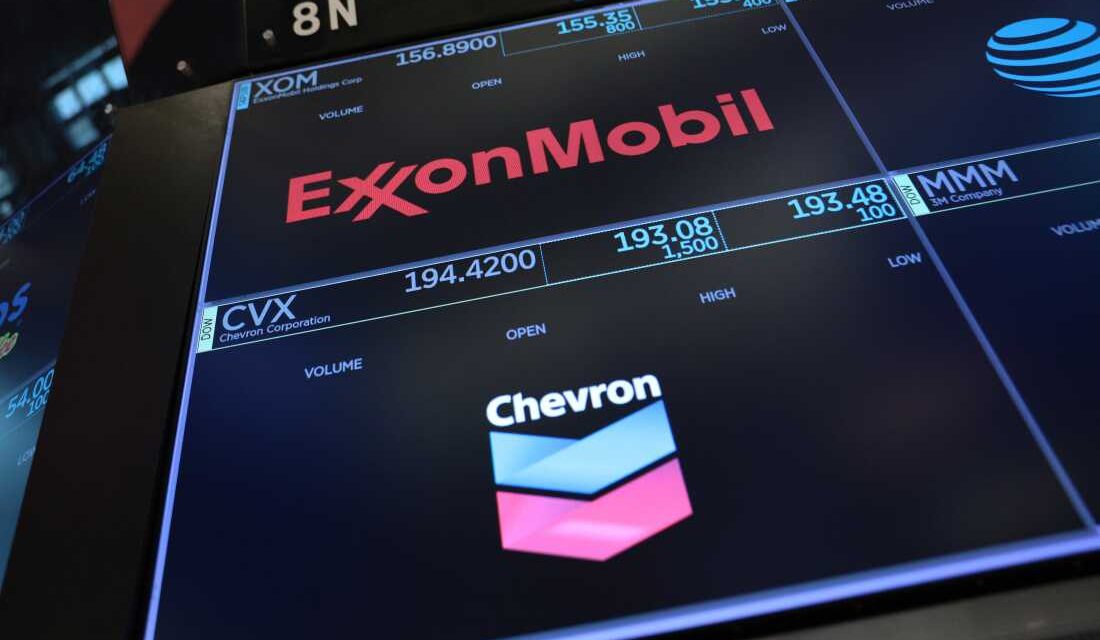
The logos for ExxonMobil and Chevron were visible on the floor of the New York Stock Exchange during morning trading on July 24, captured by photographer Michael M. Santiago/Getty Images.
Chevron recently reported its highest quarterly earnings, while Shell experienced its second-highest quarterly profits. Despite ExxonMobil’s earnings falling short of Wall Street’s expectations, the company still doubled its profits compared to last year. Together, these companies made approximately $404 million in profits daily over the last three months.
This financial success has drawn attention, particularly from European lawmakers and U.S. Congress members, who are advocating for windfall taxes on these oil giants.
Impact of Global Conflicts on Oil Prices
The ongoing war with Iran has effectively closed the Strait of Hormuz, a critical route for crude oil exports. On a recent day, only five ships managed to navigate the strait, as reported by trade intelligence group Kpler. Other routes are bringing some oil to the market, but new threats are complicating these alternatives.
The Middle East conflict has also halted the export of refined fuels such as gasoline, jet fuel, and diesel. Attacks by Ukraine on Russia’s oil infrastructure have further exacerbated the global shortage of these fuels. Consumers face higher fuel prices, leading to increased costs for various goods and services, whereas oil producers enjoy significant margins from selling crude oil and refined products.
In the recent quarter, Exxon reported $14.5 billion in profits, Chevron $12.1 billion, and Shell $9.8 billion. These earnings were achieved despite disruptions to Exxon and Shell’s operations in the Middle East. Elevated crude prices and refining margins mitigated these challenges.
Discussion of Windfall Taxes
In response to these profits, Sen. Sheldon Whitehouse, D-R.I., has proposed a windfall tax on oil earnings. Several European countries are also seeking similar measures, and the UK already enforces such a tax. A windfall tax aims to target the ‘excess’ profits resulting from external factors, rather than company innovations. This collected tax typically aids consumers burdened by high energy prices.
After the 2022 price surge following Russia’s invasion of Ukraine, the European Union imposed a windfall tax on oil profits. However, ExxonMobil CEO Darren Woods criticized these taxes as ‘misguided,’ claiming they hinder companies striving for success amid the industry’s volatility.
“We canceled investments that we had planned for Europe based on the last time they passed a windfall profits tax,” Woods said. “And in fact, we’re suing because we don’t think that’s a legal taking for the industry.”
Strategic Financial Management
Oil executives are uncertain about the duration of high profits and oil scarcity. Chevron CEO Mike Wirth stated they cannot predict the situation in the Strait of Hormuz. Exxon’s Woods expressed belief that Middle Eastern oil is too vital for the global economy to remain disrupted for long.
I think, ultimately, there’s a solution that the world will arrive at… those resources are just too critical to the overall economic health of the world for them to stay offline,
Woods conveyed.
Instead of rushing into new costly drilling projects to satisfy the current oil demand, these companies anticipate the imbalance to be short-lived. Many are prioritizing financial stability by paying off debts. In terms of growth, they aim for disciplined, long-term development of new oil fields, aligning with their strategic goals.