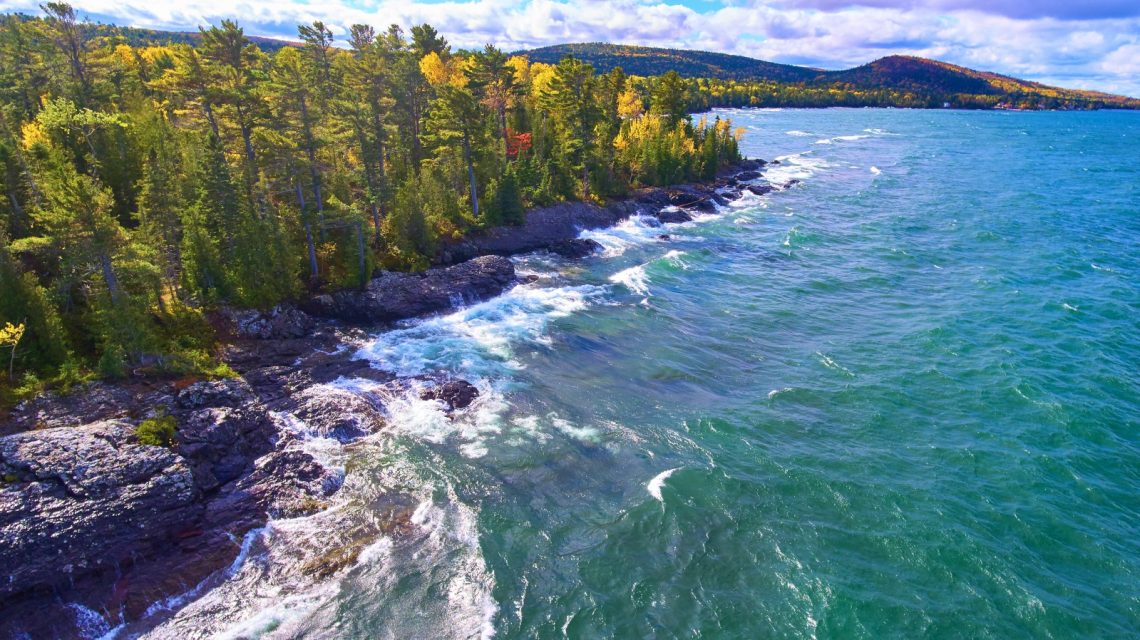
The National Weather Service (NWS) has issued beach hazards statements for all of the Great Lakes. These warnings are in effect as many people hope to enjoy the lakes during the shoulder season before fall officially arrives. Experts have explained why such alerts are not common in the summertime.
A few weeks ago, the NWS issued similar warnings when nearly 1 million people living near the five Great Lakes—Lake Michigan, Lake Superior, Lake Huron, Lake Erie, and Lake Ontario—were cautioned. Dangerous currents and large waves prompted warnings to avoid the water. This time, over 8 million people are affected by advisories on Monday.
Current Warnings
As of 10:30 a.m. Eastern time, NWS has issued beach hazards statements for areas of Wisconsin, Minnesota, Michigan, Illinois, Indiana, Ohio, Pennsylvania, and New York. People are advised to avoid water activities due to dangerous waves and currents.
Warnings have been issued in multiple locations including Duluth, Minnesota; northwestern Wisconsin; Michigan’s Upper Peninsula; nearly all of Wisconsin’s Lake Michigan shoreline; northeastern Illinois; northwestern Indiana; northeastern Michigan; northern Ohio; northwestern Pennsylvania; and much of New York’s Lake Ontario shoreline.
Many alerts will remain active until Wednesday afternoon or evening, while some may expire sooner. NWS meteorologists have urged people to avoid entering the water during these conditions.
“Life-threatening waves and rip currents are expected. Stay out of the water and away from areas like piers and breakwalls,” stated NWS Duluth. “Wind and wave action will cause currents on the lakeshore,” added NWS Cleveland. “Swimmers should not enter the water. Currents can carry swimmers away from shore through a sand bar and along structures extending out into the lake.”
Unconventional Time for Warnings
Although not typical in summer months, NWS Weather Prediction Center meteorologist Bryan Jackson explains that beach hazard statements are more common during the shoulder season as cool air moves in. “This is the time of year you get more substantial cold fronts,” Jackson noted, highlighting that a Canadian high-pressure system contributes to the adverse conditions.
During winter, cold fronts lead to lake effect snow and strong winds, impacting lake safety. The present warnings result from intense winds caused by the high-pressure system to the north.
Great Lakes Drownings
While rip currents and dangerous waves often relate to ocean conditions, the Great Lakes also face these challenges. This year, 73 drownings have been reported in the Great Lakes, with 41 occurring at Lake Michigan. The absence of lifeguards following Labor Day emphasizes the need for these warnings, as noted by Dave Benjamin, executive director of the Great Lakes Surf Rescue Project (GLSRP).
Understanding Rip Currents
Rip currents are fast-moving water streams flowing perpendicular to shorelines. If caught, avoid panic. The current won’t pull swimmers under but could distance them from the shore. To escape, swim parallel to the shoreline and angle back once freed. Float and signal for help if needed.
Future Timeline
Some beach hazard statements may expire by Monday afternoon, though others might continue for days. Those near affected shorelines should heed local weather office guidance and approach the water with caution if alerts remain.
Looking ahead, Jackson identified the Mid-Atlantic region as another concern due to a strengthening low-pressure system off the coast, potentially affecting high tides and causing beach erosion.
 Surprising Encounter with Gulf Sturgeon in the Suwannee River
  Potential Impact of Tropical Storm Polo on Southern California
  OpenAI’s Complex Solution to Navier-Stokes Equations Stirs Debate
  Reassessing the Central Role of Rome in the Roman Empire’s Road Network
  Communities Continuing Recovery from Hurricane Helene Explored through Graphic Novel
  Fire Amoeba Discovery Challenges Limits of Complex Organisms