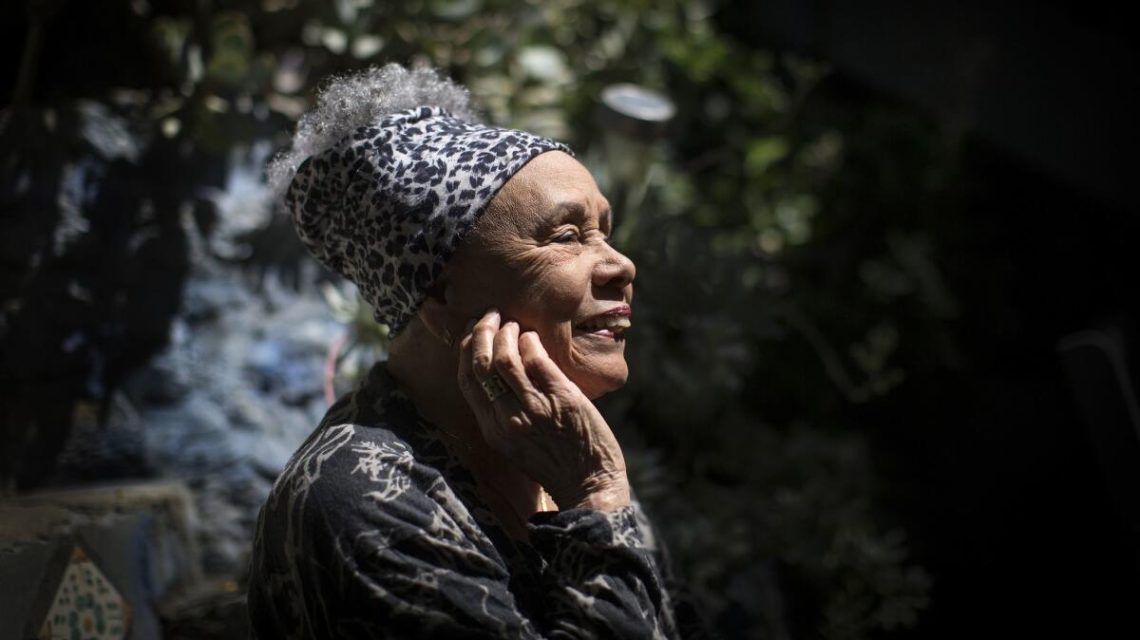
Betye Saar, a renowned Los Angeles artist, was celebrated for transforming collections of racist memorabilia into powerful assemblage art dissecting the fraught history of race in America. She passed away a few days before her 100th birthday, leaving behind a legacy that influenced generations of artists. Her death was confirmed by her longtime gallerist, Julie Roberts of Roberts Projects, and her publicist, Hannah Gottlieb-Graham.
Roberts reflected on Saar’s impact, noting her ability to transform contemporary art and inspire countless artists, scholars, and audiences worldwide. Despite her small stature and low-key demeanor, Saar was known for her steely determination. She scoured garage sales and flea markets for items to use in her collages and assemblages, addressing challenging themes like slavery and Jim Crow laws, alongside personal themes of family, memory, magic, and spirituality. She explained her artistic philosophy in the 1970s, stating, “My work has to do with recycling. Each item has a certain energy from its previous function.”
Saar first gained recognition in the 1970s with “The Liberation of Aunt Jemima,” a small assemblage featuring a Black mammy figurine armed with a rifle and grenade. This work leapt her into the Black Arts Movement and connected her to the broader tradition of assemblage art. Three years after its creation, Saar held a solo exhibition at the Whitney Museum of American Art in New York.
Saar’s early life in Los Angeles saw her immersed in creativity, encouraged by her mother to sew and craft. She was influenced by the work of Simon Rodia and his Watts Towers. After attending Pasadena City College and UCLA, she initially worked in interior design before transitioning to art. Her marriage to ceramicist Richard Saar in 1952 resulted in a family of artists. Her daughters Lezley and Alison later became respected artists themselves.
Another pivotal experience was her visit to an exhibition of Joseph Cornell’s work, which inspired her move toward three-dimensional art. Her assemblages often included symbols referencing dark episodes in U.S. history and African American struggles. She aimed to transform derogatory imagery from negative to positive, empowering symbols once associated with servitude.
Over the years, Saar’s work resided in the permanent collections of over 80 international museums. She continued exhibiting at various galleries and museums, even into her 90s. In 2025, Saar established the Betye Saar Legacy Group to preserve her archive and inspire new generations of artists. Her biography by Zoé Whitley is anticipated in 2027.
Betye Saar is survived by her daughters Lezley, Alison, and Tracye, as well as her grandchildren. Her legacy and influence will continue to inspire and resonate in the art world.