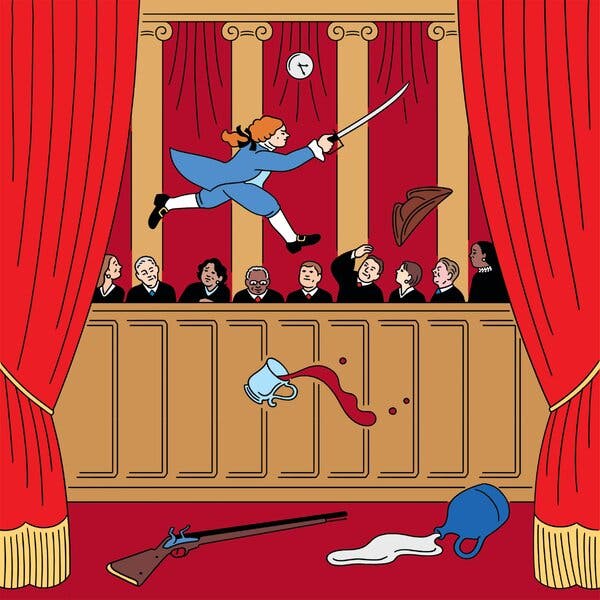
Among the many developments in a perplexing Supreme Court term, one stands out but has not received the attention it merits. This was the term when the court’s focus on “originalism” seemed to veer into parody.
Originalism is a method of constitutional interpretation that gained prominence during the Reagan era. Intended to limit judicial discretion, it roots interpretations firmly in historical context. Justice Brett Kavanaugh highlighted the principle behind this approach. He stated, “History is far less subjective than policy” in a concurring opinion for a gun rights case, emphasizing that only “history and tradition” should limit the Second Amendment right to “keep and bear arms.”
The Objectivity of History
How objective is history, really? To understand, consider a practical example. Picture a young man living with his parents near Dallas. He has a stable job and, like many in Texas, keeps a gun at home. Occasionally, he uses marijuana. A federal law, Section 922(g)(3), makes it illegal for a “controlled substance” user to own a gun. Violating this law can lead to a 15-year prison sentence.
The government decides to prosecute. They must present “history and tradition,” as required by Supreme Court precedent, in response to the young man’s invocation of the Second Amendment to dismiss the case.
History and Tradition in Court
The court’s key precedent, the Bruen decision of 2022, clarifies that “historical tradition” does not refer to when a contentious regulation was introduced. For the law in question, that year was 1986. According to Bruen, the government must find an analogous regulation from the nation’s founding or, some originalists argue, from the 1868 adoption of the 14th Amendment, which applied the Bill of Rights to states. However, marijuana was not commonly used in 1791, when the Second Amendment and the rest of the Bill of Rights were added to the Constitution, nor in 1868. This presents a challenge for the government.
Resourceful government attorneys dug up “habitual drunkard” laws from the 18th and 19th centuries. These laws removed notably intoxicated individuals from public spaces and placed them in workhouses or jails, where they had no access to firearms. Is this the best legislative analogy that the federal government, with all its resources, can find to support a modern gun law?
 The Impact of Arts and Closure on Democracy
  U.S. Ambassador Comments on Iran War Duration Amid Political Concerns
  US-China Relations Under Scrutiny: Expert Warns of Escalating Tensions
  No Timeline for End of Iran Conflict
  German Chancellor Merz Vows to Pursue Reforms Despite Election Setbacks
  The Technology Rivalry: Trump’s Meeting with Xi and the AI Ecosystem Clash