A recently discovered Byzantine-era residential city in Egypt’s western desert is making headlines. The Egyptian government believes that this and another major archaeological find could enhance tourism, a crucial economic pillar for the nation.
In the Dakhla Oasis and near Alexandria at the Marina el-Alamein site, two significant discoveries were unveiled. The Dakhla Oasis find includes human remains and numerous artifacts in a section of a Greco-Roman cemetery dating back over 2,300 years. Notably, scholars uncovered the full skeletal remains of two wild boars. In ancient Egypt, boars symbolized Seth, a deity connected to chaos.
Tourism, partnering with Egypt’s Suez Canal, is a key foreign currency source. Newly discovered limestone tombs at Marina el-Alamein further amplify Egypt’s archaeological appeal.
Insights into Byzantine Daily Life
The Tourism and Antiquities Ministry provided details of life in the fourth-century Byzantine Empire. This period saw Egypt as part of the Byzantine realm. Findings reveal structural designs in the Dakhla Oasis, centered around north-south roads intersected by east-west streets. Open areas and public squares were also present.
At its forefront was a basilica church from the mid-fourth century. Surrounding it were watchtower remnants, reflecting the settlement’s strategic defenses. The oasis is on UNESCO’s Tentative List for World Heritage recognition.
The fortified locale contained reception halls and protective walls. Among the structures was the house of Tisous, a church deacon from the latter half of the fourth century. It likely served as a house church before the basilica’s construction.
Other finds included cooking ovens, grinding tools, bronze coins bearing Byzantine rulers, and Roman gold coins from Emperor Constantius II’s reign (337-361). Additionally, around 200 pottery shards called ostraca were discovered. These pieces, used as writing materials, contained details about commerce and daily Byzantine life.
Ancient Tombs and Artifacts
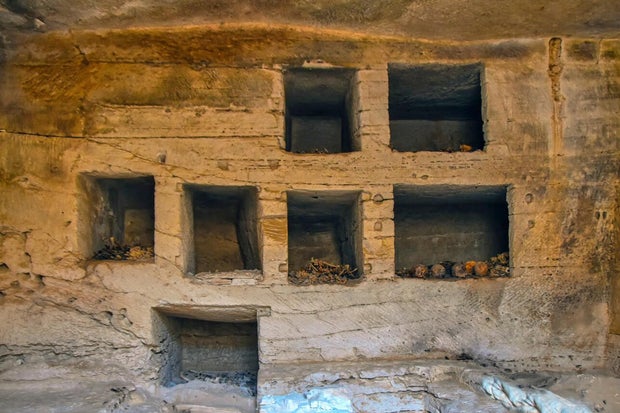
Archaeologists have also uncovered 18 ancient tombs at the Marina el-Alamein site, 62 miles from Alexandria. There are 11 rock-cut tombs, each averaging a depth of 26 feet. Besides these, seven limestone tombs were unearthed, bringing the site’s total to 48.
Artifacts at the site comprise pottery, lamps, altars, and limestone basins. Eman Abdel-Khaliq, leading the mission, detailed an 8-foot granite sarcophagus with skeletal remains for study. Near it was a plaster sphinx statue.
Notably, some deceased had gold pieces in their mouths, hinting at funerary customs known as “the golden tongue.” Marina el-Alamein, unearthed in 1986, was likely the Greco-Roman port city Leukaspis, devastated by a fourth-century tsunami.
After years of political upheaval and pandemic challenges, Egypt’s tourism sector is seeing an upswing. Official figures highlight a record 19 million tourists last year, a 21% increase from 2024. The first part of 2026 recorded 6.1 million tourists, surpassing the same period in 2025.
 The Curious Case of Mark Jackson’s NBA Hoops Card
  Communities Continuing Recovery from Hurricane Helene Explored through Graphic Novel
  Art Institute of Chicago Returns Nazi-Looted Painting to Heirs
  Fire Amoeba Discovery Challenges Limits of Complex Organisms
  Chicago History Museum Responds to Protest with Aquí en Chicago Exhibit
  Ari Emanuel’s Memoir Explored