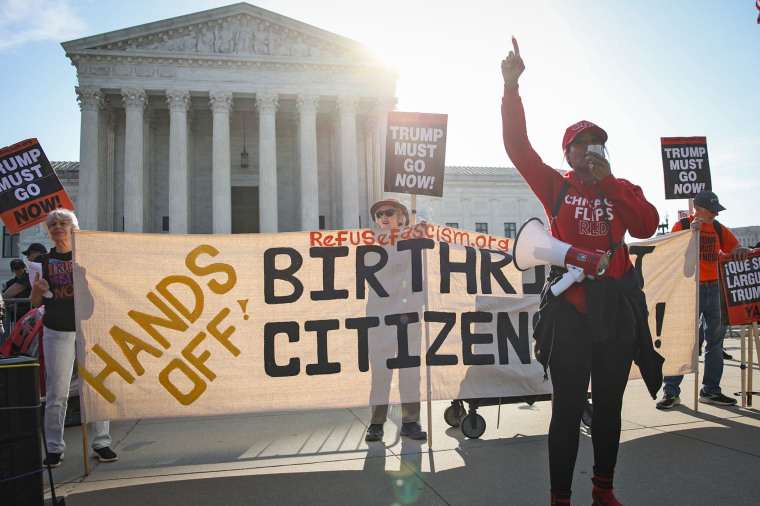
The Supreme Court has decisively blocked President Donald Trump’s attempt to alter birthright citizenship rules in the United States. This controversial measure, introduced on January 20, 2025, aimed to restrict citizenship by birth on U.S. soil. However, the court ruled 6-3 against it, marking a significant setback for Trump’s policies.
According to the majority, led by Chief Justice John Roberts, the executive order violated the Constitution’s 14th Amendment. This amendment has historically been interpreted as granting citizenship to nearly all individuals born in the U.S. Roberts highlighted the lack of substantial evidence supporting the Trump administration’s reinterpretation of longstanding legal norms.
Writing on behalf of the majority, Roberts emphasized, “Citizenship then and now, was the right to have rights — to freely participate in our political community.” He explained that the 14th Amendment, established after the Civil War, was intended to ensure citizenship rights for all, including former slaves. He concluded that this principle remains intact.
While Justice Brett Kavanaugh agreed that the executive order was illegal, he did not find it unconstitutional. However, conservative Justices Clarence Thomas, Samuel Alito, and Neil Gorsuch supported Trump’s proposal, contending that the 14th Amendment allowed such an executive order.
The executive order sought to restrict birthright citizenship to children with at least one U.S. citizen or permanent resident parent. It excluded children born to temporary visitors or unauthorized migrants. However, lower courts quickly blocked its implementation after Trump signed it.
Cecillia Wang, the American Civil Liberties Union’s National Legal Director, praised the court’s decision. She stated, “The court’s decision reaffirms a fundamental American promise — if you are born here, you are a citizen. A president cannot change the Constitution by executive fiat.”
The 14th Amendment has consistently been understood to encompass nearly all individuals born on U.S. soil, with few exceptions such as diplomat children. Federal law with similar language has further bolstered this interpretation, particularly after precedent set by the United States v. Wong Kim Ark case in 1898, which confirmed the citizenship of a man born in San Francisco to Chinese parents.
Trump’s executive order faced challenges from civil rights groups and liberal states. Multiple courts ruled against the administration’s stance. In December, the Supreme Court agreed to hear a related case from New Hampshire, where plaintiffs represented by the American Civil Liberties Union included babies potentially affected by the order.
 The War on Poverty: A Lesson on Intentions and Outcomes
  Reporters Blocked from White House by Trump Administration
  Universities Should Reject Political Influence on Research Funding
  Trump’s Approach to China: Trade Dynamics and Challenges
  Media Outlets Sue After White House Ban
  American Public Opinion on Press Freedom