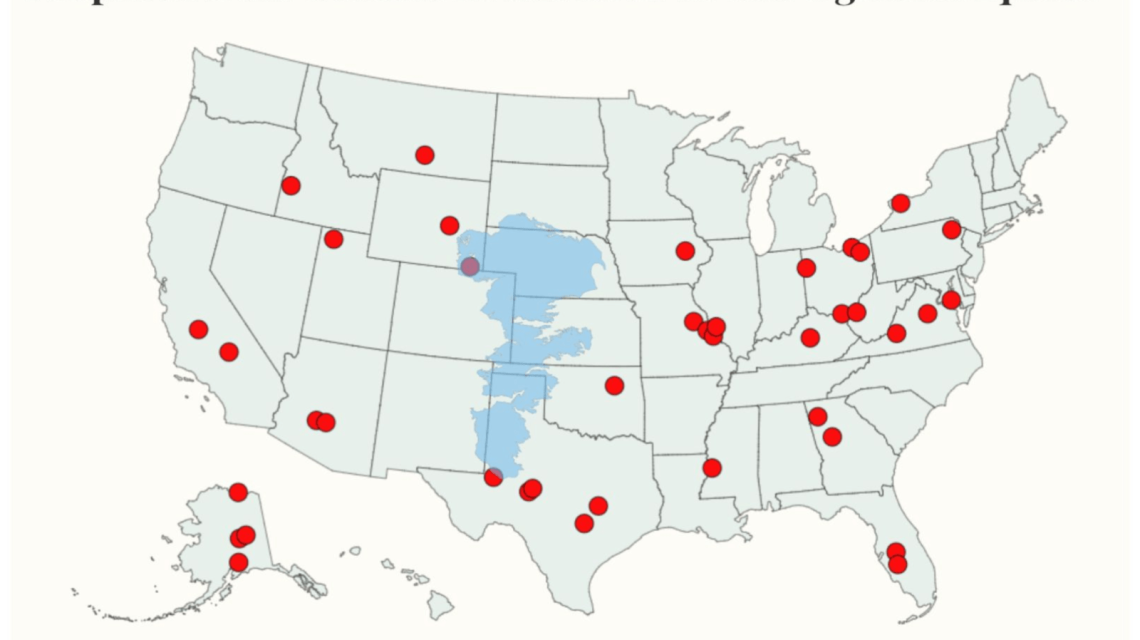
The rapid growth of AI data centers raises a pressing environmental question in the Great Plains. Can one of America’s key groundwater reserves, the Ogallala Aquifer, support the booming digital economy alongside the agricultural communities that depend on it?
Mapping New Developments
Recent data from Brockovich AI Data Center Reporting reveals several new AI facilities are located near or over the Ogallala Aquifer. As key sites in Texas and Wyoming develop, local governments are grappling with weighing AI’s economic benefits against long-term water availability concerns.
In Tom Green County, Texas, over 500 residents protested against data center developments during an April meeting. This prompted the county to call for stricter regulations on water usage.
Key Projects Examined
Several large AI data center projects stand out:
- In Ector County, Texas, a 438-acre campus is set for construction in late 2026, co-developed by New Era Energy & Digital and Primary Digital Infrastructure.
- In Cheyenne, Wyoming, Microsoft plans a major expansion worth $68 million, involving 3,200 additional acres.
- In Natrona County, Wyoming and Tom Green County, Texas, large campuses like Prometheus Hyperscale and Skybox are being proposed.
Some AI centers under construction include the Crusoe Project Jade and Related Digital Cheyenne in Wyoming, and the Fermi Project Matador and Aligned Project Caprock in Texas.
Diverse Technology Strategies
Not all AI facilities use water equally. Some, like Related Digital’s Cheyenne campus, employ air-cooled systems to minimize water use. Others, planned in locations like San Angelo and Cheyenne by Microsoft, have yet to disclose their cooling methods.
The choice between evaporative cooling and water-saving technologies significantly affects the environmental impact. Evaporative systems can consume large amounts of water, unlike air cooling or closed-loop systems.
Importance of the Ogallala Aquifer
The Ogallala Aquifer, spanning eight states, is crucial to U.S. agriculture, supporting about 30% of groundwater irrigation. However, water levels have been declining due to decades of agricultural withdrawals. Some areas have seen levels fall by over 200 feet.
Researchers warn that the aquifer’s recharge rate is much slower than the rate of extraction, exacerbating the depletion issue.
Why the Great Plains Attracts Developers
The region offers cheap land, infrastructure access, power generation, and tax incentives. Yet, a site’s environmental impact hinges more on its engineering and water-management choices.
Facilities vary in water use, even within similar footprints. Large campuses might consume up to five million gallons daily.
Local Communities’ Concerns
Water availability is now a political issue. Communities in Texas and Wyoming are demanding transparency regarding water use and cooling technologies. Residents ask critical questions about water sourcing, consumption, and risk management.
The Future Outlook
The long-term effects depend on current decisions by developers and governments. Potential outcomes include permanent irrigation loss, shifts in agricultural production, and economic implications for rural communities.
As more AI data centers locate near the Ogallala Aquifer, the balance between digital growth and water resource sustainability remains crucial.
 Fat Bear Week 2026 Highlights: Meet the Competitors
  Annual Fat Bear Week Begins at Katmai National Park
  Understanding Hurricane Development
  California Prepares for El Niño-Fueled Storms with Emergency Declaration
  California’s Growing EV Adoption: Challenges and Benefits
  Data Centers in Virginia face Growing Opposition