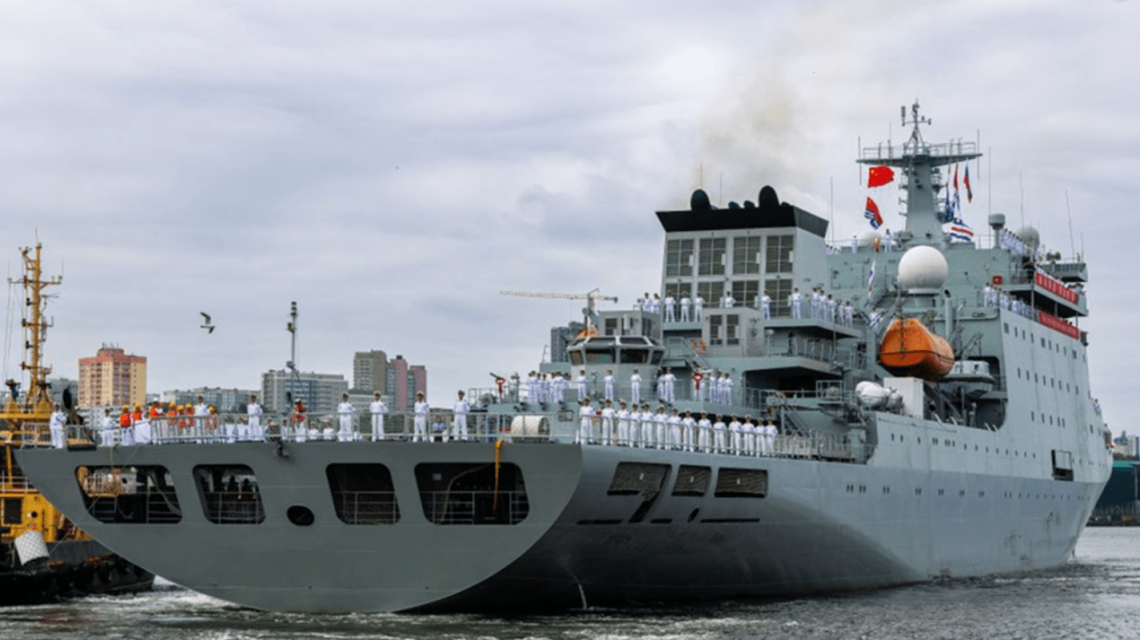
A Chinese naval flotilla arrived at Russia’s far eastern port of Vladivostok on Tuesday, marking four days dedicated to training and exchanges. This visit signifies the strengthening military relationship between Beijing and Moscow amid growing tensions with the United States and its allies in the western Pacific.
The People’s Liberation Army Navy’s Task Force 83, which includes the training ship Qi Jiguang and the amphibious dock landing ship Kunlunshan, arrived in Vladivostok, headquarters to Russia’s Pacific Fleet. The invitation came from the Russian Navy, and arriving vessels were met with spectators waving flags along the waterfront, as reported by Chinese state media outlet Xinhua.
Despite China’s stance of neutrality regarding Russia’s war in Ukraine, Beijing has supported Russia’s struggling economy through increased cross-border trade, including dual-use exports and larger purchases of discounted Russian oil and gas. The United States and its European allies frequently label China as an enabler of Russian President Vladimir Putin’s ongoing conflict.
Russian President Putin and Chinese leader Xi Jinping have reaffirmed their strategic partnership during Putin’s visit to Beijing last month. Both nations pledged further cooperation in defense, energy, and technology sectors. China’s Defense Ministry reiterated that the militaries of both countries would implement the leaders’ consensus by expanding practical cooperation.
The Chinese and Russian militaries will earnestly implement the consensus reached by the two heads of state and continue to expand practical cooperation in various fields.
—China’s Defense Ministry Statement
Naval Cooperation
The deployment serves as a “long-distance sea internship,” involving exchanges between Chinese sailors and Russian naval officers during their time in Vladivostok, as stated by the Chinese Defense Ministry.
China and Russia have bolstered security ties in recent years, increasing joint air and naval exercises. Although there was a dip in joint drills in 2025, with six compared to a peak of 14 in 2024, the countries conducted their first joint submarine exercise, according to the Center for Strategic and International Studies.
The Congressional Research Service highlights the central role Russia’s navy plays in its global aspirations, specifically within the Asia-Pacific region, noting that naval exercises and patrols have been more extensive compared to ground military operations, indicating higher familiarity and trust between naval partners.
U.S. and Allied Concerns
The U.S. Coast Guard has raised concerns over increasing patrols by Chinese and Russian vessels near U.S. territory, focusing particularly on areas around Alaska.
Military operations by China and Russia, both independently and jointly, have stirred anxiety in Japan and South Korea, the United States’ Northeast Asian treaty allies. In December, Chinese and Russian bombers performed a joint air patrol over the Sea of Japan and international waters near Japanese islands, causing Japan’s Air Self-Defense Force to dispatch fighter jets.
Japan’s Defense Minister Shinjiro Koizumi expressed that the operation was clearly a show of force against the nation, posing a serious threat to national security.
Although China and Russia lack a formal military alliance, they share a common goal of challenging U.S. military dominance and fostering a multipolar global order.
 Controversy Surrounds Performances at Gillette Stadium
  Tucker Carlson’s Remarks on Britain and WWII Spark Backlash
  Police Divers Uncover Ancient Roman Artifacts in Sardinia Waters
  Conservative Activist Urges AI Safety Measures
  G7 Nations to Release 100 Million Barrels of Oil Amid Fuel Price Surge
  Attempted Hijacking on FlyDubai Flight to Tel Aviv