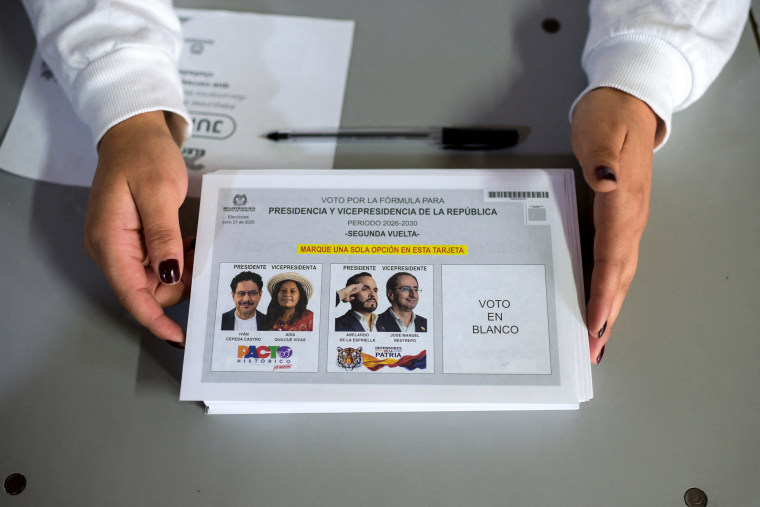
BOGOTA, Colombia — A critical presidential runoff in Colombia is taking place, featuring two markedly different candidates: Abelardo de la Espriella, a conservative outsider, and Iván Cepeda, a progressive lawmaker. This election follows a campaign fraught with fears of renewed internal conflict.
De la Espriella, a businessman and lawyer, squares off against Cepeda, who is a political successor to the outgoing leftist President Gustavo Petro. Both candidates advanced following their May 31 electoral victories over nine other contenders.
Violence once dominated Colombia, with notorious kidnappings, bombings, and forced displacements marking the nation’s past. De la Espriella advocates for aggressive measures to curb violence and has garnered support from U.S. President Donald Trump. In contrast, Cepeda aims to perpetuate Petro’s initiatives that seek dialogue with various armed factions, despite previous setbacks.
The candidates also propose divergent remedies for Colombia’s health system, growing public debt, and corruption issues. This election coincides with psychological polarization within the electorate and concerns of possible violent unrest post-election.
“Right now, what worries me is the polarization that exists between us: there are two very extreme sides, and the violence is concerning,” said John Manrique, a Bogota lawyer.
In preliminary voting, Cepeda secured 41% of votes to de la Espriella’s 44%. Petro cast aspersions on the election’s integrity after Cepeda, predicted to win, finished second.
The election follows the decade anniversary of Colombia’s peace agreement with FARC rebels. However, violence remains prevalent, notably propelled by drug trafficking involving former rebel factions. Statistics reveal escalating violence and homicides, including the assassination of conservative candidate Miguel Uribe. Extortion cases rose to 13,417 by 2025.
Over 41 million Colombians are eligible to vote. Among de la Espriella’s promises is a plan to build jails inspired by El Salvador’s President Nayib Bukele, who reduced homicides amid human rights controversies. Cepeda intends to persist with Petro’s efforts in negotiating peace deals with guerrillas and criminal gangs. These efforts made a minor breakthrough with the first rebel group, numbering about 100, opting for demobilization.
Public skepticism of the left, connected with past rebel alliances, shapes voter perceptions. Noteworthy is voice from Cepeda supporter Yamile Guevara, who believes Petro’s strategies need further time for effectiveness and criticizes deep-seated distrust toward leftist policies.
The left has always been viewed negatively; it has been harsh, and many people have died,” Guevara mentioned. “So, one wonders what’s wrong with people who have forgotten history… how can they not think carefully about which candidate they are going to elect?”
Preceding the runoff, exchanges between the candidates intensified, leading to allegations of electoral misconduct, including fraud and intimidation. Cepeda lodged complaints with legal authorities against de la Espriella, charging him with paramilitary connections, a claim de la Espriella refutes.
 Navigating Republican Challenges in Upcoming Midterm Elections
  Bobby Pulido: A Latin Grammy Winner in Congress?
  Illinois Struggles with Immigration Enforcement Post-Operation Midway Blitz
  Confronting the Challenges of Far-Right Fame
  Hungary’s New Government: Policy Shifts and International Relations
  Challenges Facing Prince Harry and Meghan Markle’s Return to the U.K.