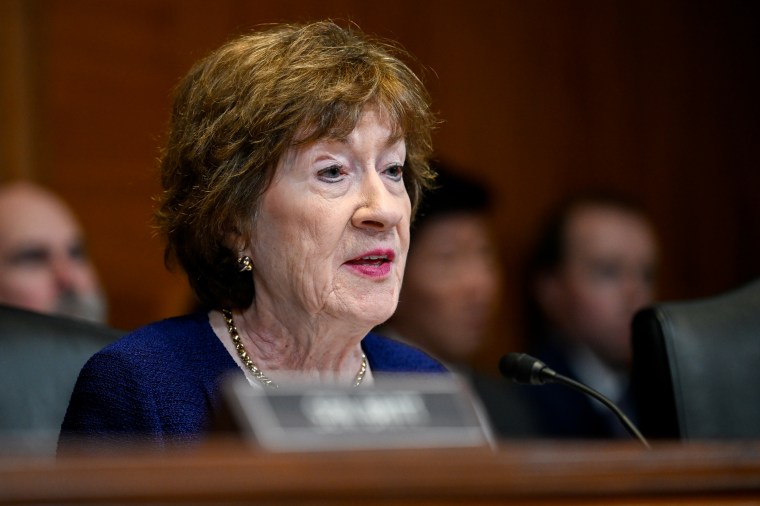
Amidst war, increasing costs, and cuts to Medicaid, an issue from eight years ago remains a key focus in Maine’s Senate race – the confirmation of Brett Kavanaugh to the Supreme Court. The controversial confirmation took place in 2018, thanks to Maine’s Republican Senator Susan Collins, who previously believed Kavanaugh perceived Roe v. Wade as ‘settled law.’ This statement proved inaccurate when Kavanaugh voted with the majority to overturn the landmark ruling in 2022, resulting in abortion bans in numerous states.
Democrats, still feeling discontent over Collins’ pivotal vote for Kavanaugh, rally behind her Democrat challenger, Graham Platner. “After the vote for Kavanaugh, that was the breaking point,” recounted Arie Mobley, a rally attendee.
Collins’ decision to back Kavanaugh, despite allegations of sexual assault against him, remains a hot topic. Kavanaugh denied these allegations, declaring, “The truth is I’ve never sexually assaulted anyone, in high school or otherwise.” This decision, still fresh in voters’ minds, could influence the Senate’s future, especially if Republicans regain control and a new Supreme Court seat opens.
In a recent rally, Platner highlighted the decision by Kavanaugh to overturn Roe v. Wade as evidence of Collins’ unreliability. Platner insisted Collins betrayed voters by assuring Kavanaugh’s respect for Roe v. Wade.
She got elected promising to protect Roe versus Wade, only to put a justice on the Supreme Court who overturned it? She lied to us.Platner said to his supporters.
Democrats view Collins as a key target, especially since Maine often elects Republican Senators while historically supporting reproductive rights. A prominent Democratic fundraiser, the Senate Majority PAC, plans to focus advertising on Collins’ perceived anti-choice stance.
Recent PAC polling found focusing on Collins’ role in confirming justices who overturned Roe v. Wade resonated well with Democratic voters. This strategy also contrasts heavily with Collins’ own actions, such as voting against Justice Amy Coney Barrett due to procedural concerns.
Adding complexity to the race, allegations have been raised against Platner by an ex-girlfriend, who accused him of physically threatening behavior. Platner denied these claims, which emerged from Lyndsey Fifield, a known conservative and Kavanaugh supporter.
Democratic supporters argue that Fifield’s accusation is a smear campaign, driven by her criticism of Kavanaugh’s accusers during his confirmation hearings. Platner and his supporters counter these allegations, pointing to Fifield’s past advocacy for Kavanaugh.
The campaign strategist involved in the race indicated that Kavanaugh’s actions in the Supreme Court will feature prominently in campaign discussions. Despite complex personal allegations, Platner’s team believes his focus on Supreme Court decisions and their consequences will resonate with voters.
Collins, meanwhile, maintains her stance on supporting a bipartisan range of justices, having voted for seven out of eight current justices, spanning both conservative and liberal ideologies.
 Mayor Mamdani and President Trump Discuss Major Housing Project in NYC
  Poll Reveals MAGA’s Increasing Popularity Over DSA as Democrats’ Future Debated
  North Korea’s Hypersonic Weapon Test Amid Global Tensions
  Debate Over ICE Action in Austin Escalates
  President Trump Warns of Escalating War with Iran at UN Assembly
  Tariffs and Their Impact on Everyday Products