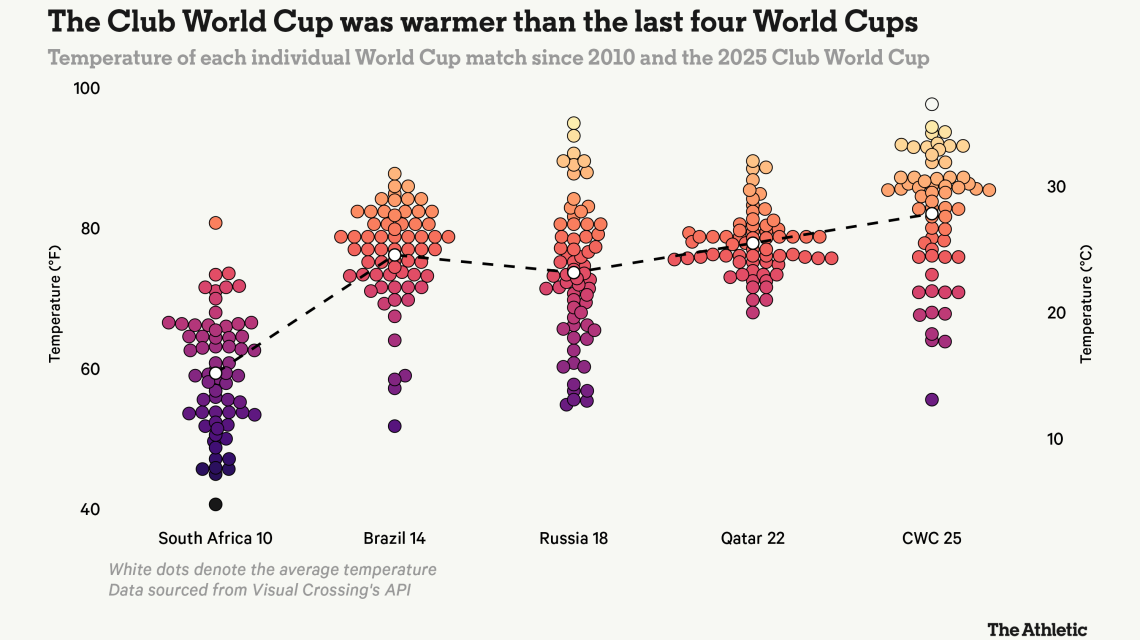
The upcoming World Cup promises to be hot, with many matches scheduled in temperatures above 90F (32C). This tournament may match the heat of the 1994 World Cup in North America. Back then, most games took place before 5 PM under intense afternoon sun, making the conditions challenging.
A notable example is Mexico’s 2-1 win over the Republic of Ireland in Orlando, where field temperatures hit 117F. Similar conditions are expected this time, upgrading the importance of game scheduling and location.
This summer, FIFA’s Club World Cup in the U.S. served as a test for these conditions. Historical weather data shows that it was warmer than in the last four World Cups. Yet, only five venues used then will host World Cup matches, which will also occur in Mexico and Canada.
The Athletic analyzed ten years of hourly weather data for each fixture, factoring in kick-off time and surrounding hours. For instance, they reviewed weather from 7 PM to 9 PM in Kansas City from July 8-14 for a match on July 11.
The findings indicate AT&T Stadium in Dallas might average 90F (32C), closely followed by Estadio BBVA in Monterrey. On July 14, temperatures may peak at 93F (34C) during a semifinal at Dallas. Dallas, Atlanta, and Houston will use closed roofs and air conditioning to moderate the climate.
However, open-air stadiums present a different challenge. In the past decade, temperatures above 100F have occurred around kick-off at six of the venues at least once during the week of scheduled games. Aaron Mentkowski from WKBW-TV Buffalo explains the intense field conditions. He notes that the open fields allow solar heat to radiate back onto the pitch while stands remain shaded.
“Fields are open while stands are shaded, absorbing solar radiation, and stadiums block cooling winds,” says Mentkowski.
The Athletic collaborates with Mentkowski as the World Cup’s weather expert. His forecasts will highlight significant weather events during the tournament affecting team performance.
Heat will make high-energy play difficult. Germany’s forward Jurgen Klinsmann described the challenge of maintaining a rhythm in brutal conditions during Germany’s 1-0 win over Bolivia in Chicago in 1994.
Some teams are adopting unique preparation strategies. Norway’s players trained in North Carolina’s 90F weather, a stark contrast to their cooler native climate. However, Mentkowski believes players from cooler areas will adapt within weeks.
“A fit person from a cooler climate acclimates to hot conditions in a week or two,” he says.
Moreover, most Norwegian players compete in clubs outside their home country, under similar conditions. An analysis of team compositions reveals that many players are accustomed to the heat.
While extreme weather affects play, thunderstorms could pose logistical challenges. U.S. thunderstorm protocol mandates match suspension if lightning is detected within eight miles of the stadium, implementing a 30-minute countdown that resets with each new strike. Last summer, Chelsea’s match against Benfica experienced over four hours of delays due to lightning.
Mentkowski identifies Miami and Mexico City as storm-prone venues, with Kansas City at risk during severe weather season.
“Miami, Mexico City face daily storms, while Kansas City could see severe storms,” Mentkowski points out.
Unexpected breaks can disrupt team momentum and complicate training plans. Adapting to these elements is vital for World Cup success and may be as crucial as skills or tactics in deciding outcomes.
 Tensions Rise as Sophie Cunningham Discusses Incident with DiJonai Carrington
  WNBA Faces Debate on Transgender Athlete Participation
  Minor League Team’s Jersey Giveaway Sparks Laughter
  LIV Golf Event at Trump National Golf Club Bedminster
  Dorsey High Alumni Unite to Celebrate Athletic Legacy
  Controversy in WNBA: Caitlin Clark’s Popularity and Officiating Issues