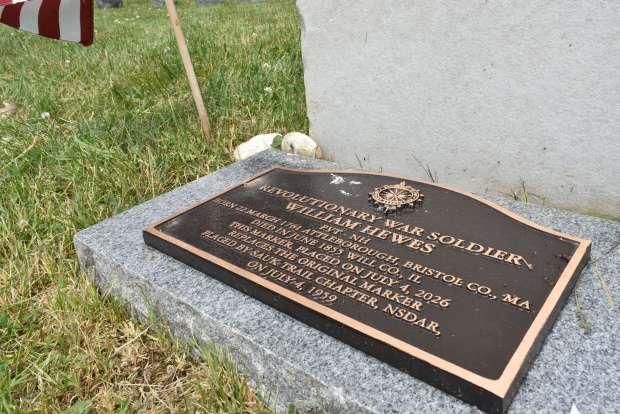
William Hewes, born in 1761, experienced a world where the United States of America was yet to be formed. By the time of his death in 1855, the threat of national rupture over slavery loomed large. His life spanned these pivotal 94 years, during which Hewes donned a uniform against the British, contributed to the founding of a new nation, and eventually moved west with his family, settling in Crete. His legacy lives on, as evidenced by the descendants numbering 29 who reside there today, though he has been deceased for a length exceeding his lifespan.
This past Saturday, nearly three dozen individuals, including Hewes’ descendants, local historians, and members of the National Society Daughters of the American Revolution, convened to rededicate the plaque at his grave. The initial plaque was installed in 1959. Melody Paris-Rush, regent of the DAR, explained the necessity of this ceremony. The original plaque had deteriorated due to exposure to the elements and maintenance activities, making the 250th anniversary of the nation a fitting occasion for its replacement. The new metal marker succinctly acknowledges Hewes’ service in the Revolutionary War along with his birth and death details.
Tim DeMuth, a descendant of Hewes, delivered a speech during the ceremony at the First Congregational Church, adjacent to Hewes’ resting place. DeMuth elaborated on Hewes’ service. As a young private, Hewes enlisted for a six-month stint during which he witnessed the execution of John Andre—the man who persuaded Benedict Arnold to turn against the Continental Army—and served at the strategic West Point fort under George Washington’s command. Though Hewes was not a soldier of historical fame, DeMuth emphasized that victory was forged by the collective efforts of every soldier. “They made it possible to enjoy the blessings of liberty as we observe our 250th anniversary as a nation,” DeMuth expressed.
Post-war, Hewes journeyed via the Erie Canal toward the Great Lakes and proceeded to Detroit, before trekking to Crete. DeMuth reflected on this journey, noting the challenges of traversing dirt trails from Detroit, particularly for Hewes, who by then had advanced in age and traveled alongside his son. Five of his twelve children migrated to Illinois, planting roots in the Crete region, taking roles as politicians, a clergyman, farmers, and shopkeepers. With time, the family thrived, echoing their ancestral legacy into the present.
DeMuth shared an intimate detail, mentioning that some family members still reside in a home that has housed five generations. “It’s just part of our soul, the land,” he remarked.
This tribute to William Hewes serves as a reminder of his role in history and the enduring impact of his lineage.
 The Challenges and Solutions to Chronic Lateness
  Reflecting on a Career at Fox News
  Young Mom Raises Awareness About Life with Down Syndrome
  Navigating Complex Adult Friendships
  A Family’s Journey with Sickle Cell Disease
  Unexpected Discovery in Indiana Thrift Store Unites Family with WWII Heirloom