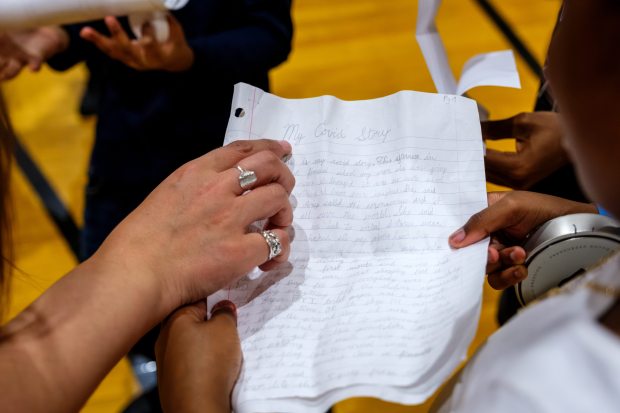
In 2021, amid the COVID-19 pandemic, an idea was born. A friend and I wanted young people across Chicago to preserve their experiences during this unique historical moment. We initiated a citywide project, encouraging thousands of young individuals to contribute letters, artwork, photographs, and reflections capturing their lives during the pandemic. This initiative eventually evolved into Living Record, the organization I now lead.
After five years, we have begun reopening these time capsules. People of all ages have explored their contributions from this tumultuous time. For children creating these capsules in 2021, the pandemic brought significant challenges. Normal joys and routines vanished without any clear timeline for their return. Kids wrote about missing friends and grandparents, longing for soccer practice, and the disappointment of missing birthday parties.
Now, as we examine these capsules, the current young generation’s reactions are telling. Comments such as “Those kids were so sad. I wasn’t that sad” reflect a difference in experience. Many are surprised by how simple things like seeing friends or dining out were once treasured. Today’s students recall the pandemic as a period with more family time and reduced social pressures. They feel disconnected from the loneliness described in those letters.
This contrast in perspectives is significant. We learn something those children didn’t know at the time; many challenges eventually passed. Although new challenges appeared, new opportunities and relationships also emerged. This experience reminds us time changes both circumstances and viewpoints. The lesson extends beyond the pandemic.
Two people read a letter titled “My Covid Story” on June 2, 2026, at the James R. Jordan Boys and Girls Club in Chicago. (David Turner Productions)
I often hear a sense of pessimism about our current moment and the future—political division, economic uncertainty, social isolation, distrust in institutions, and technological impact are concerning. A Gallup poll earlier this year noted record low optimism in America. Yet reopening the time capsules suggests today’s challenges may not be permanent. Five years can bring more change than expected.
The time capsules sparked curiosity about the next five years. What current challenges will feel distant? How will our memories differ from our experiences today? What will be evident in hindsight? This curiosity fuels Living Record’s collaboration with the Chicago Public Library at the Obama Presidential Center. Celebrating the nation’s 250th anniversary, we invite visitors to reflect on present life and the future they want to help shape. Their responses will be sealed in a new time capsule, to be reopened in five years.
In 2026, we’ll look back on this period with new understanding. What challenges will seem insignificant? What new opportunities or obstacles will arise? The future holds answers we don’t have yet.
Stacey Gillett is the co-founder and executive director of Living Record, a Chicago nonprofit connecting the past, present, and future through art and storytelling.
 Colin Kaepernick’s Press Tour Raises Unasked Questions
  Controversial Claims in Charles Spencer’s Book about Princess Diana’s Divorce
  The Curious Case of Mark Jackson’s NBA Hoops Card
  Communities Continuing Recovery from Hurricane Helene Explored through Graphic Novel
  Art Institute of Chicago Returns Nazi-Looted Painting to Heirs
  Chicago History Museum Responds to Protest with Aquí en Chicago Exhibit