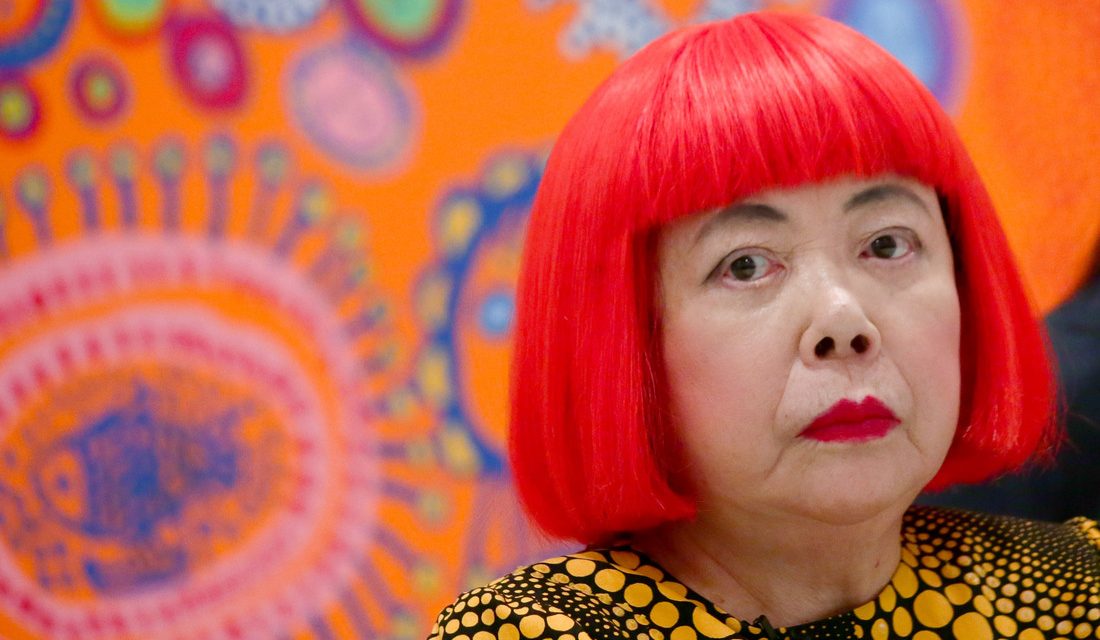
The Japanese artist Yayoi Kusama, renowned for her vibrant polka dot sculptures and mesmerizing “Infinity Rooms,” passed away at the age of 97. Her representative, David Zwirner, announced that Kusama died from “multiple organ failure” at a Tokyo hospital on August 14. Kusama’s imaginative creations often reflected her intense personal experiences. Her work included repetitive brushstrokes on dotted canvases known as infinity net paintings, giant polka-dotted pumpkins, and enclosed mirror rooms filled with twinkling lights that create an illusion of endless space.
Kusama described her art as a means of survival, offering viewers a unique perspective on their place in the universe. She once wrote, “Our earth is only one polka dot among a million stars in the cosmos.” Some of her notable works include Dots Obsession — Love Transformed Into Dots and All the Eternal Love I Have for the Pumpkins.
Born in Matsumoto, Japan, Kusama grew up near the mountains in Central Japan. Her family ran a seed nursery, and during World War II, she worked in a parachute factory. Throughout her life, she experienced hallucinations and used art to cope with these episodes. Writing in her autobiography, she shared how drawing in sketchbooks helped ease the shock and fear of these visions. Her mother disapproved of her artistic pursuits and would often confiscate her art supplies.
Inspired by a book of paintings by Georgia O’Keeffe, Kusama wrote to the artist seeking advice. O’Keeffe encouraged her to pursue art in the U.S., despite acknowledging the challenges of making a living as an artist there. In the late 1950s, Kusama moved to New York, where she became part of the avant-garde art scene. During the Vietnam War, she organized public “happenings,” painting polka dots on protestors’ bodies and wrote a provocative open letter to President Richard Nixon proposing a unique way to achieve peace.
Art dealer Richard Castellane, who represented Kusama in the 1960s, recalled her impactful Infinity Rooms, featuring phalluses and blinking colored lights synchronized to a machine-gun beat. The lights reflected infinitely in mirrors, leaving spectators mesmerized and disoriented.
Despite her innovative contributions, gaining recognition as a female artist in a male-dominated art world was challenging. Curator Mika Yoshitake noted that Kusama was often exoticized and didn’t shy away from it. She embraced her cultural heritage by wearing kimonos and presenting herself as an exotic figure.
Kusama returned to Japan in the early 1970s, living in a psychiatric institution while continuing to create art. Her exhibitions gained prominence in the U.S. and Europe. The Yayoi Kusama Museum opened in Tokyo in 2017, cementing her legacy. Her designs have appeared on various products, including cellphone cases, Lancôme lipsticks, and Louis Vuitton items.
For Kusama, art was an essential part of her life. She expressed contentment at the thought of her work being appreciated a century from now, stating, “Art, for me, is a creed.”
 Exploring the Lucas Museum of Narrative Art
  Converse Apologizes and Withdraws Controversial Ad Amid Criticism
  Lucas Museum of Narrative Art Unveils in Los Angeles
  Lonnie G. Bunch III Reflects on His Legacy at the Smithsonian
  A Decade of Impact at the National Museum of African American History and Culture
  Urgent Archaeological Efforts in Quinhagak Stay Ahead of Erosion