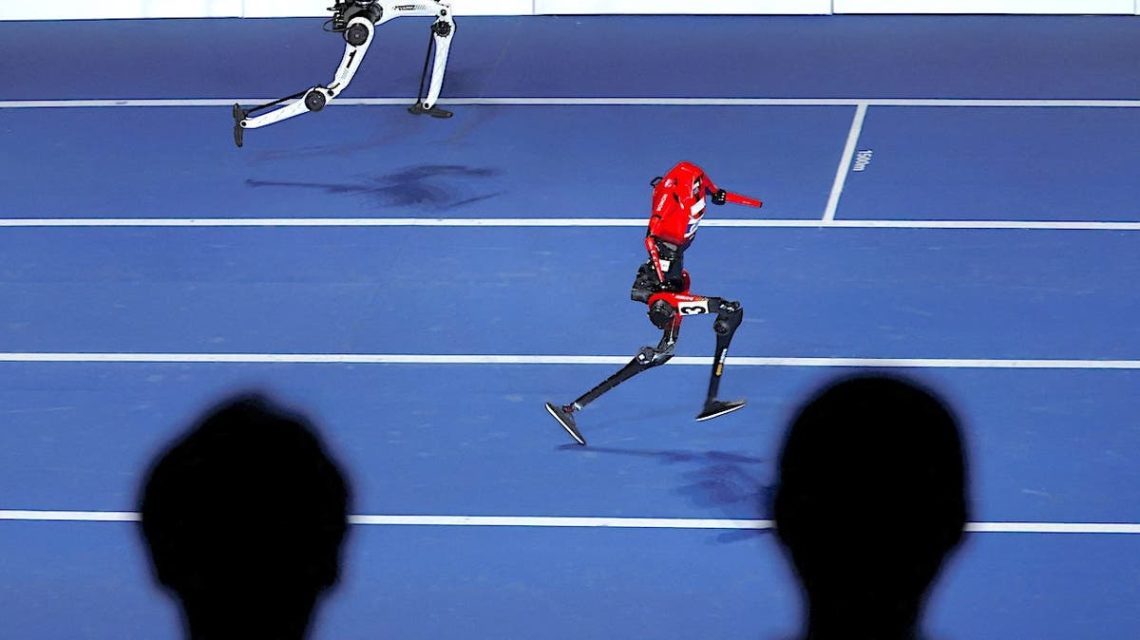
The record for the world’s fastest 100-meter dash was recently broken at the World Humanoid Robot Games in Beijing. A robot named Lightning Bolt, created by the Beijing-based X-Humanoid team, completed the sprint in 9.39 seconds, surpassing Usain Bolt’s 2009 record of 9.58 seconds. However, the robot collided with a wall after completing the race.
Prior to the event, a trial run saw a humanoid robot from the Chinese smartphone company Honor finish the same distance in 9.32 seconds, achieving a peak speed of 14.5 meters per second. Both robots, after hitting the wall, were moved with assistance, a stark contrast to Usain Bolt’s 2009 lap of celebration.
The Games featured over 2,000 robots competing across 51 events, including sports such as table tennis and soccer. The event highlights China’s progress in robotics during an intense technological competition with the U.S.
The second edition of the World Humanoid Robot Games coincided with the 2026 World Robot Conference in Beijing, showcasing around 3,000 products including humanoid robots. Events took place at the National Speed Skating Oval, a venue constructed for the 2022 Winter Olympics.
Among other achievements at the Games was a humanoid robot high jump reaching 2.88 meters, improving on last year’s result and surpassing the human record of 2.45 meters set by Javier Sotomayor in 1993. Spectators noted the rapid evolution of robot capabilities.
Humanoid robots are evolving rapidly,
said Li Yanfeng, a Beijing education worker. Initially hesitant about AI’s impact, she became intrigued by its development.
Yang Shangzheng, another spectator, expressed amazement at robots performing sports traditionally associated with humans. Liu Tao, attending with his son, was eager to see top-tier robots from various countries, including the U.S., Germany, and Japan, as 16 countries participated.
Beyond competitive events, the Games also featured displays of weightlifting and tug of war. Meanwhile, scrutiny from the U.S. toward Chinese robots increased, reflecting concerns over national security.
Under President Trump’s administration, the FCC banned imports of certain foreign-made robots. FCC Chair Brendan Carr supported this decision, indicating it aligned with efforts to secure U.S. supply chains.
 The New York Knicks Face Decisions as Championship Camp Begins
  Caleb Williams Avoids Major Injury, Chicago Bears Relieved
  Don McCullin’s Final Book: A Pioneering War Photographer’s Legacy
  Rep. Alexandria Ocasio-Cortez Defends Macklemore Amid Tour Controversy
  Caleb Williams Injury Update: Chicago Bears Quarterback Escapes Major Setback
  Bettors Reflect on Recent Plays and Monday Night Football