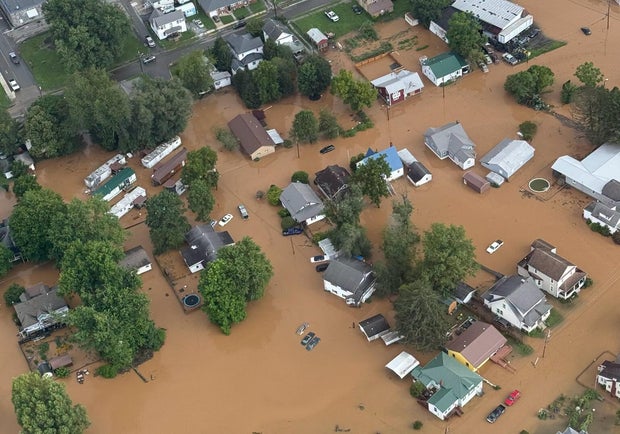
Torrential rains led to flash floods in West Virginia, inundating homes and businesses, washing out bridges, and prompting many water rescues. The situation turned dire as the state’s governor reported that some residents were unaccounted for during ongoing search operations.
Massive Rescue Efforts
Governor Patrick Morrisey announced the deployment of 500 National Guard members to the worst affected regions in the north. A state of emergency was declared for all 55 counties. Over 100 people required rescue from the floodwaters, and concerns grew about potential missing persons. Nineteen National Guard and state police helicopters were operational for rescue missions or on standby.
On Wednesday, three shelters opened to accommodate more than 100 displaced residents. Forecasters recorded up to 7 inches of rain; in some areas, 4.5 inches fell within just 37 minutes, leaving no capacity for water to disperse.
Uncertainty and Caution
When asked about those unaccounted for, Morrisey did not confirm numbers but expressed concern over possible fatalities. He assured that updates would follow as information becomes available. He called on West Virginians to unite in support and prepare to aid in rebuilding efforts.
Lars Dalseide, communications director for Morrisey, noted that flooding details would be released following verification processes to ensure accuracy.
Further inquiries for information from various officials were unmet, including those directed to the West Virginia Department of Homeland Security and the West Virginia National Guard’s public affairs.
Imagery and On-the-Ground Reports
Images circulated on social media depicted submerged vehicles in parking areas, like a Walmart in Weston with water breaching far inside. Across from a nearby highway, a hotel faced similar flooding. Video footage showed a man and his son fleeing their home just before their shed was swept away.
Emergency crews reported multiple rescues of individuals stuck in vehicles within floodwaters, though some rescuers faced accessibility challenges due to flooding.
Public Response and Ongoing Threats
Officials in several communities awaited water recession before establishing donation drop-off sites. Buckhannon’s Mayor Robbie Skinner identified West Virginia Wesleyan College as one planned site, expressing resolve for community recovery despite the devastation.
Heavy rains were part of broad storms that also caused tornado reports, stretching from Cincinnati to New York City suburbs. Central Ohio experienced severe winds leading to building damages, while New York saw downed trees. There were 14 tornado reports across six states on Tuesday.
Prior rainfall had left the ground saturated, leading to heightened flood risks. Even as rains subsided Wednesday, flood warnings persisted for lower-lying regions and near water bodies. Extensive flood watches were issued from eastern Tennessee through Virginia to North Carolina.
Historic Comparisons
Lewis and Upshur counties, home to a combined population of about 40,000, experienced significant communication channel activity as first responders engaged in water rescues. Lewis County Commissioner Agnes Quinn Queen described the county’s devastation on social media.
Flooding forced road closures, including parts of Interstate 79 and U.S. Route 48. A sinkhole in Fayetteville swallowed a vehicle, highlighting the storm’s destruction. The flooding revisited areas devastated a decade ago by a fatal rainstorm claiming 23 lives.
According to a U.S. Geological Survey gauge, a creek tributary, Sand Run, reached record levels near Buckhannon, surpassing a 1985 flood event known for its tragic impact on the state.
 Nikole Hannah-Jones Reflects on Educational Choices for Her Daughter
  Life and Challenges at Chennai’s Kasimedu Fishing Harbour
  Chicago Bears Eye Potential Move to Indiana: A Look at the Developments
  Amazon Offers Discounts to Employees at Whole Foods
  Inside the American Airman Rescue Mission in Iran
  Trump Comments on China’s Surveillance Amid Reports of Aid to Iran