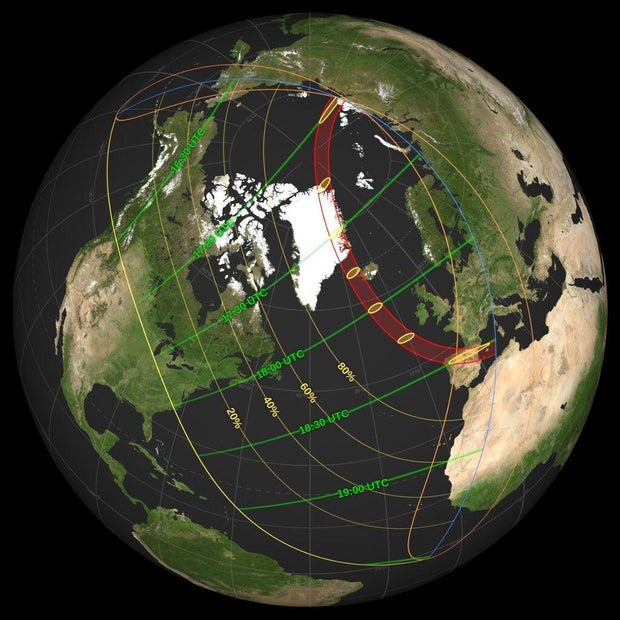
On August 12, 2026, people across the Northern Hemisphere will have a chance to observe the only total solar eclipse of the year. This astronomical event, where the moon passes in front of the sun, occurs somewhere on Earth approximately every 18 months. However, for any specific location, a total solar eclipse might not be visible for hundreds of years.
Visibility of the Solar Eclipse
The eclipse’s path will include several regions, some of which are sparsely populated like northern Greenland. Western Iceland and northern Spain, however, also fall within the path of totality, offering peak viewing experiences. Notably, Spain last observed a total solar eclipse in 1905.
NASA has developed an animation showing the path of totality, including the times it will pass each area. Although totality is confined to few regions, a partial solar eclipse will be visible across a broader area. Approximately 230 million people will be able to view 90% totality, including major European cities like Madrid, London, and Paris. In North America, Fairbanks, Alaska will experience 37% totality, while cities such as Boston, New York City, Toronto, and Philadelphia will see significantly less.
Timing
The total eclipse begins in northern Russia at 17:00 UTC (1 p.m. ET) and continues to northeast Greenland by 1:30 p.m. ET and western Iceland by 1:45 p.m. ET. In Reykjavík, the totality will occur at 5:48 p.m. local time. It will then cross the northern Atlantic until 2:30 p.m. ET when it reaches northern Spain, culminating in Valencia at exactly 8:32 p.m. local time. The total eclipse path concludes by 2:45 p.m. ET.
In North America, those experiencing partial eclipses will find peak visibility times differ from location to location. In Toronto, the fullest point occurs at 1:40 p.m., while in New York City, it arrives at 1:54 p.m. local time. In Fairbanks, observers need to wake early as the fullest point arrives at 8:27 a.m. local time.
Viewing the Eclipse Safely
If fortunate enough to witness totality, the darkness will last approximately two minutes. It’s crucial to wear solar eclipse glasses to protect your eyes, as staring directly at the sun can damage your retinas. Glasses can be removed during those two minutes of totality. For those viewing only a partial eclipse, keep protective glasses on throughout the event.
A woman is pictured trying out eclipse glasses in Almelo, eastern Netherlands on August 11, 2026, the day before the eclipse.
Future Total Solar Eclipses in the U.S.
The next total solar eclipse in the U.S. will be observable in 2044 and will only cover three states: Montana, North Dakota, and South Dakota. By 2045, another eclipse will traverse from Northern California to Florida, again passing numerous cities including Reno, Colorado Springs, Tulsa, Little Rock, Jackson, and Orlando. Another occurs in 2052 over the Southeast, affecting Florida, Georgia, and South Carolina, while the northeast will wait until May 1, 2079.
Coverage of the 2026 Total Solar Eclipse
Live coverage of the eclipse begins at 2 p.m. ET on CBS News, featuring Rob Marciano in Mallorca, Spain, which will reach totality around 2:30 p.m. ET. Stream the event live on CBS News via your mobile or streaming device.
 Organic Farming with Bokashi in Zambia
  California’s Demographic Shifts: A Closer Look
  Israel Marks Tragic Anniversary Amid Political Turmoil
  Israel Commemorates Third Anniversary of Hamas-Led Attacks
  Immigration Policies and Their Impact on Afghan Refugees in the U.S.
  Henri Kagan and Kenso Soai Win 2026 Nobel Prize in Chemistry