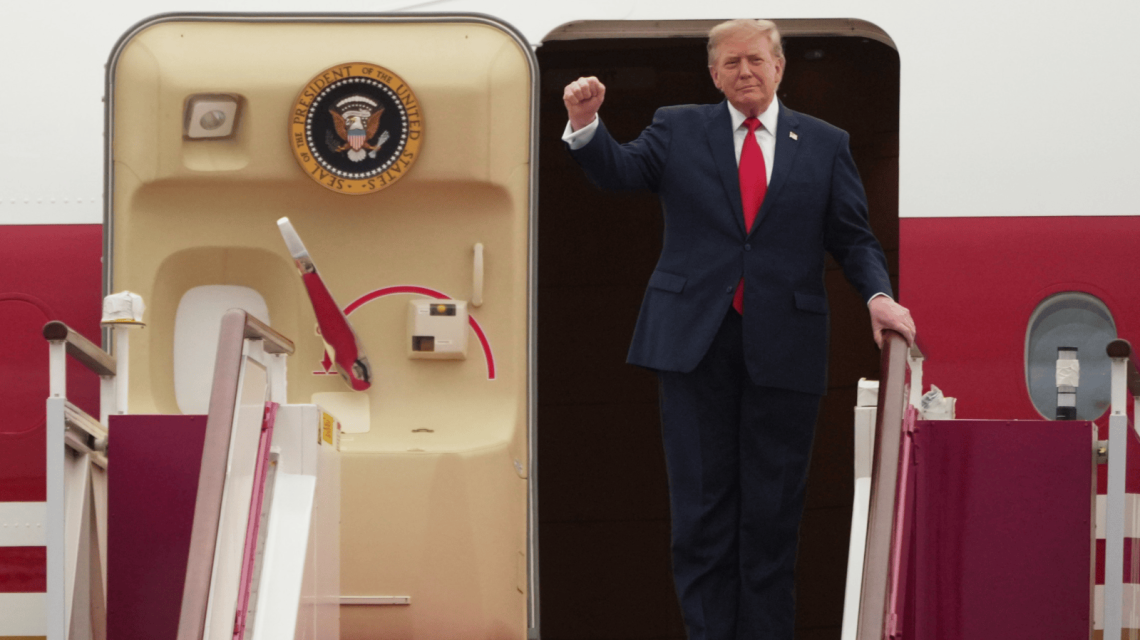
President Donald Trump’s approval rating is largely negative nationwide, with a significant gap between those disapproving and approving of his performance. As of 8:30 a.m. ET on Thursday, November 19, data from Civiqs’ rolling job-approval tracker shows that out of 143,723 responses collected between January 20, 2025, and November 18, 2026, 33 percent of registered voters approve of Trump’s presidency, 59 percent disapprove, and 7 percent have no opinion. This results in a national net approval rating of minus 26 for Trump.
An analysis by Newsweek reveals that Trump’s approval is positive in 11 states but negative in 39 states. No state shows an even division in opinion.
The White House defends Trump’s record, citing tax cuts, border policies, job growth, and trade agreements as achievements.
Trump’s approval could impact his ability to push his agenda during his remaining two years in office, especially with Democrats controlling Congress. Costas Panagopoulos, a political science professor at Northeastern University, emphasizes that Trump’s approval rating is crucial for setting the stage for the 2028 presidential race and influencing Congress.
Trump’s approval ratings have notably declined since the start of his second term. His net rating fell in every state analyzed by Newsweek using Civiqs data. Trump’s administration points to various policies as successes, but his approval ratings remain challenging for advancing his policies with a Democratic Congress.
A Newsweek analysis indicates that Trump’s positive ratings remain mainly in Republican strongholds. For instance, Wyoming shows a plus 16 net rating, and other states like North Dakota and West Virginia also display positive figures. However, even in these states, there is a marked decline in approval from the beginning of Trump’s term.
The national results highlight stark differences in approval based on demographics such as age, party affiliation, education, gender, and race. Republicans predominantly approve of Trump, while Democrats overwhelmingly disapprove. Independents offer a net rating of minus 40. Younger voters are more critical compared to older age groups. Education level affects perceptions as well, with postgraduates showing a minus 51 net rating.
Several Republican states have shifted from approval to disapproval, signaling a notable change in political dynamics during Trump’s second term. States like Kentucky and Mississippi have transitioned significantly downward in support.
Trump’s approval is underwater in every battleground state from the 2024 presidential election. High disapproval ratings are noted in key states like Arizona, Ohio, and Georgia. Even traditionally Republican states like Texas and Florida have shown substantial declines.
Democratic-leaning states record the lowest approval ratings for Trump, with Hawaii, Vermont, and Massachusetts indicating the highest disapproval scores. Despite these declines, changes in Democratic states are less severe compared to Republican areas.
Panagopoulos suggests that Trump’s future ratings could shift when Democrats assume more congressional power. The potential for either continued decline or a recovery in approval will depend on Trump’s ability to navigate these political challenges and assign responsibility for policy failures to Democrats.
This report was developed by Newsweek reporters using Martyn, their AI assistant.
 Debate on School Choice in Texas Elections
 Amy Klobuchar Takes On Governorship with Promises for Minnesota’s Growth
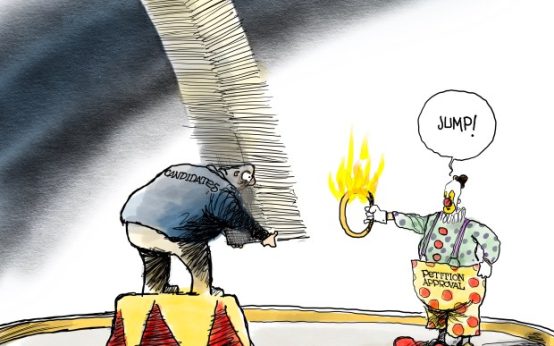 Challenges of Signature Requirements for Political Candidates in Illinois
 Debate Rekindled Over Gray Wolves and Livestock Losses
 White House Faces Backlash Over Controversial Video
 Former Press Secretary Critiques Republican Strategies