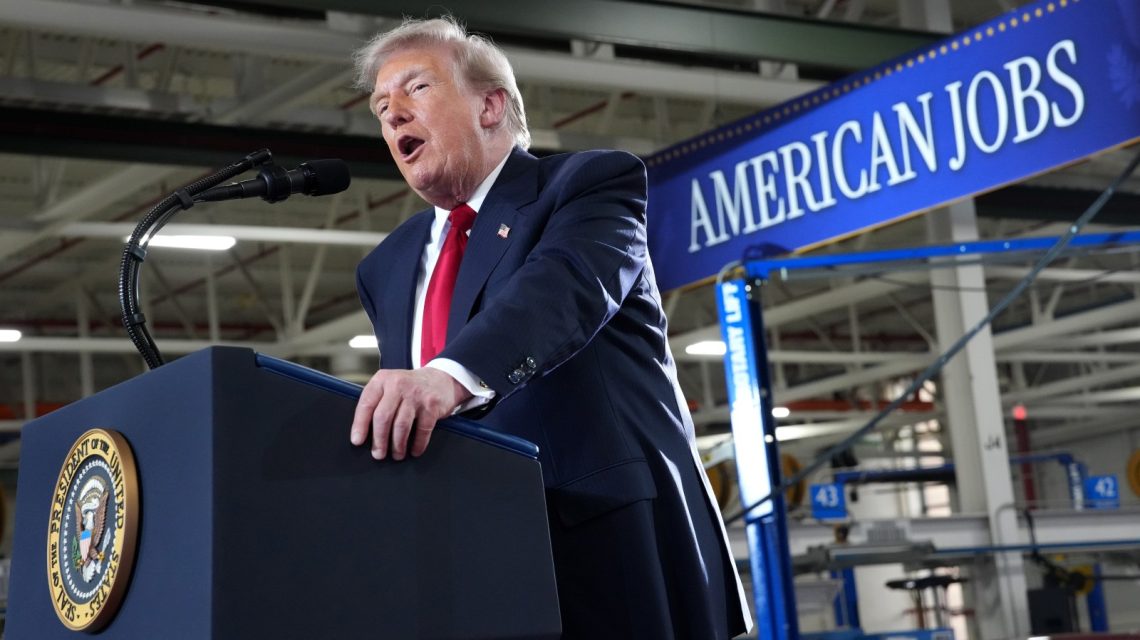
President Donald Trump announced on Saturday the approval of new fuel economy standards aimed to end the Biden administration’s perceived electric vehicle mandate. He contends these changes will lower car prices and bolster U.S. auto manufacturing. In a post on Truth Social, Trump argued that previous standards escalated costs for both automakers and consumers by steering manufacturers towards electric vehicles. According to him, the new standards will bring down vehicle prices and invigorate domestic auto production.
“That means LOWER PRICES, saving families thousands on a new, beautiful, and safe car,” Trump wrote. However, he did not provide specific details about these standards, and the administration has yet to release an accompanying final rule. Earlier proposals from Trump’s administration suggested significantly lowering future fuel economy requirements for automakers.
Trump’s announcement came shortly before what seemed to be a broader statement from the administration. Transportation Secretary Sean Duffy hinted on X about an impending “major victory for America’s auto workers” expected on Monday, though he did not confirm if it pertained to the fuel economy standards mentioned by Trump.
Newsweek sought comments from the White House, the Department of Transportation, Sean Duffy, and the National Highway Traffic Safety Administration on Saturday.
Trump Touts Auto Policy Shift
Trump claimed the new standards would attract manufacturing jobs and investments to states like Michigan, Ohio, Indiana, and South Carolina, facilitating automakers in creating vehicles that consumers prefer. He expressed gratitude to Duffy and Commerce Secretary Howard Lutnick for progressing the administration’s auto policy goals. Trump also mentioned that executives from General Motors, Ford, and Stellantis expressed their desire to expand U.S. manufacturing.
NHTSA Proposed Lower Standards
This administration indicated in August its intention to propose significantly lower fuel economy requirements compared to those under President Joe Biden. At the time, Duffy stated the aim was for automakers to focus on vehicles desired by consumers rather than those favored by federal policymakers.
A National Highway Traffic Safety Administration proposal from December suggested a fleetwide average fuel economy of approximately 34.5 miles per gallon by 2031, down from roughly 50.4 mpg under Biden-era standards. It remains uncertain whether the standards Trump mentioned align with this proposal or include further changes.
Biden’s fuel economy rules sought to curtail fuel consumption and greenhouse gas emissions, urging automakers to enhance the production of fuel-efficient and electric vehicles. Advocates of the Biden-era standards argued these rules would lessen oil consumption and curtail transportation sector emissions. Trump’s administration, however, labeled these policies as an electric vehicle mandate, even though the rules did not obligate consumers to purchase electric cars.
NHTSA criticized prior fuel-economy standards for overly depending on expected electric-vehicle adoption and compliance credits, claiming this contradicted federal law.
Costs, Fuel Use, and Emissions
Proponents of the proposed rollback argue it might decrease vehicle prices and minimize compliance expenses for automakers. NHTSA projected its earlier proposal could lower the average upfront cost of a new vehicle by around $930. The agency also anticipated the suggestion would lead to an additional 100 billion gallons of fuel consumption by 2050, increase fuel expenses by about $185 billion, and elevate carbon dioxide emissions by around 5 percent.
The announcement aligns with Trump’s ongoing efforts to reverse policies pushing for electric vehicle adoption. Congress abolished federal tax credits for new, used, and commercial electric vehicles acquired post-September 30, 2025, including a consumer credit up to $7,500 for eligible new EV purchases.
Moreover, Congress took steps to bar California from enforcing rules demanding all new passenger vehicle sales be zero-emission by 2035, igniting legal challenges and continuous discourse surrounding the state’s regulatory power.
Trump’s post did not clarify the timeline for implementing the new standards, leaving uncertainty about whether they align with the previously outlined fuel economy proposal or if additional information will emerge on Monday.
 Trump TV Trademark Could Impact Government Use
  Trump Faces Record Low Approval As Midterms Approach
  New Legislation Ensures Faster Care for Abused Animals in Shelters
  Potential Agreement on Permitting Reform
  Voter Concerns and Challenges in Upcoming Elections
  Growing Dissent in Trump’s Republican Party