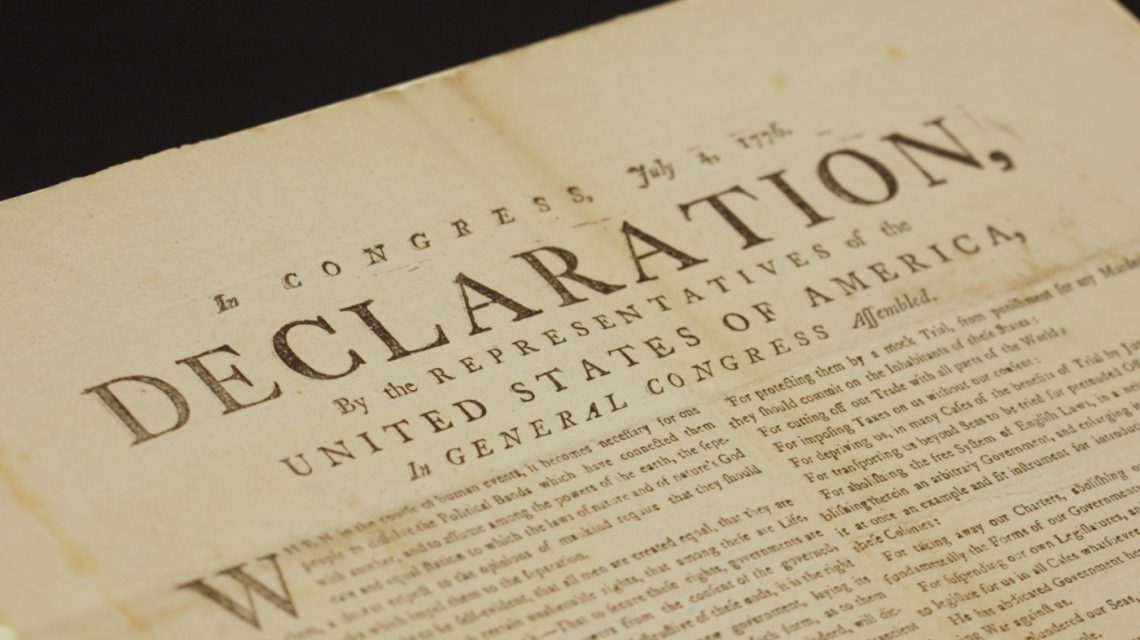
In an unexpected discovery, a copy of the U.S. Declaration of Independence, printed in July 1776 in Exeter, is now displayed at The National Archives in London. This revelation shines a light on some lesser-known facts about the Declaration’s history, particularly its ties to the United Kingdom.
Twelve years ago, at the British National Archives, I had the rare opportunity to hold an original copy of the Declaration of Independence dated July 4, 1776. It was presented to me during a private tour associated with my policy fellowship with the British House of Lords. Surprisingly, these original copies, four in total, are part of the U.K.’s collection. Three came into possession without U.S. consent.
These four copies include the Dunlap Broadsides Copies and the recently discovered Exeter Print. The story of the Exeter Print’s arrival in the U.K. dates back to December 24, 1776, when the Royal Navy found it among documents on the American privateer ship, Dalton. Meanwhile, the Dunlap Broadsides copy I viewed had made its way to London through British colonial channels, likely by mid-August 1776. It reached Lord Germain, who then informed King George III. The other copies arrived through military interception and seizure.
To the British, the Declaration stood as a symbolic break from the colonies. For Americans, these documents hold an inestimable historical value. Despite the 250-year-old declaration of independence from Britain, the U.S. has not formally sought their return.
The 250th anniversary of American independence presents an opportunity for U.S. authorities and the State Department to initiate an official request for these significant copies to be returned. Currently, one Dunlap Broadsides copy is exhibited in the U.K. under the theme “The Path to American Independence,” with plans also to showcase the Exeter Print.
In the United States, the Philadelphia Museum of the American Revolution temporarily hosts another Dunlap Broadsides copy, which was originally intercepted with a letter in Yiddish from Jonas Phillips.
As these documents continue to tell the intricate story of American independence in an international context, public policy discussions around their possession may arise. The historical significance and diplomatic implications make the topic both relevant and intriguing.
James Finney-Conlon, a public policy expert and writer based in Los Angeles, provides insight into this complex part of American history.
 Trump’s Executive Order Targets Mosquito and Tick Control
  Efforts to Restrict Voter Registration Funding Trigger Concerns for Nonprofits
  News Outlets Fight White House Ban in Federal Court
  Michigan Senate Candidate Questions Football’s Ethics and Safety
  The Department of Homeland Security Urges Migrant Caravan to Avoid U.S. Border
  Kentucky Trooper’s Murder Sparks Manhunt and Mourning