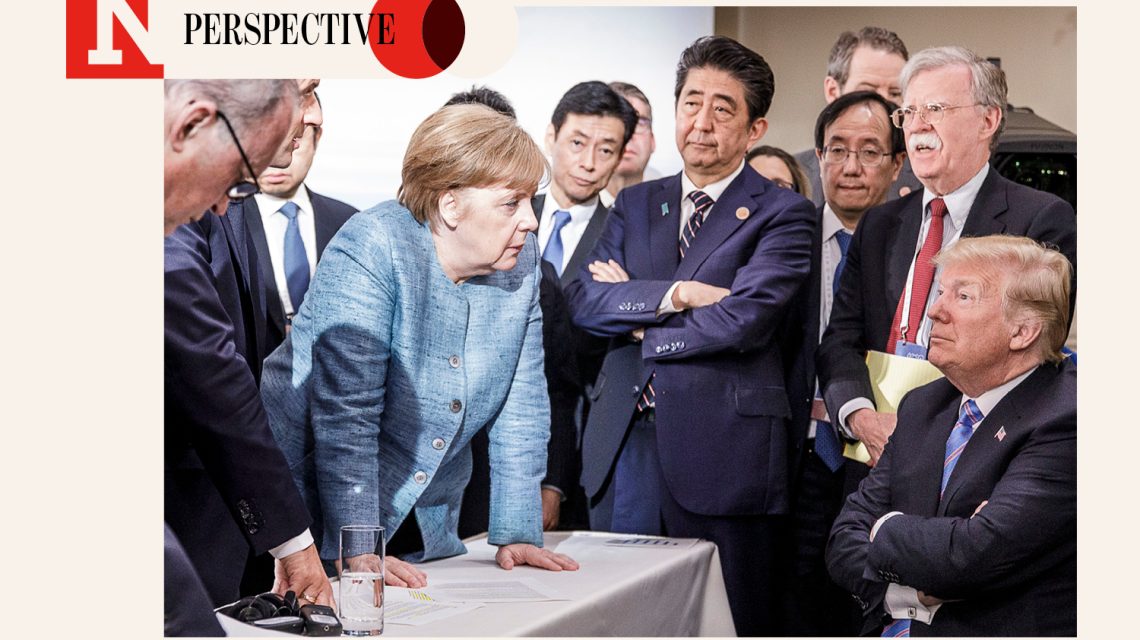
The photograph taken on June 9, 2018, in Charlevoix, Quebec, remains iconic. Jesco Denzel, a photographer for the German government, captured a moment that symbolized the diplomatic challenges of the Trump era. German Chancellor Angela Merkel leaned over a table, hands firmly placed; French President Emmanuel Macron pressed his knuckles into the wood; Japanese President Shinzo Abe stood with folded arms, while U.S. National Security Adviser John Bolton was visible in the background. Meanwhile, President Donald Trump sat with arms crossed and chin tilted, seemingly unaffected by the combined frustration of Western democratic leaders.
This image went viral, conveying sentiments that official communiqués could not. Leaders of the world’s wealthiest democracies appeared to implore an American president to remain engaged in the global system that the U.S. had long established. Not long after, from Air Force One, Trump chose not to endorse the joint statement, which had promised cooperation in trade, growth, security, and democracy. Angela Merkel described the incident as “sobering and a bit depressing.”
That approach, relying on persuasion and alliances, was soon outdated. In Évian-les-Bains, France, the G7 faces a starker reality by 2026. The previous strategy, tethered to diplomatic posture, no longer holds. This time, the summit, held between June 15 and 17, referred to as the post-American G7, recognizes the need for a broader approach by adding more participants.
The summit retains its picturesque alpine setting and democratic grandeur, but the guest list piques curiosity. Traditional G7 members—France, the United States, Britain, Germany, Italy, Japan, Canada, and the European Union—now attend alongside invitees including India, Brazil, South Korea, Kenya, Egypt, Qatar, Ukraine, and the United Arab Emirates. Institutions like the World Bank, International Monetary Fund (IMF), Organization for Economic Cooperation and Development (OECD), and African Development Bank also participate. The French leadership has prudently maintained a focus on geopolitical challenges, Ukraine, the Middle East, international partnerships, economic balancing, artificial intelligence, minerals, and global imbalances.
Despite its significant resources, the G7 no longer dominates. Recent data suggests the G7 accounts for 28.4% of global GDP in purchasing-power terms, 9.6% of the world population, and 49.3% of global military spending. These figures highlight both strength and limitations. The summit, rescheduled to avoid Trump’s 80th birthday celebration, indicates how much the landscape has evolved from 2018’s Charlevoix.
Guest Countries and Strategic Involvements
The variety of invited countries reflects strategic diversity, each providing specific advantages necessary in a shifting global context. These invitees serve distinct purposes, from enhancing legitimacy to ensuring resource security.
Qatar: Gas Valve Insurance
Though Qatar’s economy is far smaller than many global giants, its role in energy, especially liquefied natural gas (LNG), is significant. With around 18.8% of global LNG exports in 2024, Qatar is a cornerstone in global energy markets. It also plays an essential part in communications relating to the Gulf regions, Gaza, and Iran. Qatar’s inclusion underscores the necessity of stable energy supply and mediation in volatile regions.
UAE: Oil and Financial Bridge
The United Arab Emirates is larger than Qatar economically, with its GDP estimated to surpass $1 trillion in 2026 purchasing-power terms. The UAE bridges finance, energy, and diplomatic efforts between Western and non-Western regions. As a major oil producer with critical excess capacity, it is instrumental in energy diplomacy, especially with tensions surrounding the Strait of Hormuz.
Egypt: Canal Security Role
Egypt’s strategic role arises from its population and the Suez Canal, a vital trade artery handling up to 15% of global trade. Disruptions in the Suez can lead to significant global economic impacts, as shown in recent crises. Egypt brings critical geographical leverage, enabling it to manage trade routes crucial for global supply chains.
Kenya: African Representation
Kenya’s inclusion reflects a commitment to involving African nations with significant convening power and mineral resources. As an emerging economic player in the region, its role at the summit offers representation and influence in climate and resource diplomacy.
Ukraine: Moral Commitment
Ukraine’s presence is less about its GDP and more about the geopolitical message. With ongoing conflicts in the region, Ukraine remains an ally in the democratic struggle against aggression, reinforcing the G7’s commitment to upholding democratic values.
South Korea: Industrial Power
South Korea provides indispensable technological contributions, with significant market shares in DRAM production, influencing AI and semiconductor industries. It also plays a key role in global shipbuilding. South Korea’s presence affirms its essential role beyond mere economic metrics.
Brazil: Global South Influence
As a member of BRICS and a major agricultural exporter, Brazil enhances dialogue between the Global South and the G7. Brazil’s presence allows for strategic collaboration on significant geopolitical and economic issues, providing diversification in partnerships.
India: Strategic Influence
India’s size and growth make it pivotal at the G7. It balances relations between various global powers and acts as a conduit between global south aspirations and the G7’s objectives. India’s unique positioning in BRICS and the Quad reinforces its influence and necessity within the international order.
The Charlevoix photograph signified ending a diplomatic era grounded in mere persuasion. The Évian summit symbolizes a strategic evolution. By diversifying its engagements, the G7 aims to protect against over-reliance on any single nation, particularly the U.S., by cultivating broader global relationships.
As Canada’s Prime Minister Mark Carney noted at Davos, “The middle powers must act together because if we’re not at the table, we’re on the menu.”
 U.S. and China to Discuss AI Transparency
  Fraud Investigation of Autism Center Raises Questions for Minnesota Senate Candidate
  Gen Z Voters and Their Impact on the 2026 Midterm Elections
  Rep. Alexandria Ocasio-Cortez Defends Macklemore Amid Tour Controversy
  Influence Concerns Surround California Political Donors
  Michigan Senate Race Sees Influences from Soros-Linked Funding