
President Donald Trump issued a stern warning about potential economic repercussions for countries offering support to Iran. The United States is working to resolve a conflict, initiated alongside Israel approximately six months ago, that has resulted in thousands of casualties. This war has also drawn in Gulf nations and disrupted global markets. Iran demonstrated its power by affecting shipping through the Strait of Hormuz, a crucial route that previously handled about 20% of the world’s oil trade before February.
Despite both countries, the U.S. and Iran, announcing ceasefire agreements in April and June to restore shipping flow through Hormuz, these efforts quickly failed. Israel has mostly retreated from the battlefront. In a recent social media statement, Trump threatened with “Economic Warfare and Isolation on an unprecedented scale,” without providing specific details.
“ANY country that allows its financial institutions, businesses, airports, or government entities to provide any type of lifeline to Iran will itself face TREMENDOUS Economic Consequences,” Trump wrote.
Punishing economic sanctions have been imposed on Iran for nearly 50 years, starting from the Islamic Revolution in 1979. Iran’s Foreign Minister, Abbas Araghchi, accused Trump of attempting to divert American attention from domestic financial issues like record debt and rising interest rates. Washington’s persistent policies, according to Araghchi, would only lead to further failures and disenchantment among Iranians.
Araghchi labeled America’s actions as “economic terrorism,” saying they threaten global economic stability and the sovereignty of nations worldwide. Though Trump’s social media declarations are prominent, their implementation isn’t always straightforward. He did not detail specific countermeasures against nations supporting Iran, which may include allies participating in peace mediation, yet he didn’t specify any names.
Recently, the United Arab Emirates suspended all trade, commercial exchange, and financial transactions with Iran. The UAE, a major host of U.S. military presence, acted after claiming missile launches from Iran, allegations dismissed by Iran as groundless. Data from analytics company Kpler indicates China purchases over 80% of Iran’s exported oil. Any further U.S. economic measures against China could elicit a significant response, as the nation is a key supplier of essential rare earth minerals to the U.S.
While Iran remains open to dialogue with the U.S., Mohammad Mokhber, an adviser to Iran’s supreme leader, clarified that dialogue shouldn’t be seen as surrender. On Tuesday, Trump denied any active discussions with Iran. Contradictorily, Jared Kushner, Trump’s son-in-law and special envoy, suggested that talks are ongoing and “probably more robust” than ever.
Trump aims to confiscate Iran’s stockpile of highly enriched uranium, pursuing a new, more restrictive nuclear agreement. This would replace the previous deal from which the U.S. withdrew in 2018. Iran, a signatory to the non-proliferation treaty, maintains that its nuclear ambitions remain peaceful, a stance it has consistently asserted for decades.
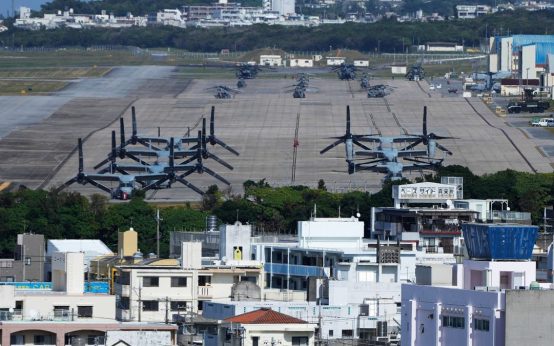 U.S. Military in Okinawa Initiates Pause Following Marine’s Arrest
  Suspected Iranian Drone Plot Pushes U.S. to Evacuate Bombers from British Airbase
  Brett McGurk Discusses Hostage Negotiations and New Book
  Suspected Drone Plot Leads to Evacuation of U.S. Bombers
  Afghanistan’s Economic Crisis and the Impact on Youth
  Jesse Marsch: From U.S. Soccer to Canadian National Team