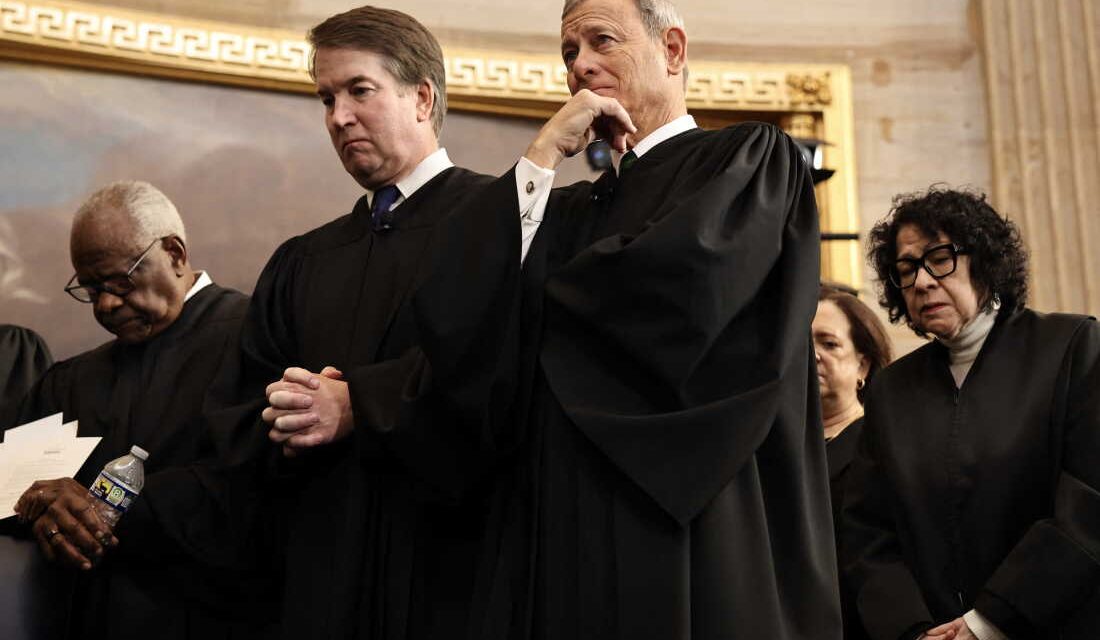
The U.S. Supreme Court has seen an increase in the duration of oral arguments in recent years, extending beyond the traditional one-hour session. Chief Justice John Roberts is contemplating adjustments for the new term starting in October, but finding a solution is challenging.
Historically, the Supreme Court strictly adhered to a one-hour limit for cases. Under the late Chief Justice William Rehnquist, time management was enforced stringently. Notable figures, such as Laurence Tribe and Brett Kavanaugh, experienced Rehnquist’s enforcement when time expired.
Current data analyst Adam Feldman notes, “Arguments are definitely longer than before, often going 90 minutes or longer.” The COVID-19 pandemic prompted changes in court routines, altering argument formats. Advocates initially presented their cases uninterrupted, followed by justices’ questions.
The purpose during COVID was you couldn’t see each other telephonically, and so there had to be some ordering or it would have been really messy,Feldman explained.
Importance of Transparent Arguments
Oral arguments are crucial as they are the sole public aspect of the Supreme Court’s decision-making. Many argue it enhances transparency despite its limited public audience. Tonja Jacobi, a law professor at Emory University, emphasizes its importance, stating it remains vital for public accessibility.
Some changes introduced during the pandemic are widely appreciated. Justice Clarence Thomas, who seldom spoke before, now frequently participates, asking the first question due to seniority.
Jacobi acknowledges these format changes as responses to research on gender interruptions. Despite changes, she finds interruption rates remain unchanged. Justices primarily use the time to converse and reinforce their positions due to court polarization.
Justice Ketanji Brown Jackson, the court’s newest and one of its three liberals, is the most vocal, followed by Justice Sonia Sotomayor. Jacobi suggests that justices on the expected losing side attempt more persuasion, contrasting with the confidence conservative justices hold in their dominant coalition.
Roberts Considers Solutions
Some justices express concern over extended oral arguments. Chief Justice Roberts acknowledged the issue during a summer audience, contemplating ways to reduce argument length.
Former acting Solicitor General Jeff Wall highlights the difficulty in managing the issue, comparing it to recurrent conference call challenges where interventions are awkward.
I don’t know what you do. It’s like when I’m on a conference call and I want someone to stop talking. There’s no easy way to get people to talk less when you would like them to,Wall remarked.
Feldman believes Roberts is addressing time management tactics behind the scenes, requiring careful balance so as not to cause discord among justices.
Jacobi considers the potential necessity of longer sessions for significant cases, comparing it to jurisdictions like Australia, where arguments extend over days.
Any adjustments to the format could be revealed when the court begins the new term on October 5.