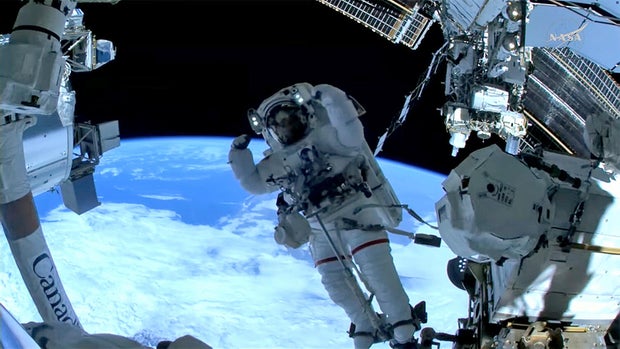
On June 30, 2026, two NASA astronauts completed the replacement of a malfunctioning joint on the International Space Station’s robotic arm during a spacewalk. This marked the station’s third spacewalk of 2026 and the 280th overall.
The faulty component, a 200-pound “wrist” joint of the 58-foot-long robotic arm, was identified by flight controllers in Houston. They discovered the joint was consuming more power than usual and was not functioning optimally. Following a detailed analysis, NASA collaborated with the Canadian Space Agency to execute the replacement, emphasizing the arm’s design for easy maintenance.
Execution of the Spacewalk
Astronauts Jessica Meir and Chris Williams began the spacewalk by activating their battery-powered spacesuits, officially starting the seven-hour, 20-minute excursion. Their mission was to install a spare joint from an external stowage platform. They first detached the robotic arm’s latching end effector (LEE) and two healthy joints.
This setup allowed Meir and Williams to focus on the problematic wrist joint. They successfully removed the faulty joint and installed a replacement within four and a half hours. Subsequently, the LEE cluster was reattached as planned, allowing flight controllers to restore power and verify the new joint’s electrical connections.
Outcome and Future Plans
NASA confirmed the operation’s success, with commentator Sandra Jones affirming proper electrical flow and data transfer through both strings of the robotic arm. The failed joint was gathered by Williams for potential refurbishment, with plans to return it to Earth for repairs. It will later be relaunched to the ISS, supporting long-term operations since the arm plays a pivotal role in station activities.
The robotic arm, integral for capturing cargo ships and assisting astronauts during maintenance, will continue to be serviced until the station’s decommissioning in 2030. Bill Spetch from ISS operations emphasized the importance of continuous maintenance, asserting the arm’s critical role until the station’s end of life.
“There’s not a time where we say hey, we’re just done repairing the arm,” Spetch stated. “Overall, the arm is critical for station operations and continued maintenance of it throughout to the end of life.”
The successful replacement underscores the collaborative efforts of NASA and international partners in maintaining the ISS.
 NASA’s Challenges Amid Goddard Space Flight Center Relocations
  Lost City Linked to Jesus Discovered Near the Sea of Galilee
  NASA’s Launch of the Nancy Grace Roman Space Telescope
  NASA Launches Nancy Grace Roman Space Telescope to Explore Universe’s Mysteries
 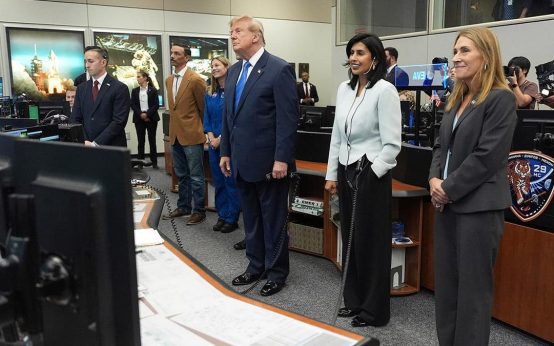 Trump Engages with Astronauts and Honors Artemis II Crew
  NASA’s Nancy Grace Roman Telescope Prepares for Launch