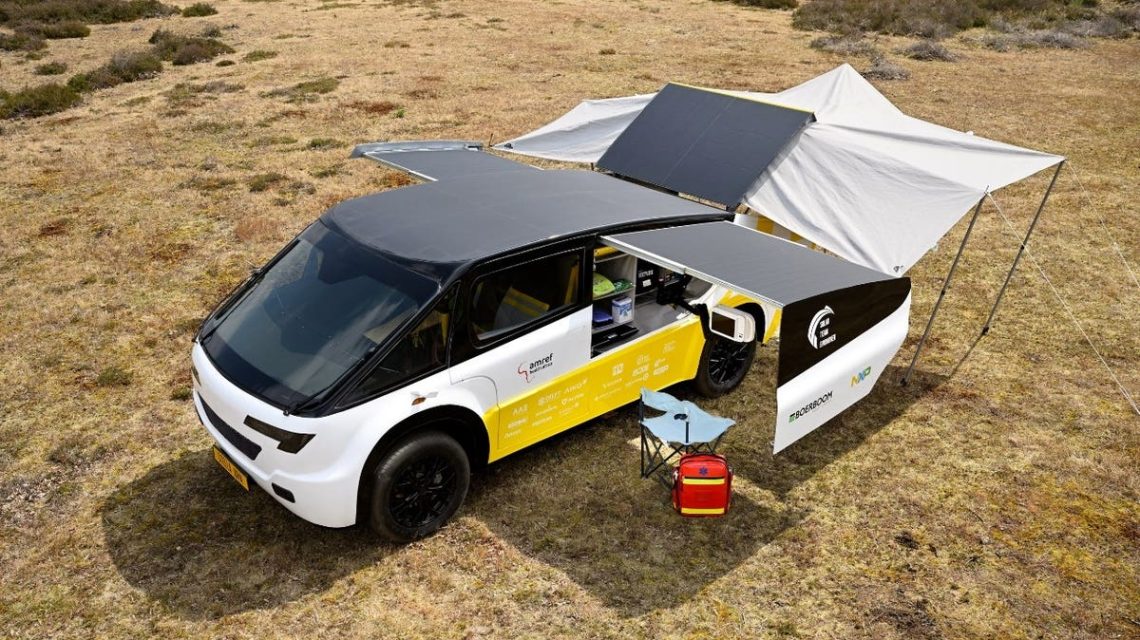
Imagine needing medical care when the nearest hospital is hours away and the location lacks reliable electricity. A team of university students in the Netherlands is addressing this issue with an innovative vehicle. Solar Team Eindhoven has introduced Stella Juva, the world’s first solar-powered ambulance.
Unlike typical ambulances, Stella Juva does not focus on transporting patients to hospitals. Instead, it brings medical care to people in remote areas. It generates its own electricity from sunlight, powering both the vehicle and its medical equipment.
In remote regions where fuel is scarce and electricity is unreliable, Stella Juva can make a significant difference. The World Health Organization estimates that around 1 billion people worldwide depend on healthcare facilities with unreliable or no electricity. This situation complicates basic medical services. Stella Juva addresses this by carrying its own power source.
How Stella Juva Operates
Stella Juva, developed by 23 students from Eindhoven University of Technology, features high-efficiency solar cells using All Back Contact technology. This design optimizes sunlight exposure on the vehicle’s roof, crucial for powering it through rough terrain while sustaining its medical facilities. A 50-kWh lithium-based battery stores energy, ensuring operation even in low-light conditions, and providing power at night.
The vehicle can travel up to 715 kilometers (approximately 444 miles) on a sunny day, with a top speed near 75 mph. Although real-world conditions may vary this distance, its solar-based mobility remains impressive.
Medical Equipment Prioritization
One of Stella Juva’s features separates the vehicle’s electrical system from that of the medical cabin. In critical situations, the remaining electricity is allocated primarily for medical equipment. This prioritization minimizes risks to patient care.
Pure sine wave inverters provide stable electricity required for sensitive medical devices, preventing voltage fluctuations from affecting healthcare operations.
Lightweight Design Challenge
To overcome the challenge of additional weight requiring more energy to move, the team constructed Stella Juva using lightweight carbon-fiber composite materials. As a result, the vehicle weighs around 1,350 kilograms (about 3,000 pounds), significantly less than conventional ambulances.
The vehicle’s aerodynamic teardrop shape effectively reduces wind resistance, conserving energy for reaching communities in need.
The Mobile Medical Clinic
Inside Stella Juva, a climate-controlled cabin supports healthcare activities in remote locations. It carries tuberculosis screening equipment, facilitates pregnancy ultrasounds, malaria tests, and can administer vaccinations. An automated external defibrillator is available for emergencies, along with refrigeration for storing vaccines and medications safely.
Testing in Kenya
Stella Juva will be tested in Kenya in collaboration with Amref Health Africa, evaluating its performance under realistic conditions. The team will simulate healthcare scenarios, including tuberculosis care, to assess its capabilities in diverse situations.
The student-built vehicle reflects years of developing solar transportation technology, as seen in their previous project, Stella Vita.
Potential and Future Prospects
Although Stella Juva remains a prototype, it highlights the potential for solar-powered medical units. While commercial production is not guaranteed, the project encourages larger entities to explore the concept further. Advances in solar technology and battery improvements continue to make such innovations appealing.
Mobile units like Stella Juva could prove valuable in disaster responses, rural healthcare, and areas with frequent power outages.
The upcoming field testing will play a crucial role in determining the vehicle’s real-world viability, paving the way for potential large-scale application.
 Apple Unveils Foldable iPhone Duo with Cutting-Edge Features
  Impact of Ukrainian Strikes on Russian Data Centers
  The Impact of AI on Job Quality and Economic Growth
  Choosing the Best LED Light Bulbs: A Comprehensive Guide
  Strategies to Reclaim Focus in the Digital Age
  Michigan Senate Candidate Proposes AI Development Freeze