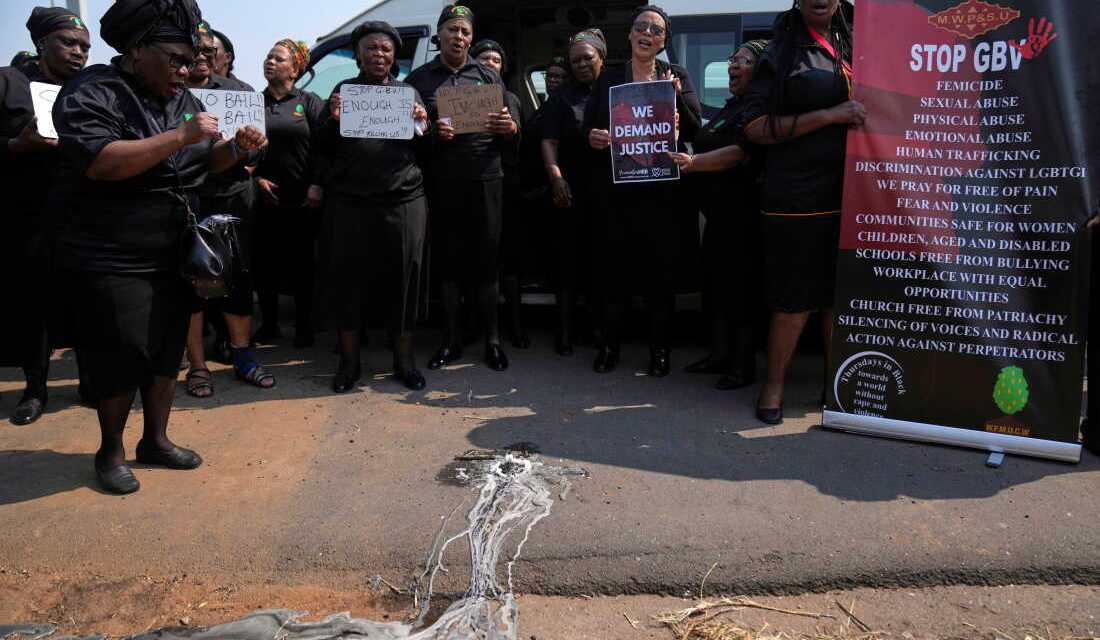
In Kempton Park, east of Johannesburg, a women’s church group gathered to pay respects. They sang beside a melted candle, marking the site where a woman’s body was discovered the previous week. This tragic event has put a spotlight on the alarming state of gender-based violence in South Africa.
Elizabeth Moselakgomo, a 38-year-old manager and mother, went for her routine jog near Johannesburg airport. Her 8-year-old daughter grew worried when Moselakgomo did not return home and alerted relatives who informed the police. Her body was found five days later, beaten beyond recognition. Moselakgomo’s death is one of nine in recent weeks in the same area, with many victims also sexually assaulted.
South Africa faces some of the highest rates of gender-based violence globally. Police data reveals over 100 rape incidents reported daily and approximately 15 women killed each day. The recent string of murders has heightened public fear and anger, even in a country accustomed to such statistics.
Authorities have not dismissed the possibility of a serial killer. They have advised women against walking or running alone, a suggestion criticized on social media. Users argue the responsibility to ensure safety rests with the police, not the victims.
President Cyril Ramaphosa vowed that “no stone will be left unturned” in finding the culprits. Yet, many remain skeptical, asserting the government’s inadequacy in addressing the crisis. In 2025, gender-based violence and femicide were labeled national disasters.
Amnesty International’s South Africa Director Shenilla Mohamed emphasized, “Women in South Africa are being hunted. We need decisive action for safety.”
Protests erupted in Kempton Park and Cape Town. Women demanded action, asserting their right to safety. Moselakgomo’s passion for running prompted memorial runs nationwide. Participants mourned in black, commemorating victims with moments of silence.
Shari Maluluke, a 26-year-old runner, shared her frustration. “Gender-based violence, especially femicide, is rampant here. Ordinary activities are risky,” she told NPR. Many present echoed her sentiments of feeling imprisoned in their homeland.
Didi Tsitsi, 31, described the safety precautions women take, from sharing locations to tracking transport. Tsitsi cited failures in governance and policing, societal norms regarding masculinity, and apartheid’s lingering effects as contributing factors. Academic studies suggest oppressive history has affected gender dynamics deeply.
The crisis has led to a national introspection about safety, justice, and societal progress in South Africa.
 Court Rules Against Third-Country Deportation Policy
  Claims to Nazi-Looted Art Spark Legal Battle in California
  Ed Sheeran Addresses Gaza Crisis and Tour Controversy
  UMass Dartmouth Football Player Stabbed in Providence
  U.S. Secures Strategic Control Over Greenland
  U.S. and Denmark Move Towards Security Agreement Over Greenland