The decision to expand hinges on the addressable market size. Household surveys reveal that in India and Mexico, families switch from motorbike rides to car rides when monthly expenses reach around $1,200, equating to $300 per person, based on current market prices.
By 2036, approximately 850 million more people in emerging markets are expected to spend over $300 monthly, making them prime candidates for car rides. Half of these individuals will reside in India and China. Indonesia, Vietnam, the Philippines, and Bangladesh will contribute an additional 125 million potential customers. This group will include about 200 million Gen Z members and approximately 420 million women.
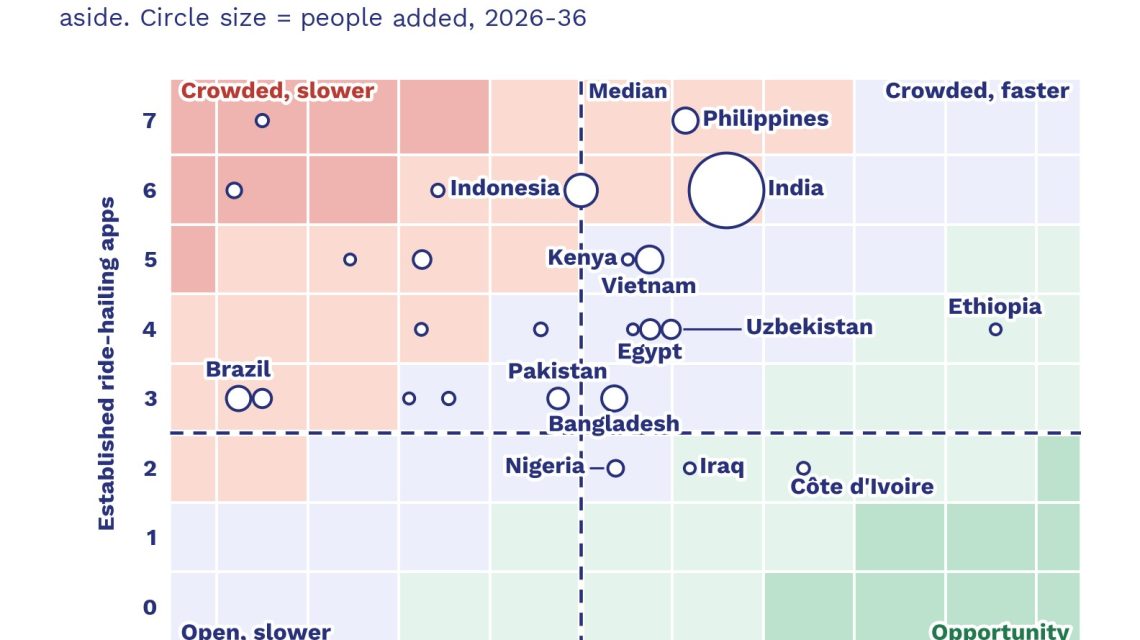
Yet, nearly 90% of these individuals will be in markets where at least three established ride-hailing apps already operate. An app is considered established if it has over a million downloads, a 5% share of local rides, or 10,000 drivers. Of the top 25 emerging markets gaining new customers, only Iraq, Nigeria, and Côte d’Ivoire have fewer than three established apps in their most populous cities.
Even quickly growing markets like Kenya, where taxi spending could rise by nearly 6% annually, already have five active apps in Nairobi. Meanwhile, Ethiopia, the fastest-growing of the 25, supports four apps. These markets are saturated before new entrants can establish a foothold.
According to World Data Lab, smaller markets that remain open are insufficient for substantial growth. Namibia, Botswana, and Mozambique might add about 2 million people spending over $300 monthly by 2036, starkly contrasting with the 35 million anticipated in Nigeria, Egypt, South Africa, and Kenya.
While exploring uncontested markets offers limited addressable demand, new consumers in these countries will be spread beyond capital cities. Outside of China, major cities are set to gain 118 million people by 2036. Smaller towns and secondary cities like Patna in India or Can Tho in Vietnam are expected to see customer bases more than quadruple from modest starting points.
A few rapidly growing cities with only one or two apps are found in small African markets like Maputo and Lomé, but they together represent only about 1% of new customers.
A concentrated market offers ride-hailing apps more opportunities than merely increasing rides. By 2036, annual spending on restaurant meals in emerging markets could double to $3 trillion, outpacing grocery expenditures. Gen Z allocates 6.1% of its budget to dining out and 3.3% to ride-hailing, compared to 5.5% and 2.6% for those aged 45-64.
As Gen Z’s wealth grows, expenditure on meals and rides will increase. By 2036, almost two-thirds of Southeast Asians spending at least $300 monthly will shop online. Currently, many will utilize the same app for ordering dinner as they do for ride-hailing services.
If competitive markets offered no additional value, limited open expansion would be problematic. Yet, most growth potential remains in these markets since riders spend more on pricier rides as they become wealthier. For instance, in India, the Philippines, and Brazil, the proportion of households using car rides jumps from 4% within the lower middle class to about 20% among wealthier families.
This perspective suggests current cheap rides are an entry cost rather than a race to the lowest price. Budget riders, who presently choose inexpensive motorbike trips, are the most probable future car-ride customers once their spending surpasses $300 monthly.
If forecasted income increases materialize, budget riders are expected to book the majority of future car rides. The majority reside in countries with existing app services. While expanding into new countries may sound appealing during earnings reports, it likely won’t result in many additional customers.
For ride-hailing companies, the crucial task is identifying when budget riders can afford costlier rides, understanding when this threshold is crossed, and pinpointing which countries and cities hold these groups. The ride-hailing market has little untapped potential left; future growth aligns with existing competition.
 Diplomatic Mission Confronts Antisemitism at Auschwitz
 Recruiters Tackle AI Agents in Job Applications
 Massive Casualties in Russia’s Invasion of Ukraine
 Successful Rescue Operation Ends Hostage Siege in Cartagena, Colombia
 Shanghai Party Secretary Under Investigation Amid Ongoing Anti-Corruption Campaign
 Jennifer Barreto Wins Miss Universe 2026 Amid Controversy