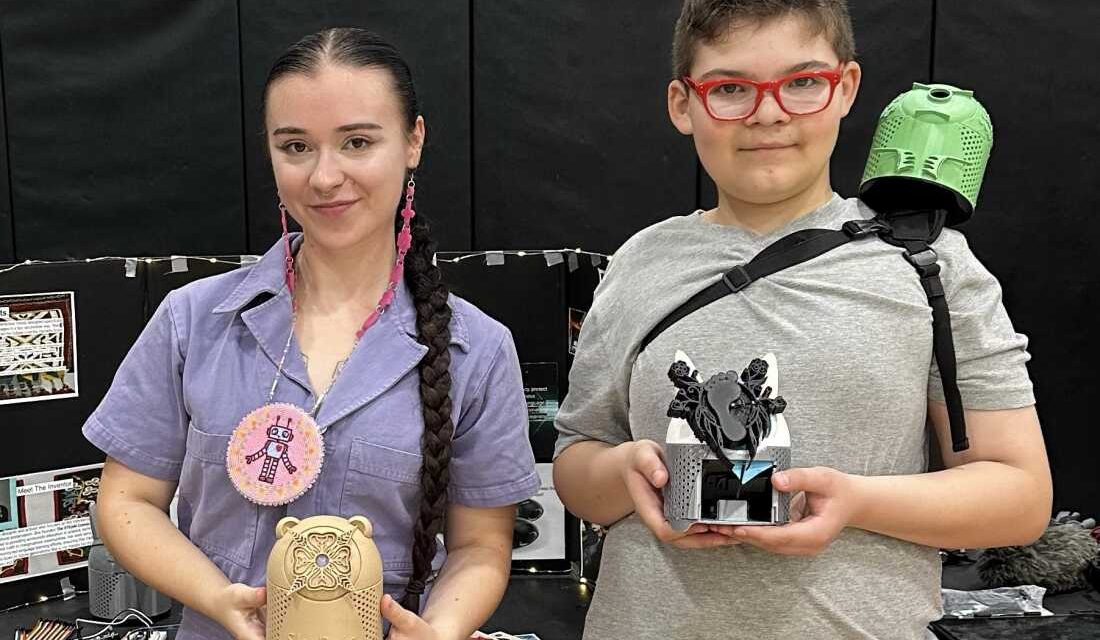
Holden Hoy is using robotics to learn the Ojibwe language, Anishinaabemowin, which faces endangerment. Guided by mentor Danielle Boyer, Hoy is acquiring skills like coding and electrical circuitry.
Danielle Boyer found her inspiration in a toy store, specifically from Tickle Me Elmo. “Whenever you’d press his belly, he would talk, and he would teach you things,” she shared. “There are toys that teach us in English, but no toys teach Anishinaabemowin.” Boyer aimed to change that.
Anishinaabemowin comprises languages like Potawatomi, Odawa, and Ojibwe, with fewer than 10,000 speakers in the U.S. and around 25,000 in Canada. Some Native languages have only a few fluent speakers left. Boyer’s grandmother is among the last fluent speakers of their dialect.
“It is devastating to feel like your language could be lost,” Boyer, a member of the Sault Ste. Marie Tribe of Chippewa Indians, expressed. “You lose your culture, you lose a way to describe who you are.”
Historically, U.S. Indian boarding schools contributed to the loss of Indigenous languages by forcibly separating children from their families and teaching them, often violently, to abandon their native tongues. This impacted language transmission across generations.
Although some Native youth now learn their languages in schools, Boyer highlights that many students treat it as just another assignment. This led her to create SkoBot, a customizable toy robot designed to motivate Indigenous children to learn their languages.
“I can say ‘Hey SkoBot, what is bear?’ And it will respond ‘Bear is makwa, makwa.'” SkoBots utilize artificial intelligence to speak Indigenous languages and are designed to resemble woodland creatures with Native American floral decorations.
Boyer’s nonprofit, founded when she was 18, has mentored hundreds of Native American children across the country in building their SkoBots. Among them is 12-year-old Holden Hoy, who is passionate about robotics and language preservation.
Hoy showcased his SkoBot at his school’s science fair, programming it to respond to questions in Anishinaabemowin. They named their robot Sabe, meaning Bigfoot, representing honesty in Ojibwe culture.
Hoy’s SkoBot detects movement with a sensor, activating prerecorded audio without AI-generated language, ensuring accuracy and avoiding AI-related issues common in generative models.
“It’s important not to use generative AI,” Hoy remarked. “AI tends to falsify things, not relying on trustworthy sources.”
Boyer emphasizes that SkoBots aim to engage children in both Indigenous languages and STEM subjects, fostering ethical AI use awareness. She warns of the potential harm when AI technologies, not created by Indigenous people, provide inaccurate data or undermine cultural preservation.
Boyer discussed that some use chatbots for language learning, noting that models like ChatGPT have invented fake Anishinaabemowin terms. She insists on learning languages correctly to protect cultural integrity.
Hoy’s mother, Jocelyn, appreciates how her son embraces this cultural identity and teaches her about their heritage. “At a time in my life, I didn’t want to be identified as Native American. Now, I can’t wait to learn more,” she said. “SkoBots will help many, including me, reconnect with our heritage.”
Hoy confidently states, “The language is the culture!” He believes it’s crucial to protect it, as it forms the foundation of many people’s lifestyles across generations.
Edited by Steve Drummond and Lauren Migaki
Visual design and development by LA Johnson
 Debate Continues Over Virginia’s Data Center Energy Plans
  Trump Suggests Renaming AI to ‘Super Intelligence’
  The Rise of Data Centers and AI Development
  How China Uses AI to Challenge U.S. Dominance
  Controversy Surrounding Automated License Plate Readers (ALPRs)
  U.K. Test-Fires U.S. Torpedo from XV Excalibur