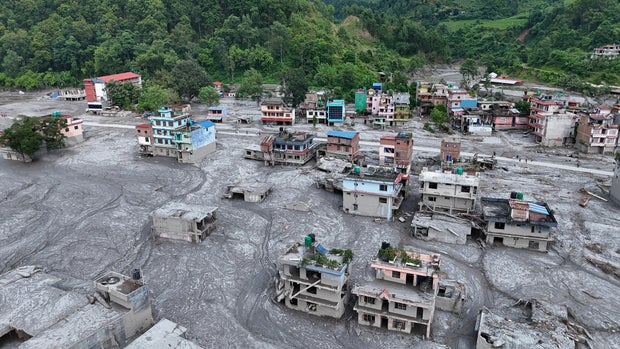
On August 29, 2026, authorities reported a rising death toll exceeding 600 due to recent flash floods in Nepal and the China border. Rescue operations are ongoing, with around 3,000 individuals still missing. The adverse weather has hindered aerial rescues for workers and military personnel who have been searching tirelessly for survivors since the disaster occurred.
Obstacles in Rescue Efforts
Brig. Gen. Raja Ram Basnet, from the Nepali Army, mentioned that helicopter operations remain suspended due to the weather. Authorities are concerned about more than 100 individuals trapped in mud at a hydropower construction tunnel in Nepal’s Rasuwa district. A video showed rescuers pulling a mud-covered man from the tunnel, a site where many are feared trapped.
Limited landing zones and 4-5 feet of mud have delayed operations, although helicopter baskets are used to reach some people. Aerial images highlight the extensive debris and mud covering settlements in DevGhat village, captured on August 28, 2026.
Warning of Further Flood Risks
Nepali and Chinese authorities have alerted communities about potential flooding from a newly formed lake upstream of the area, with populations advised to relocate to safer locations. Risks of further flash floods have compelled rescue teams to move temporarily. Experts observed the lake’s overflow tendencies, signaling increased danger.
More than 3,700 individuals have been rescued in Nepal. On the Chinese side, 558 persons are reported missing, including many foreign workers, trekkers, and pilgrims.
Causes of the Flash Floods
The floods likely stemmed from the collapse of a rocky ledge supporting a glacier. Scientists indicated bedrock beneath a glacier in the high Himalayas collapsed, triggering a 5.2 magnitude event. This caused significant rockfall and glacial melt, resulting in swollen rivers that swept away infrastructure in Tibet and Nepal.
Geoscientists continue to collect data for a detailed understanding. Jakob Steiner, based in Bangladesh, confirmed that a glacier portion had indeed broken off. The rapidly warming Himalayan region remains highly vulnerable, with about 78% of the glacier area subject to noticeable temperature changes.
American Involvement and Aid
Of the many missing, 90 are Americans. Five have reached safety, while the U.S. State Department collaborates with Nepal to deliver aid, including essential supplies like food and shelter materials via Catholic Relief Services and Caritas Nepal.
Among those missing were 22 U.S. individuals involved in a pilgrimage organized by the Isha Foundation, run by Sadhguru Vasudev, to Mount Kailash, Tibet. Isha Foundation’s community liaison, Leslie Crespi, stated that outreach has continued through diplomatic channels.
Statements and Support
President Trump expressed distress over the disaster’s severity. He remarked on the massive structural damage, comparing the devastation to the ease of breaking toothpicks. The U.S. has communicated willingness to assist Nepal in recovery efforts.
 The Cost of Challenging Beijing
  Tensions Escalate in Iran Conflict as Global Leaders Weigh Options
  White House Approves F-35 Sales to Saudi Arabia Amidst Regional Tensions
  Inside the Secret Deals Powering the President’s Push to Deport Migrants to Countries Not Their Own
  Navigating the Challenges of Third-Country Deportations
  Midair Altercation on Bangladesh to London Flight