Overview
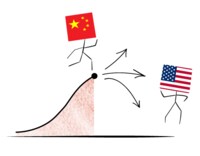
The United States and China are the largest economies in the world and have developed a complex relationship characterized by mutual dependence. This relationship includes trading partnerships, economic competition, and geopolitical challenges. Both countries have attempted to reduce their reliance on one another, a process referred to in the U.S. as ‘decoupling,’ ‘derisking,’ or ‘rebalancing’ by different administrations.
Trade Dynamics
The trade interactions between the U.S. and China began undergoing significant changes in 2018 with the imposition of tariffs. President Donald Trump initiated a global trade war with China as the focal point, prompting Chinese President Xi Jinping to limit exports of vital minerals. This led Trump to adjust his levy strategy, offering concessions for a trade truce. Despite these tensions, the U.S. continued to export to China at consistent levels.
Examining the export volumes, there has been a steady flow of trade between the two countries. The U.S. exports to China remain substantial, though geopolitics has introduced complexities.
U.S. Treasurys
China has historically been one of the principal holders of U.S. Treasury securities. In 2013, Chinese investors owned over $1.2 trillion of U.S. government debt. However, China has since diversified its holdings. As of December 2025, the top foreign holders of U.S. Treasury securities also include Japan and the UK.
U.S. Businesses
China continues to be a pivotal market for U.S. multinational corporations, notwithstanding geopolitical tensions and tariff impositions which have dampened sales and revenue from China. Intel generates about 25% of its revenue from China, while Nvidia reports almost 10% from the region. Despite the challenges, company leaders are exploring new market opportunities in regions like India.
The leaders of these companies, alongside former President Trump, are visiting Beijing to manage business interests and explore pathways for collaboration.
Student Enrollment
Chinese students have held a significant presence in U.S. higher education institutions. Enrollment peaked in 2019 but has declined post-COVID-19 pandemic. The perception within China of the U.S. as a waning yet potent power has notably influenced this trend.
In 2025, among the leading countries supplying international students to the U.S. are India, Japan, and South Korea, alongside China.
Tourism
Short-term visits from Chinese tourists to the U.S. achieved a peak in 2015, but experienced a decline due to bilateral tensions and the pandemic’s impact. In 2020, the share of short-term visitor visas allocated to Chinese nationals fell, mirroring decreasing enthusiasm for U.S. travel amid mutual discord.
Currently, the U.S. monitors short-term visitors primarily through the issuance of B1/B2 visas, allowing for better understanding of travel patterns between the nations.
 Readers’ Views on Social Security Reform and Education
  Dan Dakich Criticizes Kaepernick’s NFL Slave Trade Comparison; Simone Biles’ Car Theft Issue
  Controversy Over Racial Comments in College Admissions
  Facing the Reality of U.S. National Debt
  Ari Emanuel: A Hollywood Insider’s Journey
  Reader Reactions on Grizzlies and Data Centers