President Donald Trump on Monday advocated for bipartisan tax incentives to support the domestic television and movie industry. This sector has seen significant portions of its business relocate overseas in recent years. Trump shared on Truth Social that meetings are being arranged with leaders from both parties.
In his message, Trump emphasized the bipartisan nature of the proposal, noting the financial losses experienced in states such as California. He urged Republicans and Democrats to collaborate and expedite legislation to support the American movie, television, and entertainment sectors.
Trump’s focus on aiding Hollywood, typically criticized by Republicans, rests partly on the influence of actor Jon Voight. Voight, who served as a 2024 campaign surrogate for Trump, is seen as a guiding figure in shaping Trump’s entertainment industry policy during his second term.
Previously, in May 2025, Trump met with Voight before proposing tariffs on movies made overseas. Voight did not immediately respond to comments Monday night.
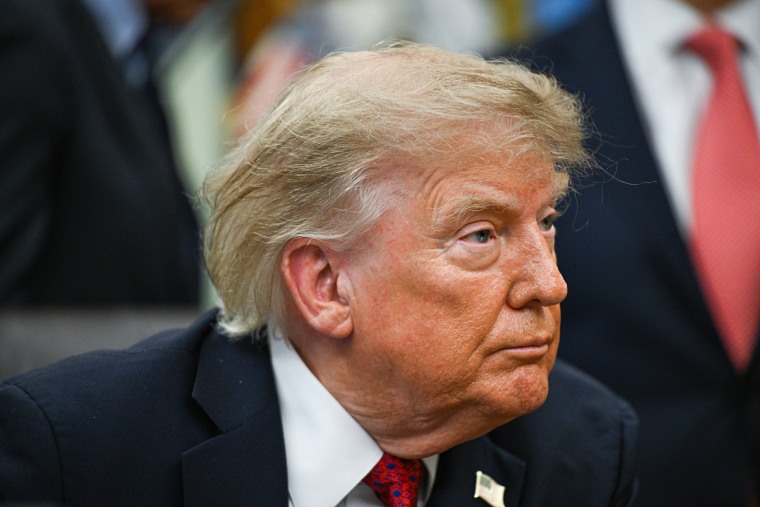
President Donald Trump in the Oval Office of the White House on Monday.— Annabelle Gordon / Bloomberg via Getty Images
Trump’s post received immediate endorsement from Democrats, who often oppose him. Sen. Adam Schiff, D-Calif., expressed strong agreement, encouraging Congress to pass a federal film tax incentive quickly. Schiff called for bipartisan cooperation to restore these jobs in America.
Rep. Laura Friedman, D-Calif., supported the measure, emphasizing the need for quick passage: “For more than a year I’ve collaborated with Jon Voight, colleagues, unions, studios, and producers to argue for a national film and television tax credit.” She highlighted the misplaced job distribution to countries like Canada and the UK, advocating for domestic job retention.
Friedman pointed out last September that Trump’s proposal for tariffs on foreign films acknowledged the loss in the U.S. industry, but she insisted that a tax credit would be a better path than tariffs.
The industry also welcomed Trump’s announcement. Charles Rivkin, CEO of the Motion Picture Association, representing leading U.S. studios, praised the support for tax incentives in a statement. He highlighted America’s century-long legacy in producing global film favorites and saw federal incentives as pivotal for fostering local production nationwide, boosting the economy, and enhancing competitiveness.
Although Trump did not disclose financial specifics, he predicted that the expenses related to the tax incentives would be compensated much more by increased revenue in the Treasury.
 Florida Senate Race Tightens as Recent Polls Show Dead Heat
  Ethics Complaint Targets Colorado Representative Lauren Boebert
  Ken Paxton’s Campaign Funding and Polls
  Melanie Griffith Reflects on Wellness Retreat and Career Legacy
  Inside the Secret Deals Powering the President’s Push to Deport Migrants to Countries Not Their Own
  Independence of Research from Political Agendas