
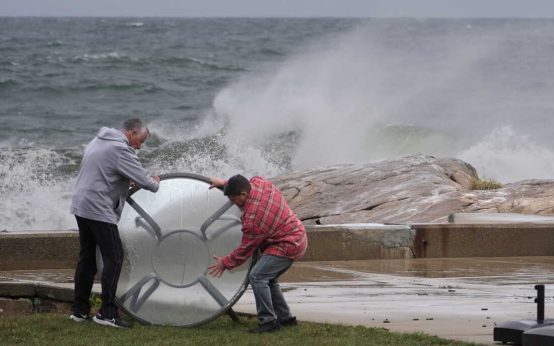
A strong nor’easter hit the Eastern Seaboard on Saturday, leading to flooding, power outages, and significant travel disruptions as powerful winds and heavy rain struck coastal areas. Millions of residents remain under coastal flood warnings, with the expectation of further adverse weather conditions persisting until Monday.
The storm has necessitated evacuations, submerged roads, and caused electricity outages for tens of thousands. Forecasters predict that the slow-moving system will linger near the New Jersey coast, thus extending the risks associated with flooding, erosion, and travel interference.
Understanding Nor’easters
The National Weather Service describes a nor’easter as a storm affecting the East Coast of North America, typically characterized by northeasterly winds affecting coastal regions. These storms can occur year-round, however, they’re most powerful from September through April. They often deliver heavy rain or snow, strong winds, rough seas, and at times, coastal flooding.
The last significant nor’easter occurred this past February, bringing record snowfall in the Northeast, with some areas in Rhode Island receiving nearly 38 inches of snow.
Coastal Flooding Increases With High Tides and Heavy Rain
The primary concern on Saturday was the coastal flooding caused by strong onshore winds combined with exceptionally high tides. Roads along the Jersey Shore were flooded, impacting vulnerable waterfront areas, including parts of New York City.
In Edgewater, New Jersey, emergency crews evacuated people from a flooded waterside hotel. Similarly, Point Pleasant, Belmar, and other Jersey Shore areas reported inundated streets. Floodwaters also affected parts of Queens, New York, and the Hamilton Beach neighborhood near JFK Airport experienced streets underwater during high tide.
New Jersey residents were advised to leave vulnerable neighborhoods. In Manasquan, authorities recommended voluntary evacuations. In North Wildwood, flooding led to the closure of the George Redding Bridge, impacting access to the community.
Ellie Hodge from Norfolk, Virginia, reported seeing stranded cars due to flooding earlier in the week. In Ocean City, Maryland, heavy surf caused beach erosion and water crossings over dunes, leading to more flooding.
Widespread Power Outages in the Northeast
Strong winds emerged as a significant threat beyond the coast. Gusts over 50 miles per hour were noted in several areas, with Nantucket, Massachusetts, recording a gust of 62 mph. Meteorologists highlighted the risk of falling trees and downed power lines due to the saturated ground and powerful winds.
Power outages surged throughout the Northeast as the storm grew more intense. Over 91,000 customers were without power by Saturday afternoon, with outages across New York, New Jersey, Pennsylvania, and Connecticut. Utility companies noted that the high winds could hinder repair efforts.
New York Governor Kathy Hochul warned that outages might last due to ongoing strong winds. She stated that while precipitation amounted to a half-inch by Saturday morning, more rainfall was expected. Nor’easters are common as New England heads into fall, but this occurrence was noted to be slightly earlier than usual.
Travel Delays and Transportation Disruptions
The storm significantly impacted air travel, especially in New England. Boston Logan International Airport experienced severe disruptions, with over 250 canceled flights. Smaller airports, like Nantucket Memorial and Martha’s Vineyard, saw cancellation rates above 70%.
New York’s main airports avoided widespread cancellations but still recorded many delays. Additional ground stops were a possibility if the winds intensified. Earlier, LaGuardia Airport faced delays as airlines adapted to the changing conditions.
Rail travel was also affected. Amtrak canceled some routes, and service between sections of Connecticut and Massachusetts was suspended. Alternative bus services were arranged to maintain regional connectivity.
Forecast Predicts Continued Rain and Coastal Flooding
Forecasts indicate two to six inches of additional rainfall over much of the Northeast, with higher amounts in eastern Long Island, coastal Massachusetts, and Cape Cod. Rainfall intensity could briefly reach an inch per hour, raising concerns about localized flooding.
The National Weather Service issued coastal flood warnings through Sunday evening for parts of northeastern New Jersey, southeastern New York, and Massachusetts, including Cape Cod and Nantucket. Each high tide presents further flooding potential.
Long Island’s southern shore, facing 7 to 10-foot waves, raises concerns over beach erosion and further flooding. In New York City, emergency officials expect significant rain Saturday night, with areas like Jamaica Bay and the Rockaways at risk of moderate flooding. Residents are urged to avoid the water and beaches.
Newsweek staff utilized Martyn, their AI assistant, for this report.
 Mother Arrested Over Abandoned Baby Found in Riverside
  Man Charged with Murder After Discovery of Human Remains in Georgia
  Bear Attack on California Couple Turns Tragic for Pet
  Security Lapses Revealed in Charlie Kirk Shooting at Utah Valley University
  Nor’easter Hits Mid-Atlantic and New England; Hurricane Nolo Advances on Hawaii
  Investigation into Overdose of Cindy Crawford’s Son Persley Gerber