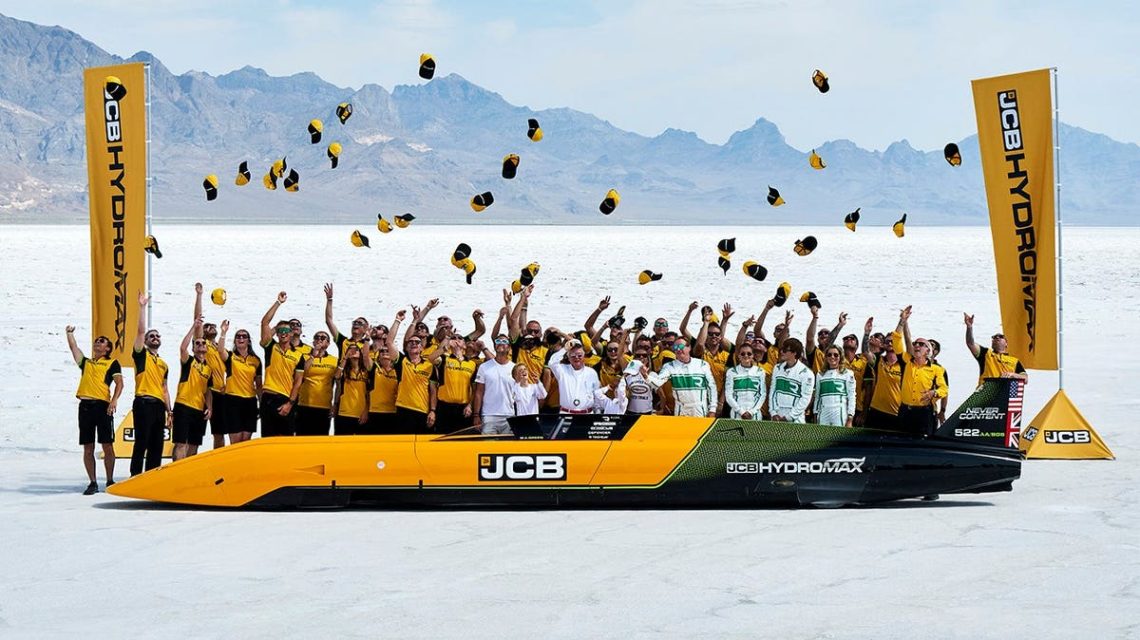
On a momentous Tuesday, JCB Hydromax achieved a significant breakthrough with its hydrogen-powered car. The vehicle, equipped with twin engines and measuring 32 feet, made two impressive runs at the Bonneville Salt Flats. During the first run, it recorded an average speed of 400.623 mph and reached 412.135 mph on the second. The overall average speed of 406.320 mph established a new world land speed record for hydrogen-powered internal combustion vehicles, eclipsing the previous 185.5 mph record set by the BMW H2R in 2004.
The record awaits official confirmation from the Fédération Internationale de l’Automobile (FIA).
Wing Commander Andy Green, OBE, the driver, described the record as an ‘extraordinary’ engineering feat.
Green stated, “This is the first of its kind. It is not only creating a new class at Bonneville Speed Week for hydrogen racing but also surpassing every other hydrogen car with this record.” He explained that typically, getting a car to 400 mph takes three to five years. Yet, JCB Hydromax had its first design meeting only a year ago and used this short timeframe to reach the new record.
JCB Hydromax’s team took just over a year from design meetings to hitting the track. After their first design discussions, they spent nine months designing and manufacturing components, finished building the car in five weeks, tested it in the UK for three weeks, and then aimed for the record at Bonneville. The hydrogen engines employed run on a perfect fuel ratio, a unique feature.
Experienced professionals initially assumed it would need multiple visits over several years to achieve such speeds. Green remarked, “Instead of five or six years, they did it in five or six days.” Despite the challenges presented by engine development, high altitudes, and extreme temperatures, the team succeeded in their mission.
The car’s cooling relied on about 400 pounds of ice and water to manage engine and air temperatures. The hydrogen engines are sensitive to hot air and needed a perfect cooling system to prevent damage. Engineers also had to balance oil temperatures to ensure durability.
Maintaining a high speed was not the sole concern; stopping the car safely held equal importance. The unique parachute system plays a critical role in decelerating the 5,500-pound vehicle traveling at 400 mph.
After meticulous preparation, Green expressed satisfaction with the car’s performance. The team aimed for 400 mph as a baseline and achieved an average of 406 mph. A second run recorded 412 mph, possibly setting a new world record.
The measured mile took slightly under nine seconds to complete. Green noted the unique visual effect experienced at such high speeds, requiring adjustments in distance perception.
As the car’s speed increased, decelerating became a primary focus. On both runs, the car stopped as planned, underlining the team’s precise calculations.
Green’s passion for high-speed driving spans decades, beginning with his experience as a jet fighter pilot in the UK Royal Air Force. In 1997, he set the absolute world land-speed record at 763.035 mph, becoming the first person to break the sound barrier on land. This feat remains unmatched.
Green expressed excitement for the future of motorsports, highlighting the potential of zero-carbon technology. He remarked on the advancement of using sunlight and water to produce hydrogen, powering race cars to these incredible speeds.
Today’s achievement marks a promising start for the next generation of motorsport technology.
 Case Keenum’s Impressive Performance Leads Bears to Victory over Eagles
  LeBron James Joins Philadelphia 76ers
  Challenges in College Football Playoff Selection
  Chicago White Sox Face Astros in High-Stakes Playoff
  Senate Approves Protect College Sports Act
  ASU Investigates Overpowering Workout Incident Involving Hockey Player