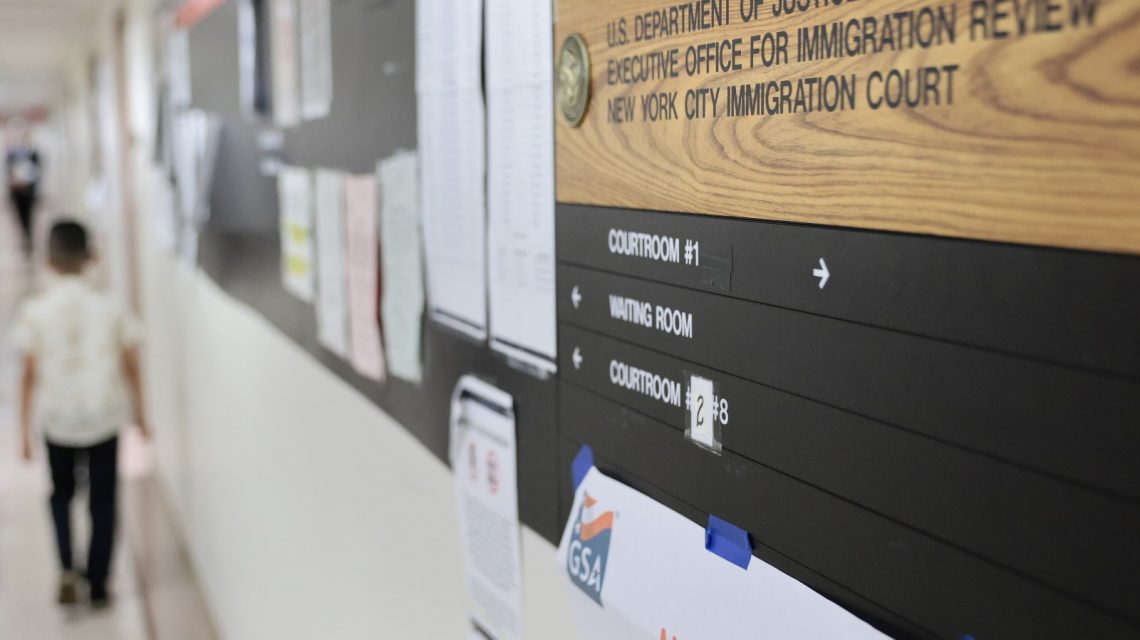
Under a new rule from the Trump administration, immigrants facing deportation will have only 10 days to appeal many decisions made by immigration courts. This rule revives a significant change that a federal judge blocked earlier this year. Scheduled to be published in the Federal Register by the Department of Justice (DOJ), the rule reduces the appeal period from 30 to 10 days and imposes other restrictions on appeals before the Board of Immigration Appeals (BIA), in an effort to address the backlog that has overwhelmed the system.
The DOJ attempted this change in February, but legal challenges resulted in a judge partially setting aside the policy. After a period of notice and comment, the DOJ has reintroduced the policy as a final rule.
“This rule is part of the Trump Administration’s attempt to offer only a facade of due process,” stated Jill Family, a professor at Widener University Commonwealth Law School, to Newsweek. “Such procedures do not permit meaningful internal review of immigration court decisions. To tackle the backlog, more resources and procedural innovation are required, which should maintain, if not improve, the process. The Administration’s approach suggests, ‘the line is too long; let’s eliminate the service.'”
Immigration court proceedings have increased under the Trump administration, partly due to more detentions by U.S. Immigration and Customs Enforcement (ICE). The backlog has also grown due to the dismissal of long-serving immigration judges, who have been progressively replaced.
Changes for Immigration Appeals
The BIA, as the Justice Department’s top administrative body for interpreting and applying immigration law, processes a large volume of appeals from removal decisions made by immigration judges. According to the plan outlined in the Federal Register, the appeal window for many cases will decrease from 30 to 10 days. Appellants must identify the issues they raise in their Notice of Appeal. Some asylum cases will retain the 30-day window.
The new system significantly expands summary dismissal, meaning an immigration judge’s removal order becomes the final government decision unless a majority of BIA members decide to accept the case.
The DOJ justifies the changes by citing a “lengthy and unprecedented” backlog of cases. In Fiscal Year 2017, the BIA had a backlog of 35,837 cases. By Fiscal Year 2026, that number increased to 325,774, a nearly ninefold rise.
Reason for Blocking the 10-Day Deadline
On February 6, the DOJ issued an interim final rule proposing the new deadline, which led to a lawsuit in the U.S. District Court for the District of Columbia. Plaintiffs argued that the deadline would limit meaningful BIA reviews.
The lawsuit involved claims under the Administrative Procedure Act, the Immigration and Nationality Act, and the Constitution. On March 8, Judge Randolph D. Moss set aside parts of the rule, notifying immigration judges that the 10-day deadline was suspended and the appropriate deadline remained at 30 days.
The ruling did not establish a constitutional right to 30 days. Moss emphasized that the DOJ improperly implemented the policy without following notice-and-comment procedures for substantive policy changes.
Does the 10-Day Deadline Violate Due Process?
The renewed deadline may reignite the debate over the constitutional requirements for due process in deportation proceedings. The Justice Department maintains that while noncitizens have due process rights in removal proceedings, the Constitution does not guarantee an administrative appeal before the BIA.
When an appeal process is established, the critical issue is whether conditions can be imposed that effectively prevent its usage. With a 10-day timeframe, immigrants facing deportation would need to quickly obtain the judge’s decision, secure counsel, understand their case’s faults, and draft a Notice of Appeal. This would have to occur potentially while detained in ICE custody, without English proficiency.
“The BIA Interim Final Rule undermines due process,” said Emilie Raber, Senior Attorney at the Amica Center for Immigrant Rights, in a February release. “Beside stripping away potential benefits the BIA offers immigrants, it will cause chaos for those with pending cases in immigration court or federal appellate courts.”
In 1994, the Ninth Circuit Court of Appeals examined a 20-day appeals deadline in Gonzales-Julio v. INS, cited by the DOJ in its 2026 rule. The court deemed a 10-day deadline unconstitutional in some situations, such as an immigrant in Hawaii having to file an appeal in San Diego, California, within that period.
The DOJ claims that technological advancements, like electronic filing, have mitigated this issue, allowing document submissions online at any time.
What Lies Ahead
The DOJ plans to publish the rule on November 17, with it taking effect 30 days later. The rule will apply to cases filed after that date, sparing currently pending cases from the shortened deadline.
Further legal challenges are anticipated, as the plan addresses concerns about due process, access to counsel, and comprehensive case review. While the BIA serves as the last administrative layer, immigrants with dismissed cases can still seek further examination in federal court.
 Amy Klobuchar Takes On Governorship with Promises for Minnesota’s Growth
 Challenges of Signature Requirements for Political Candidates in Illinois
 Debate Rekindled Over Gray Wolves and Livestock Losses
 White House Faces Backlash Over Controversial Video
 Former Press Secretary Critiques Republican Strategies
 Migration, Politics, Peace Talks, Health Alerts, Legal Settlements, and Fire Conviction News