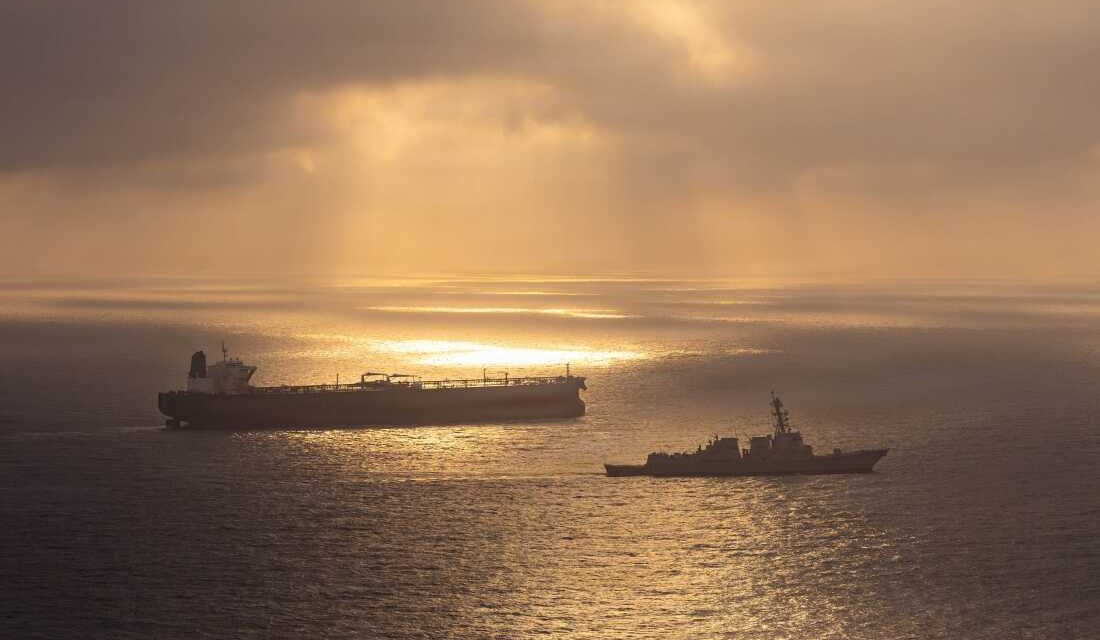
On April 24, the USS Rafael Peralta, a U.S. Navy ship, participated in a maritime blockade against an Iranian-flagged ship heading towards an Iranian port. This action is part of the ongoing U.S.-Iran conflict. The U.S. Central Command provided the accompanying photo, raising attention to the situation.
Recently, at a virtual town hall meeting, Navy families who were suddenly evacuated from Bahrain six months ago expressed concerns about the lack of information. NPR reviewed both the meeting’s recording and the list of questions posed by the families to Navy officials. These families left Bahrain with minimal possessions after the U.S.-Iran war started. Many continue to live in temporary accommodations like hotels and short-term rentals within the United States and abroad.
During the call, Vice Adm. Curt Renshaw, head of the Navy’s Fifth Fleet, addressed the issues caused by swift evacuations. He acknowledged that the Navy is developing solutions as the situation evolves. Initially, when the military and the State Department ordered the evacuation on March 2, Renshaw expected a brief disruption similar to the U.S. and Israeli attack on Iran’s nuclear facilities in June 2025. That conflict lasted 12 days. However, the current situation has persisted much longer and became more challenging.
Renshaw noted, “Unfortunately, this has just stretched on and on, and has evolved into something greater and a bigger challenge.” He highlighted their dilemma in not wanting to finalize decisions that would prevent families from returning to Bahrain.
U.S. Families Leave Everything Behind
The Iran war forced the Navy to manage the displacement of 1,300 dependents who abandoned most of their belongings in Bahrain, the base for the Navy’s Fifth Fleet. This figure excludes displaced sailors and civilian workers. One Navy spouse, with two young children, shared her ongoing relocations—eight times in less than six months. After initially reaching Europe, she moved to several U.S. locations. She prefers anonymity to safeguard her husband’s career, as he remains stationed in Bahrain.
“I need to take control over my life again,” she said. “I don’t want to be dragged around any longer. I feel like my spouse is holding up his end of the deal.” As her children’s school year approaches, she’s facing additional expenses to maintain stability in one area. Living in a state with little military presence, she feels isolated.
Searching for Permanent Solutions
The State Department plans to conclude the ordered departure governing the evacuation soon. Differing rules among the Navy, Department of Defense, and State Department affect family compensation during these mandatory evacuations.
A State Department spokesperson confirmed, “The safety and security of our personnel and their families remain the Department’s top priority as we continue to assess conditions across the region.” With ordered departures limited to 180 days, the State Department collaborates with its embassy in Bahrain to determine further actions as the deadline nears.
During the virtual town hall, families were informed about transitioning to a more permanent location while awaiting broader decisions regarding their status in Bahrain. They would receive a housing allowance similar to other military families.
However, families expressed concern about the delays in resolving their situation and the increasing personal expenses. Many have not reclaimed belongings from Bahrain and needed to purchase additional cars and clothing. While typical Navy deployments last two to three years, some civilian employees have remained in Bahrain for over a decade.
The Navy couldn’t answer questions about dependents lacking U.S. visas. Vice Adm. Renshaw acknowledged some issues stem from outdated regulations, like the unchanged cap on rental car payments since the 1990s.
Naval Support Activity Bahrain is a crucial U.S. Navy supply hub, but carriers and supply ships face heightened risks from nearby Iran, preventing current usage.
Mark Cancian, a retired Marine colonel and current military analyst with the Center for Strategic and International Studies, said the war might have changed the U.S.’s Middle Eastern base operations permanently. Families may not return to Bahrain anytime soon due to safety concerns.
After nearly six months, the U.S.-Iran conflict is characterized by a prolonged U.S. naval blockade involving two aircraft carriers. Cancian anticipates the conflict continuing beyond the midterm elections in November.
 Significant Events in Chicago History on September 21
  Presley Gerber Passes Away at 27 in Rehab Facility
  Shooting of DoorDash Delivery Driver by ICE Agent Raises Questions
  Growing Concerns Over Food Safety and National Security
  Teen Arrested in Penn State Student’s Murder; Second Suspect at Large
  Carnival Panorama Passenger Jumped Overboard During Final Leg of Cruise