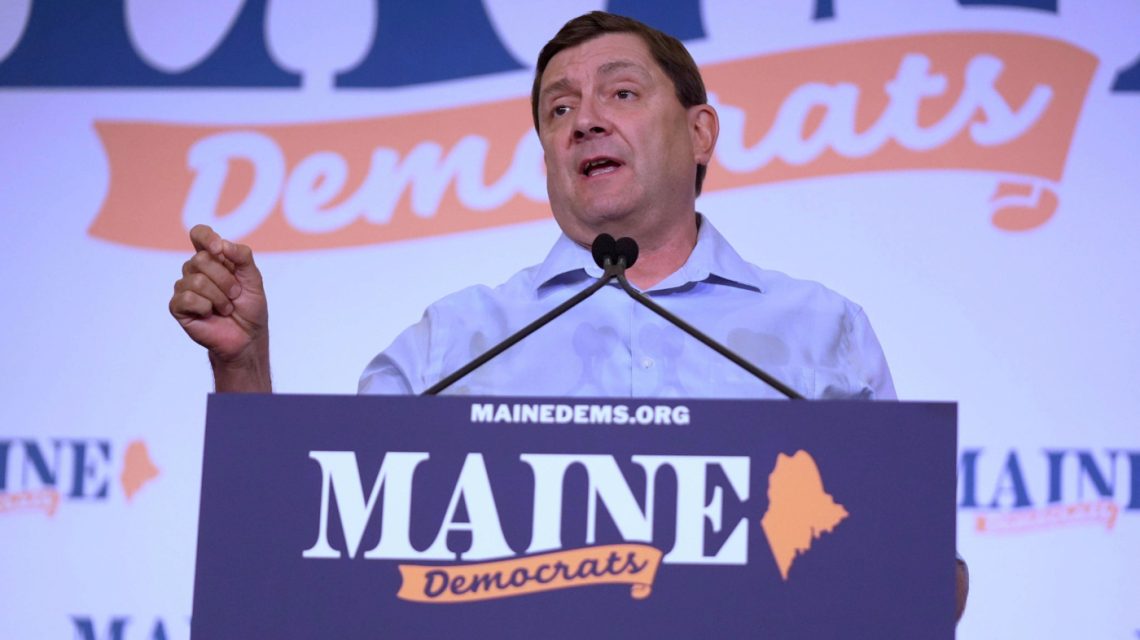
Troy Jackson, the Democratic contender for the U.S. Senate, addressed the Maine Democratic Nominating Convention on Saturday, July 25, 2026, in Bangor, Maine. As the election day approaches, Maine holds a crucial position in the nation’s political scene. The state’s U.S. Senate race could determine the Democratic Party’s ability to regain control of the Senate from the Republicans.
Maine’s voters will be informed of two crucial facts: incumbent Sen. Susan Collins’ significant financial contributions to the state and the implications of reelecting her for the Republican Party’s hold over the Senate.
The contest between Collins and Jackson transcends the qualifications of two candidates. It exemplifies the clash between established political dynamics and evolving political paradigms. The notion of traditional politics was notably championed by the late House Speaker Tip O’Neill, whose belief that “all politics is local” shaped a focus on directing federal funds to specific regions based on congressional seniority and committee leadership. As Collins has navigated this traditional landscape, she has leveraged her role since her 1996 election and her chairmanship of the Senate Appropriations Committee to channel millions into Maine. Promotional materials for Collins celebrate her acquisition of $190 million for the state’s rural hospitals, urging citizens to express gratitude for her efforts.
In contrast, the new political philosophy champions a shift where “all Politics Is National.” The transformation is evident as states deepen their partisan alignments. Maine has echoed this trend, with the last Republican to win being George H. W. Bush in 1988. Kamala Harris triumphed over Donald Trump in Maine by 7 percentage points in 2024, mirroring the Northeast’s Democratic leanings. Only Maine and Pennsylvania maintain Republican senatorial representation.
Leading the new political shift are figures like Trump and Sen. Bernie Sanders, representing diverse voter grievances. Trump resonates with older, rural, and non-college-educated voters, disillusioned by economic stagnation. Sanders appeals to young, educated urban voters, demanding action against economic inequality. Jackson embraces Sanders’ progressive stance. His political journey commenced as a Republican in Maine, with an unsuccessful attempt for the state House in 2000. He shifted party allegiance, won a Senate seat in 2008, and eventually became Senate President. Jackson endorsed Sanders during the 2016 Democratic primaries.
Jackson’s campaign gained momentum following Graham Platner’s withdrawal. Accepting the Democratic nomination, Jackson criticized Collins for her roles in corporate tax break approvals and confirmations of conservative justices who overturned Roe v. Wade. He aims to disrupt the Senate’s norms, opposing Sen. Chuck Schumer as Senate Democratic leader, advocating the abolition of Immigration and Customs Enforcement, especially post the tragedy involving Johan Sebastián Durán Guerrero in Maine, and supporting healthcare system reform toward Medicare for All.
Maine’s electorate navigates the dichotomy of old and new political ideals. Frank Bragg, an 85-year-old retired doctor, encapsulates the thoughtful shift. Formerly aligned with Collins, Bragg commends her funding initiatives but now endorses Jackson as a testament to prioritizing national integrity. Drawing parallels with Senator Margaret Chase Smith’s defiance during McCarthyism, Bragg critiques Collins for lack of similar principled opposition.
With extensive political advertising, Maine’s electoral outcome may hinge on “double haters.” Despite animosity toward both candidates, voter discontent may lean decisively toward one. Trump’s aggressive branding of Jackson as a “lunatic” contrasts Jackson’s portrayal of Collins as affluent interests’ puppet and Trump’s enabler. Collins’ hopes to attract voters willing to split their ballot are challenged by the transition from localized to nationalized political considerations, limiting such voters’ prevalence in Maine’s evolving landscape.
 Trump Criticizes Rep. Salazar Amid Election Tensions
  U.S. Space Academy Plans and States’ Competition
  A Proposal for Addressing Presidential Influence on Press Freedom
  Immigration Debate: Democrats and Republicans Face Messaging Challenges
  Insight into the Biden Administration’s Gaza Policy
  Systemic Issues Plague U.S. DOGE Service