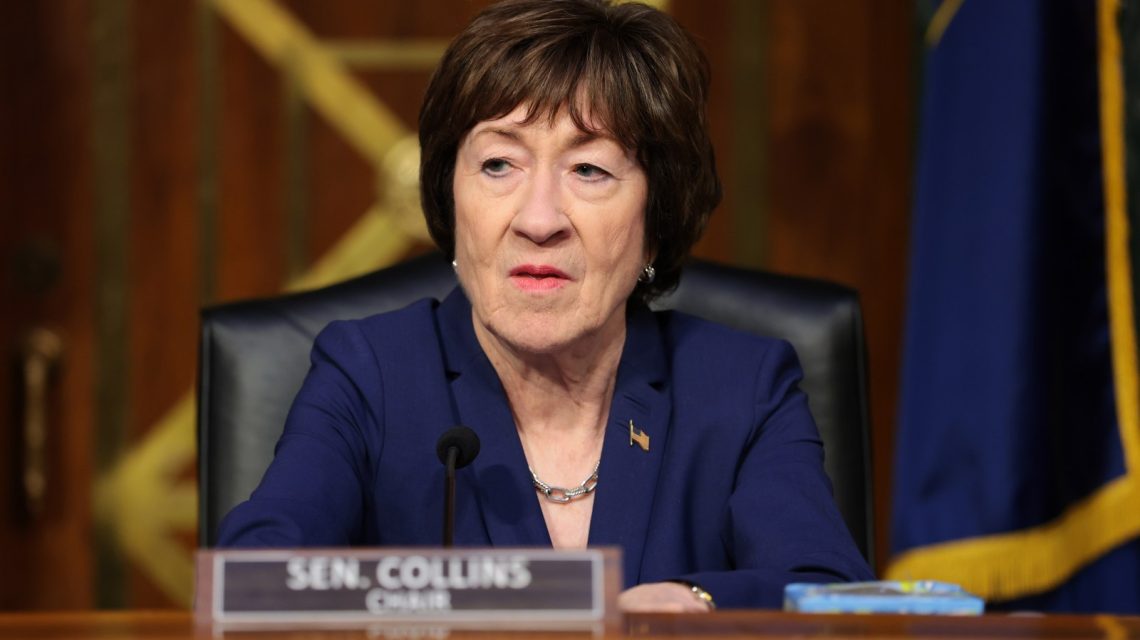
The 2026 U.S. Senate race in Maine has turned competitive with Democratic candidate Troy Jackson slightly leading incumbent Republican Senator Susan Collins. A Fox News poll conducted from August 6-10 shows Jackson ahead with 48% compared to Collins’ 46%. The poll’s 3% margin of error indicates a tight race.
In June, a poll showed Collins leading the then-Democratic nominee Graham Platner, 50% to 47%. Platner withdrew following allegations about his conduct, including inappropriate behavior and alleged sexual assault, which he denied. The recent poll surveyed 1,000 registered voters in Maine.
Although Collins is known for her moderate Republican stance and has occasionally disagreed with former President Trump, Maine voters remain concerned about her alignment with Trump’s policies. The poll reveals 55% of voters are extremely or very concerned about Collins voting in line with Trump.
Historically, Maine voters elect candidates across parties. Independent voters play key roles in their elections. Newsweek sought comments from both campaigns on Wednesday night.
Who Is Troy Jackson?
Troy Jackson’s candidacy as the Democratic nominee has significantly influenced the race. Jackson became the nominee after Platner’s withdrawal. A fifth-generation logger from northern Maine and former Maine Senate President, Jackson emphasizes his working-class background and experience representing rural areas. His roots might attract voters typically not aligned with Democratic candidates, particularly in northern and rural Maine.
What To Know
While Jackson appears competitive, Collins remains resilient in Maine. Jackson leads by two points, but this is within the poll’s margin of error. The campaigns have months to sway undecided voters.
Jackson may face scrutiny over his progressive stance and political past, whereas Collins might address her Republican ties, Trump relations, and policies. Jackson’s strongest support comes from liberals, younger adults, college-educated, and union households. He leads among voters under 45, with men evenly split between candidates.
Collins retains support among conservatives, White evangelicals, non-degree holders, and rural voters. Compared to Platner, Jackson has held sway with women, college graduates, and suburban voters, with significant gains among those under 45. Collins has lost a previous 10-point lead among men.
MAGA Republicans largely support Collins, yet her backing dips by nearly 20% among non-MAGA Republicans. Interestingly, nearly one in five non-MAGA Republicans back Jackson.
Current polling positions the Maine Senate race as a real toss-up, not a secure seat for Collins. The Cook Political Report categorizes this race as such. Jackson’s marginal lead is significant given the unique circumstances of his candidacy. Nonetheless, close margins suggest the race is open. November’s election might hinge on Collins rebuilding moderate and independent support or Jackson expanding his lead across the state.
What Other Polls Show
The University of New Hampshire’s Pine Tree State Poll gives Jackson a slight edge at 49% over Collins’ 46%, with 2% favoring another candidate and 3% undecided. The poll involved 1,178 likely voters from July 15-20, 2026, with a 2.9% margin of error. A Hart Research Poll signifies Jackson at 49%, Collins at 45%, with 6% undecided, surveying 802 likely voters from July 27 to August 1, having a 3.5% margin of error.
 Systemic Issues Plague U.S. DOGE Service
  The Scope of Accountability in Missouri’s Education System
  Faith and Politics: Democratic Candidates Embrace Religion in Congressional Campaigns
  Navigating Republican Challenges in Upcoming Midterm Elections
  Bobby Pulido: A Latin Grammy Winner in Congress?
  Illinois Struggles with Immigration Enforcement Post-Operation Midway Blitz