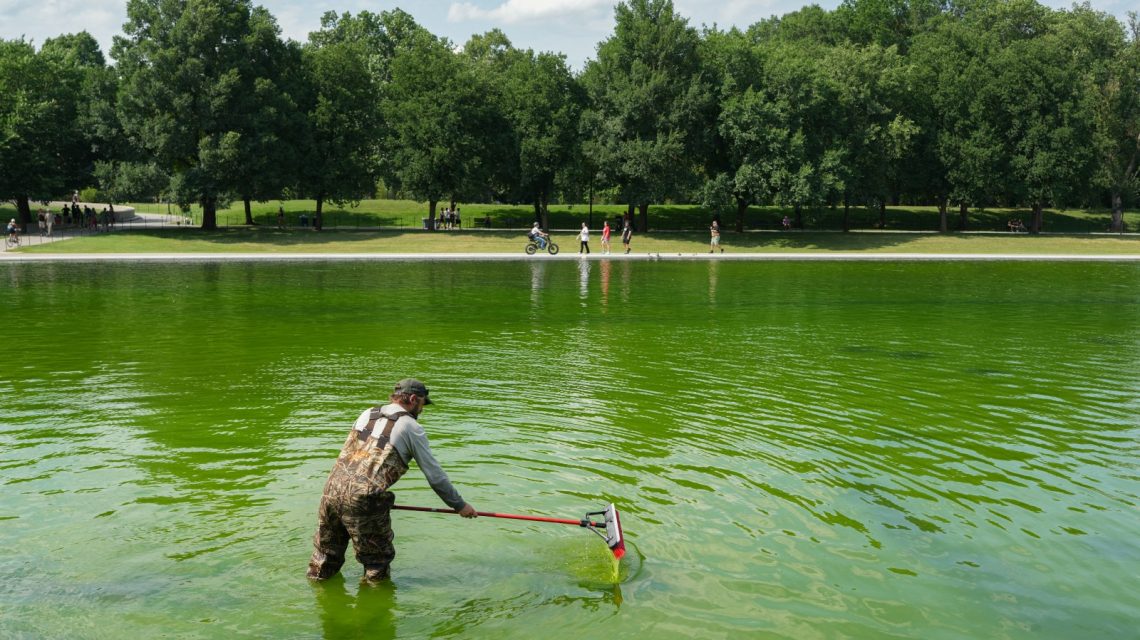
The Lincoln Memorial Reflecting Pool recently turned green, surprising many shortly after its reopening. Workers have been seen pouring hydrogen peroxide into the water to manage a rapidly spreading algal bloom. This issue arises after a costly renovation aimed to give the pool a deeper “American flag blue” appearance. This raises concerns about the possibility of mishandling and whether the chemical solution is safe.
Reasons Behind the Pool’s Algal Bloom
The occurrence of algae in the reflecting pool is not new. The pool’s shallow water, partly fed by the nearby Tidal Basin, promotes ideal conditions for algae growth. However, the rapid spread of this bloom has caught attention.
Recently, the pool underwent a process of draining, repainting, and refilling within a tight schedule. This may have left behind residual algae in the pipes and systems. It also introduced warmer water amidst early summer heat. Christopher Lowe, a marine biologist, explained that algae can quickly multiply, and conditions such as light and nutrients are key for their growth. While sunlight at the National Mall cannot be controlled, managing nutrient levels is possible.
Use of Hydrogen Peroxide
Hydrogen peroxide is a common water treatment agent that oxidizes and breaks down algae. Officials state that it is milder than chlorine, making it suitable for environments where wildlife exists. It’s used along with nanobubble ozone systems to eradicate algae and pathogens throughout the water.
Given the pool’s volume of about 6.5 million gallons, treating the algal bloom presents logistical challenges. Lowe noted that typical pool maintenance involves controlling natural cycles. Hydrogen peroxide effectively kills and bleaches the algae, helping to restore the pool’s appearance.
Challenges with Hydrogen Peroxide Treatment
The large scale of the reflecting pool raises doubts about the effectiveness of manual dosing. Videos of workers using 12 percent hydrogen peroxide suggest larger quantities are needed for significant impact. Experts emphasize careful calibration of dosage to concentration, which becomes complex at a large scale.
Cost Implications and Temporary Solutions
Hydrogen peroxide functions effectively as a short-term algaecide, but it isn’t a permanent fix. It breaks down rapidly, elevating questions regarding cost-efficiency. Frequent treatments could incur significant expenses compared to long-term strategies focusing on nutrient control and improved water circulation.
Design Considerations: Stillness vs. Circulation
Persistent challenges exist between maintaining the pool’s iconic still surface and minimizing algal growth. Warm, stagnant water favors algae, but increased circulation disrupts reflections. Recent renovations that included resurfacing may have altered thermal and nutrient dynamics, exacerbating bloom conditions.
Wildlife and Environmental Concerns
The pool interacts with birds and receives debris and runoff, complicating efforts to manage algae. While hydrogen peroxide poses no significant threat to wildlife or humans in the present ratios, algae can quickly recolonize in various ways, including being carried by birds.
Recurrent chemical use may impact ecological diversity. Although considered less harmful, relying heavily on hydrogen peroxide might render the pool an “ecological desert,” inhibiting other forms of life within the water.
 Texas Man Arrested in Shooting of 5-Year-Old Girl
  Star Meat Delivery Inc. Recalls Over 167,000 Pounds of Meat
  Debating Government Involvement in Family Homes
  Communities Continuing Recovery from Hurricane Helene Explored through Graphic Novel
  Tinley Park Updates Downtown Parking Rules
  Pastor Faces Deportation Amid Immigration Battle