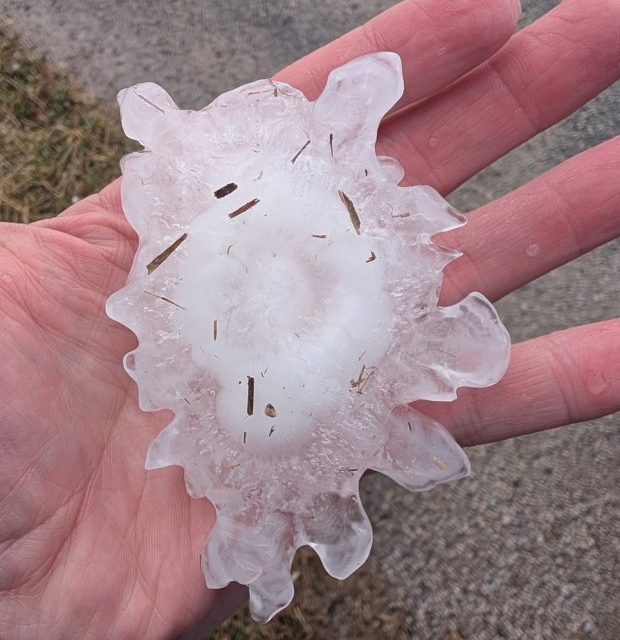
A hailstone weighing the same as a can of soup, traveling at 80 miles an hour, marked a new state record in Illinois. This hailstone was found during intense storms in a Kankakee backyard this March. Measuring 6.6 inches, it broke the previous 11-year record of a 4.75-inch stone, confirmed by the National Oceanic and Atmospheric Administration.
The verification process took six months, with Illinois state climatologist Trent Ford leading the evaluation. Ford noted the record capped a hectic year for weather. Meteorologist Victor Gensini from Northern Illinois University remarked on the unusual frequency of severe storms, including a record number of over 200 tornadoes in the state by June. Some areas in northeast Illinois and northwest Indiana remain without power following recent storms.
A 2024 study led by Gensini found that global warming is likely to increase the frequency of hailstones bigger than golf balls. This will increase severe weather impacts and property damage across the country. In the Midwest, Ohio Valley, and Northeast areas, days with severe hailstorms could rise by five days mid- to late-century.
Hail forms when icy pellets rise into the upper atmosphere, collecting supercooled water. When they become too heavy, they fall. A warmer climate intensifies this process, resulting in stronger hurricanes that suspend larger hailstones. Gensini stated, “Our changing weather patterns can support larger hail with more heat and humidity.”
The plausibility of breaking the hailstone record required confirming meteorological conditions. According to Ford, the March 10 ordeal created at least five or six stones potentially capable of setting a new state record. Gensini found one nearly 5 inches himself, surpassing the previous long-standing record. That day, the region reported several potential record-breaking stones, prompting even more discussions on severe weather patterns in Illinois.
“There were probably larger stones that day,” Gensini noted. “This was one that someone preserved.”
Gensini, who initially sought large hailstones across the Central Plains, humorously acknowledged finding the largest near Kankakee. Holding the hailstone is akin to holding history. Gensini cherished preserving this hailstone at the university, calling it “one of one.”
Understanding conditions in the clouds, rather than just by ground evidence, is complex. Hailstones often grow by merging, and scientists must ensure they did not form as smaller stones fusing together, affecting the interpreted strength of storms. Northern and central Illinois had suitable conditions during the March event, featuring a warm, humid air mass coupled with a violent supercell storm.
Moving forward, Ford stated these studies on larger hail are vital for improving building codes, insurance rates, and better roofing practices. The Insurance Institute for Business and Home Safety, involved in documenting the 6.6-inch record, has highlighted the destructive potential hail presents year after year. Hail causes 60%-80% of severe thunderstorm damage annually.
Tragically, tornadoes often overshadow hail damage due to their lethal nature; hail’s consistent toll is significant. Despite tornadoes often grabbing attention, comprehensive strategies are needed to address hail’s mounting impact on property, especially as recent insurance data reflect increased claims and repair costs due to storm damage.
Ford concluded that the record serves both for scientific curiosity and groundwork for future preparedness in tackling advancing hailstorm threats.
 Personal Journey in Understanding Neurodegenerative Diseases
  Great Lakes Face Beach Hazards Due to Dangerous Currents
  Surprising Encounter with Gulf Sturgeon in the Suwannee River
  Potential Impact of Tropical Storm Polo on Southern California
  OpenAI’s Complex Solution to Navier-Stokes Equations Stirs Debate
  Reassessing the Central Role of Rome in the Roman Empire’s Road Network