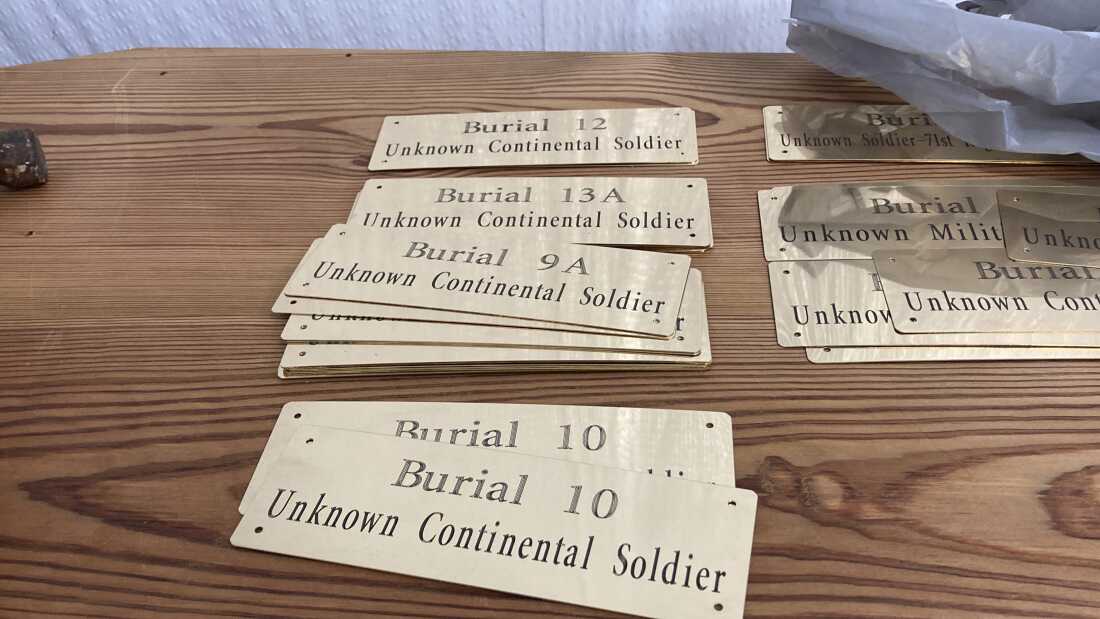
On March 30, 2023, plaques to commemorate 14 unknown soldiers discovered at the Battle of Camden site were observed in Columbia, South Carolina. DNA analysis has recently identified one of these soldiers.
Pvt. John Pumphrey, who enlisted in the 7th Maryland regiment as a teenager in 1777, played a significant role in early American history. He participated in battles such as Brandywine, Germantown, and Monmouth. His service included enduring harsh winters at Valley Forge and Morristown before heading south to confront British forces. In August 1780, Pumphrey was killed at the Battle of Camden, left in a shallow grave.
“This is absolutely a miraculous discovery for us,” remarked Nancy White, a distant relative contacted through DNA testing.
In 2022, the University of South Carolina archaeologists unearthed Pumphrey’s remains and sent them for DNA analysis to determine his identity. FHD Forensics then matched the DNA with genealogy records. Among many matches was Nancy White, who discovered Pumphrey was her fourth great uncle.
FHD President Allison Peacock explained that three DNA analyses were used, resulting in 20,000 matches with modern relatives. Nancy White, with her sisters, had already opted into a DNA database. They were aware of the Pumphrey line but believed that branch, being predominantly Quaker, wouldn’t have fought in the war.
Peacock highlighted Pumphrey’s situation, noting he lost his parents young and enlisted as a teen, possibly seeing the army as his home. He even re-enlisted, which was rare given many soldiers returned to farming.
The identification process included collaboration with family members who provided records. Peacock emphasized the quality of the DNA matches despite the generational gap.
Archaeological Find in Camden
James Legg and USC colleague Steve Smith led the excavation of 14 sets of remains at Camden. Known reports of possible remains guided them, yet the COVID-19 pandemic spurred deeper exploration. Metal detecting led to discoveries like musket balls and buttons that pointed to shallow burials.
Legg noted two sets of remains were nearly uncovered, suggesting graves dug by imprisoned Continentals using minimal tools. Rick Wise of the South Carolina Battleground Preservation Trust explained they likely used hands and sticks.
Continuing Searches and Historical Insights
Peacock is now tracking relatives for another soldier from Camden, to whom she is related. This revelation came as a surprise, reaffirming the connection between historical events and modern genealogy.
Wise provided insights into Pumphrey’s last battle, where the Continental Army faced a two-to-one disadvantage. The left side of the line managed to retreat, but Pumphrey and his companions on the right were overwhelmed. The graves hint at soldiers depending on one another until the last moment, with the oldest likely being a noncommissioned officer.
 150 Years Since the Battle of the Little Bighorn
  Danube River’s Record Low Levels Reveal WWII German Battleships
  Dudley Laufman: Revivalist of New England Folk Dancing
  Duneland Area Celebrates Brown Mansion Restoration
  The Unseen History of Interstate 5 and Tejon Pass
  Chicago Area Events on July 31