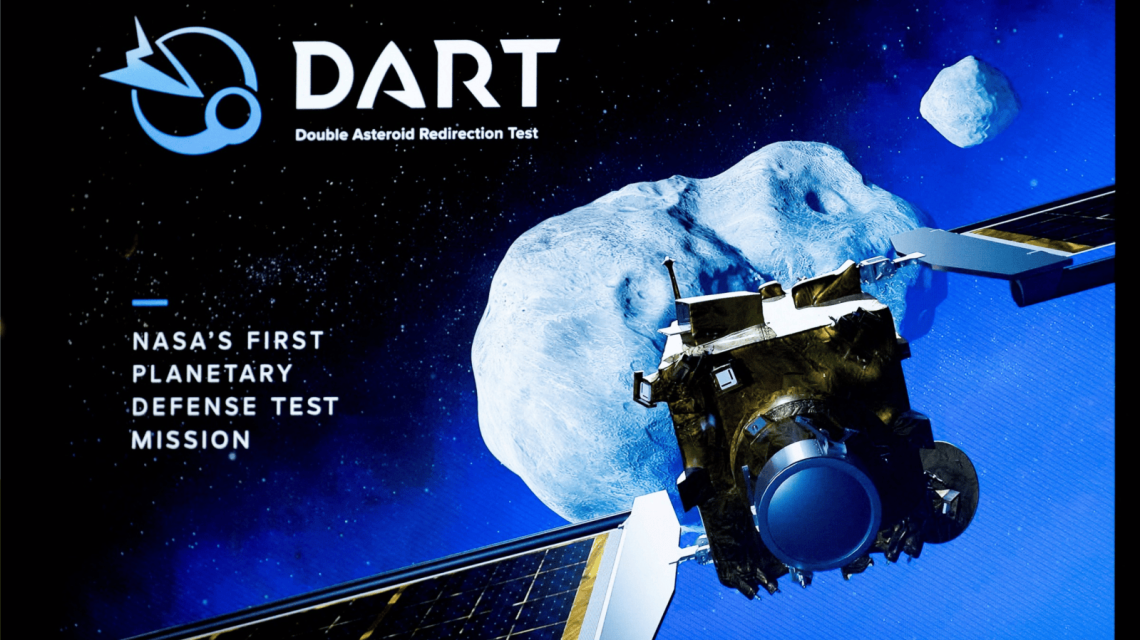
Humanity is poised to gain its first detailed view of an asteroid after NASA’s successful mission to redirect its path by crashing a spacecraft into it. The European Space Agency’s (ESA) Hera spacecraft has reached the Didymos asteroid system following a two-year journey. ESA will unveil Hera’s initial close-up images of Dimorphos, the small asteroid targeted by NASA’s Double Asteroid Redirection Test (DART) in 2022, on Wednesday, November 25.
The images are expected to shed light on the impact of the DART mission. They may also indicate whether intentionally hitting an asteroid might help protect Earth in potential future scenarios. The Hera mission, which began on October 7, 2024, aims to closely examine Dimorphos and its larger companion, Didymos. It will assess the effects of the DART collision. ESA plans to use this information to refine the DART experiment into a replicable technique for asteroid threat mitigation.
Ian Carnelli, overseeing the Hera mission, noted, “DART and Hera were designed as a coordinated dual-spacecraft mission, with one performing the deflection and the other conducting precise measurements.” Newsweek reached out to Carnelli for further comments.
Didymos and Dimorphos form a binary asteroid system, with the smaller asteroid orbiting the larger one. Didymos has a diameter of about 780 meters, comparable to the Burj Khalifa. Dimorphos measures roughly 151 meters across, akin to the size of the Eiffel Tower. Before the DART mission, Dimorphos circled Didymos at a distance of about three-quarters of a mile and completed its orbit every 11 hours and 55 minutes.
NASA’s Intention Behind the Crash
On September 26, 2022, NASA sent the DART spacecraft crashing into Dimorphos at 14,000 miles per hour. This marked the first full-scale test aiming to change an asteroid’s trajectory through space. By striking an asteroid with a spacecraft, scientists intended to generate a small push. Over time, this could redirect the asteroid enough to avoid a collision with Earth. Though Didymos and Dimorphos posed no threat to Earth, they served as a testbed for this technology.
NASA Administrator Bill Nelson emphasized the mission’s objective, stating, “This mission shows that NASA is trying to be ready for whatever the universe throws at us.” Observations indicated that the collision reduced Dimorphos’s orbital time around Didymos by about 33 minutes. It became the first solar system object to have its path measurably altered by human intervention.
The DART impact resulted in over two million pounds of rocky debris being ejected into space, equivalent to filling several rail cars. The change in Dimorphos’s orbit exceeded scientific predictions. Now, Hera will investigate the substantial effects of the collision and analyze how it altered the asteroid’s properties.
Researchers hope to uncover details about Dimorphos’s subsurface and assess how the crash influenced its shape. They also seek to measure how effectively DART’s kinetic energy translated to the asteroid. ESA previously noted that DART might have created a 20-meter crater on Dimorphos, but Hera’s data aims to verify this and other questions.
Where to View the New Images
ESA will release the close-up images of Dimorphos during a livestream on November 25. The broadcast will be accessible via ESA WebTV, ESA’s YouTube channel, and their official website. While scientists have already studied close-up imagery of the larger Didymos, Dimorphos remained within its shadow. The upcoming release promises the first detailed view of Dimorphos since DART’s collision in 2022.
 Pentagon UFO Investigation: Evaluating Evidence of Black Triangular Objects
 Scientists Uncover How Bacteria Create Cancer-Fighting Compounds
 Chicago’s Rookery Building: A Landmark in Skyscraper Evolution