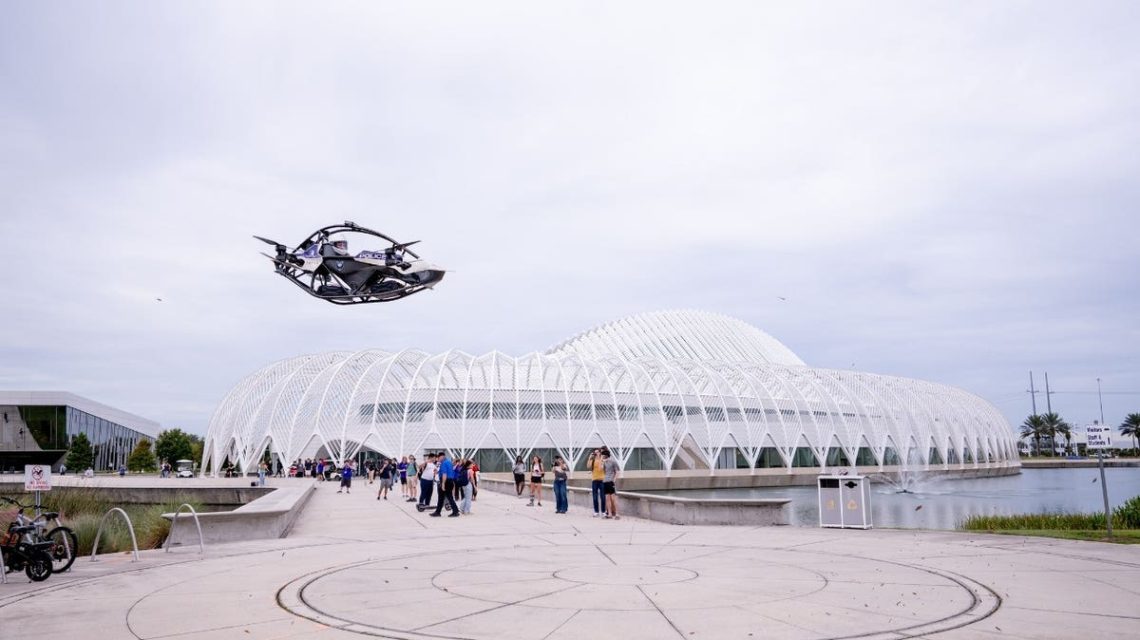
Florida Polytechnic University Police Department in Lakeland has introduced an innovative flying patrol vehicle named Astro. Built by Jetson, the company behind the Jetson ONE personal flying machine, this single-seat electric aircraft resembles a giant drone. According to the university, it is the first U.S. law enforcement agency to incorporate such a piloted electric aircraft into its fleet. Jetson claims this represents a world first. However, Astro requires FAA approval before being deployed for police patrols.
Astro’s Features and Capabilities
Drawing its name from the dog in the classic cartoon The Jetsons, Astro boasts electric vertical takeoff and landing technology, or eVTOL. This allows it to ascend vertically without a runway. In contrast to traditional police helicopters, Astro’s compact frame folds for easy transport and storage. The aircraft includes an open cockpit surrounded by a lightweight frame and is powered by eight electric motors and propellers. A four-axis joystick lets the pilot navigate the vehicle.
Florida Polytechnic University chose the Jetson ONE to explore its potential in law enforcement. The aircraft was delivered in the summer of 2026. Police personnel, including Chief Aaron Murray, have completed flight training. Jetson has identified the aircraft with the registration number N911FP, hinting at its emergency services role and Florida Polytechnic University. Enhancements like police lights, a handheld radio, and action camera mounts have been added. Potential future features include a pilot-controlled searchlight.
Performance and Limitations
Astro, despite its small size, delivers impressive performance with its ability to reach speeds of 63 mph. This speed allows it to cover short distances quickly across a large campus, bypassing road traffic. However, its battery life limits flight to approximately 20 minutes per charge. Charging time varies: around 90 minutes with a 240-volt connection and about three hours using a standard household outlet. Officers can substitute batteries between flights for quicker return times.
The 210-pound weight limit, which includes the pilot and gear, restricts how much equipment can be carried. Safety features include the ability to fly even with one motor failure, an automatic landing system, and a ballistic parachute. The aircraft’s cost is set at $148,000 pre-tax.
Applications in Emergency Response
The university is investigating Astro’s use when roads are impassable due to floods or debris, typically after major storms. Once conditions permit, a vertically takeoff aircraft like Astro could assess damage efficiently. Police Chief Aaron Murray is keen to see if the aircraft can monitor the campus and access hard-to-reach areas. The department also plans to explore delivering emergency supplies using Astro.
The vehicle’s single-seat limits its task in rescue missions as it cannot transport people or carry significant supplies. Collaborative efforts with regional law enforcement might see its application in various emergency scenarios.
Regulatory Challenges
Jetson designed the ONE as a recreational aircraft conforming to the FAA’s Part 103 ultralight rules, which don’t require traditional certifications for aircraft or pilots. But these rules confine use to recreational purposes, not police patrols. Florida Polytechnic University is seeking additional authorization under FAA Part 91 for public-safety missions, with expected approval in late 2026.
Future Developments and Student Involvement
Besides potential police duties, Astro serves as a research platform for hands-on learning in the university’s new aerospace engineering program started in fall 2026. Students and faculty will study flight data for research and senior projects. Virtual training simulations are also planned to provide insights into aircraft performance during missions, highlighting operational challenges.
The SunTrax transportation testing facility nearby will host emerging aircraft technology tests, with statewide advanced air mobility testing set for late 2026. This separates from Astro’s authorization process.
Potential for Other Departments
Astro suggests new possibilities for law enforcement beyond traditional helicopters, which require extensive resources. A smaller electric aircraft presents an alternative for certain missions but also comes with limitations. The short flight duration demands well-planned missions and reliance on battery swaps for continuity. Weather and airspace restrictions may also affect its operation.
Astro’s practicality against drones, which can perform surveillance without a human pilot, remains a debate. Nonetheless, Jetson views this development as a key step toward integrating personal electric aircraft into professional settings. The company’s 2026 and 2027 production is sold out, with 2028 orders now open at $148,000. Astro is also slated for display at the public UP.Summit event at Kennedy Space Center, Florida.
Implications for Communities
While you might not see flying patrol vehicles in your vicinity immediately, Astro showcases how small electric aircraft might be used by public safety agencies. Aerial surveys post-storm can aid in understanding and responding to damage. The same technology might assist in searching for missing people, provided Astro proves itself in real operations.
Concerns around privacy as police adopt aerial technology are valid. The public may inquire when and how police aircraft operate overhead. Addressing privacy concerns is crucial alongside exploring technological benefits. Florida Polytechnic University’s active study and FAA collaboration represents a move toward a new emergency response model.
 Amazon Enlists NYC Customers Against City Council Bill
 The Controversy Surrounding Jensen Huang and Nvidia
 GAO Finds Federal Agencies Lacking in Cybersecurity Planning
 Grand Theft Auto VI Sparks Relationship Challenges
 AI and Robotics Redefining Workforce Skills
 Cybersecurity Breach Exposes Bank Customer Data