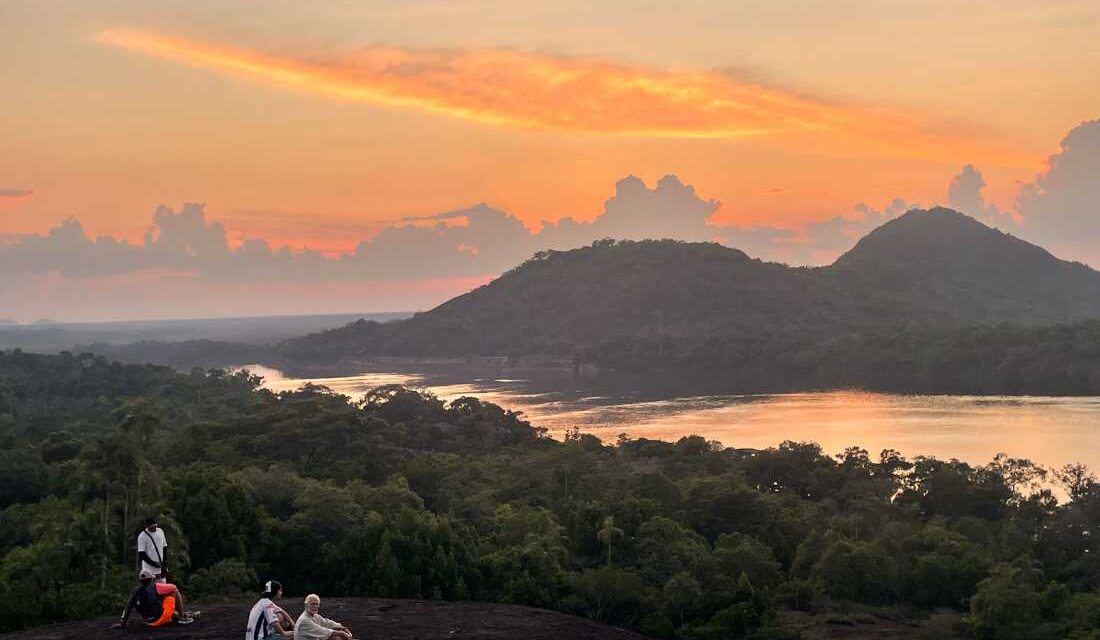
As the sun sets, it casts a warm glow over the remote Mavecure Mountains in Colombia. These towering rock formations rise majestically above the Amazon jungle.
In the early morning hours of the Amazon rainforest, the sounds of nature fill the air. Howler monkeys, parrots, and frogs serve as a natural alarm clock. Accompanied by friends from the U.S., I find myself in eastern Colombia, close to Venezuela. The landscape appears to be flat and green, stretching to the horizon.
However, our hike reveals the dramatic emergence of three massive rock formations from the jungle floor, reaching about 2,000 feet in height. These structures are known as the Cerros de Mavecure. Composed of sandstone, shale, and quartz, these buttes are barren and rounded at the top. They bear a resemblance to Sugarloaf Mountain in Rio de Janeiro, though their name, “Mavecure,” refers to the poison-dart blowguns used by local Indigenous groups for hunting.
I am guided by Ignacio Rodriguez, who explains that this site holds sacred significance for the Puinave and Curipaco Indians. They frequently climb these ridges to offer prayers to the spirits. Marcela Sánchez, an industrial engineer from Cali, expresses her admiration, calling the view “divine.” Climbing to the top of the smallest peak in the heat requires a couple of hours and a lot of effort. The hike includes guide ropes, ladders, and scenic overlooks for rest and hydration.
Reaching the summit of Mavecure offers immense satisfaction. The vista showcases the surrounding jungle and two larger peaks in the distance. Colombia, beyond its Amazon rainforest, boasts Caribbean beaches and three Andean Mountain ranges. This biodiversity positions the country as a haven for bird watchers, with 1,900 bird species, more than any other nation.
In recent decades, Colombia was beleaguered by guerrilla warfare and drug-cartel violence, deterring tourists. The scenario began changing with the 2016 peace treaty with cocaine-trafficking rebels. In the first eight months of 2025, Colombia welcomed a record 3.1 million international visitors. Delio Agapito, the mayor of Remanso, emphasizes tourism as the local economy’s primary driver.
Many people near Mavecure have transitioned from gold mining, which polluted rivers, to tourism-related occupations. Fabio Pérez, a former gold miner, now operates a hostel and sells honey from his apiary project. “My family’s life has improved,” Pérez shares, describing his joy at no longer having to leave them for extended periods.
Despite its charm, Mavecure sees fewer visitors than popular Colombian destinations like Cartagena or Medellín. Limited access, with only rivers as entry points and sporadic flights, poses challenges. Rustic bunkhouses accommodate those who venture here. “Tourism here is still very small-scale,” says Fernando Carrillo of Aroma Verde, advocating for sustainable tourism.
While climbing, our guide, Rodríguez, advises caution when grabbing branches, which may have thorns. Thankfully, the dry season keeps snakes at bay. Near the mountain top, we meet a few other climbers. Their guide finds edible rainforest ants, which Sebastián Rivera, a Colombian anesthesiologist, samples, describing it as having a lemon-like taste.
Following the other tourists, we eventually reach the summit. The view delivers a stunning panorama of the jungle and the winding Inírida River, punctuated by the other Mavecure peaks. “This is a dream come true,” says Catalina Laverde, a Colombian lab technician. Rivera, impressed by the solitude of these mountains, appreciates the lack of commercialization. “Here, it’s not the five-star resort, but these natural wonders are worth it,” he notes.
 Affordable Halloween Decorations for a Spooky Yard
  Historic Church Transformed Into Los Angeles Boutique Hotel
  Luggage Etiquette on Cruise Ship Elevators Sparks Debate
  Heightened Travel Advisory: Stay Cautious in Italy
  Ohio State Visits Texas: Saturday Activities and Match Preview
  Rising White Shark Presence Boosts Cape Cod Tourism