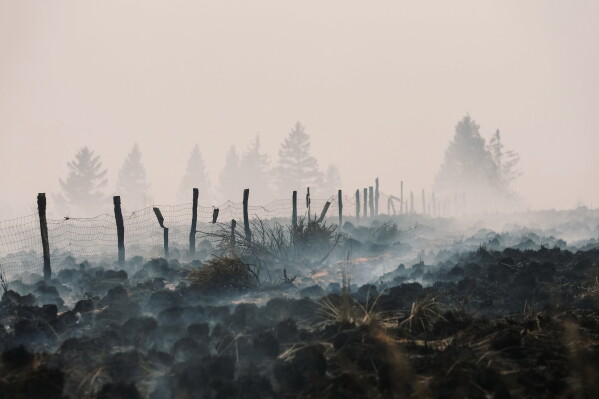
Across Europe, summer wildfires have unveiled a dangerous threat: dormant bombs and mines from World War I and II, now awakened by intense heat. Unexploded ordinances have been reported exploding in countries like France, Belgium, Germany, and the Netherlands, forcing bomb disposal teams into action.
In Belgium, near Limburg province, a bomb-disposal team checked a forest threatened by flames, where significant fighting occurred in 1944. Smoke was seen rising from the scorched fields, highlighting the danger firefighters face as they encounter hidden munitions.
“Climate change is now doing the work of unburying and reactivating what was previously stable,” said Sarah Njeri, a peace and conflict scholar at London’s School of Oriental and African Studies.
Fires reveal and ignite old munitions, influenced by climate change effects such as increased temperatures and unpredictable rainfall. This reality has marked this year’s wildfire season, which began after heavy rains in January nurtured vegetation growth, transforming it into kindling in the summer heat.
Fires Expanding Over Known Battlefields
Flames have surged through historic battlefields, uncovering lethal remnants. In southwestern France, a large wildfire near Bordeaux unveiled World War II-era ammunition concealed underneath. In Belgium’s Liege province, sporadic detonations were heard, prompting emergency services to adapt their strategies.
Photos emerged of firefighters handling rusted bombs, stirring concerns over safety. The High Fens, a dense peat-bog forest where booby traps and bombs were placed during WWII, remains a focal point. Here, unexploded munitions caused civilian deaths post-war.
A local historian, Bernard Collard, who operates near Belgium’s Germany border, continues scanning these former battlefields, now forests and pastures, unearthing historic items like mortar shells, machine guns, and even human remains.
Explosive Responses in Belgium
Each year, Belgium fields thousands of calls to address leftover munitions from past wars. The Explosive Ordnance Disposal and Destruction Service manages over 3,000 reports annually, dismantling 200 to 250 tons of war armaments.
Collard collaborates closely with demining squads, recognizing this dangerous history as an enduring aspect of his region. Farmers in western Belgium, particularly near Ypres, regularly uproot war relics, naming the experience “the iron harvest.”
Water Levels Reveal Hidden Dangers
Wildfires are just one threat. Drought conditions across Europe have reduced rivers and lakes, exposing more munitions. In Slovakia, the Danube River revealed naval mines, prompting police to conduct controlled demolitions. Similarly, receding waters in Hungary and Germany surfaced WWII-era bombs.
Christina Greene, a University of Arizona researcher, acknowledges the resurgence of war legacies due to these environmental changes; noting the struggle against unexpected reminders of past conflicts.
 Don McCullin’s Final Book: A Pioneering War Photographer’s Legacy
  Rep. Alexandria Ocasio-Cortez Defends Macklemore Amid Tour Controversy
  Google Fined for Breaching EU Privacy Rules
  South China Sea Tensions Rise after Collision between Chinese and Philippine Ships
  North Korea’s Hypersonic Weapon Test Amid Global Tensions
  Austin Tice: A Search for Answers