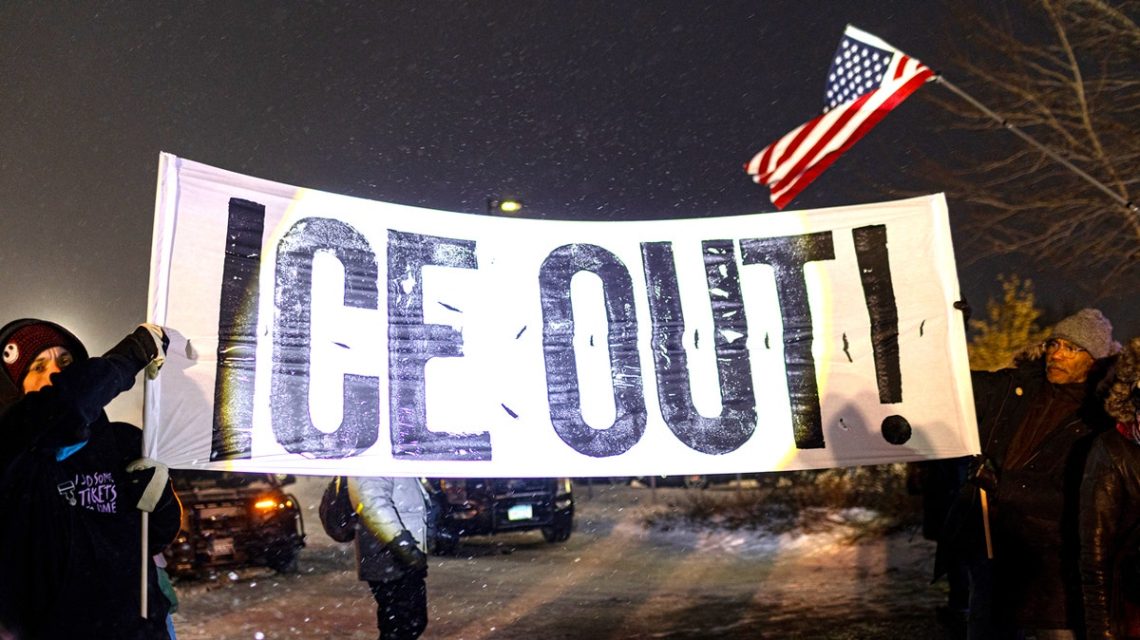
The Department of Homeland Security (DHS) has accused Minnesota officials of engaging in a “political stunt” amid a dispute over whether a U.S. Immigration and Customs Enforcement (ICE) agent should face prosecution in state or federal court. The case involves Gregory Morgan Jr., an ICE agent charged with two counts of second-degree assault following a traffic incident in which he allegedly pointed a handgun at motorists.
Morgan’s defense, supported by federal authorities, asserts that he is shielded by legal doctrines related to the Supremacy Clause of the U.S. Constitution. This clause establishes that federal law takes precedence over conflicting state laws. Courts have historically recognized that federal officers may be immune from state prosecution when performing official duties. However, Minnesota prosecutors argue that these protections do not apply in Morgan’s case, claiming his actions were not related to any legitimate federal law enforcement duties.
The situation has escalated into a broader debate about the legal safeguards for federal officers. Hennepin County prosecutors are determined to keep the case in state court, while federal officials are supporting Morgan’s push to transfer it to federal court. The Department of Justice has filed a request for Senior Trial Attorney Paul Quast to represent the United States in the matter.
“These actions by Minnesota sanctuary politicians are nothing more than a political stunt,” a DHS spokesperson stated. “States do not have the authority to charge a federal law enforcement officer while performing official duties.”
This statement followed the Hennepin County Attorney’s office urging a federal judge to deny Morgan’s request to transfer the case out of Minnesota state court. In recent court filings, prosecutors contend that Morgan is trying to convert his “moment of road rage” on a state highway into a federal enforcement action.
The filing, supported by the Institute for Constitutional Advocacy and the Washington Litigation Group, argues there is no substantial link between the alleged assault and Morgan’s role as an ICE agent. Prosecutors emphasize that Morgan’s arrest authority did not include confronting motorists on a Minnesota highway.
According to the prosecutors, Morgan’s decision to drive on the highway shoulder and brandish a firearm during the incident was not job-related. The confrontation took place on February 5 as Morgan, returning to the Whipple Federal Building at Fort Snelling after Operation Metro Surge, encountered traffic on Highway 62 near Interstate 35W. Authorities allege that Morgan, driving on the highway shoulder during rush hour, was blocked by a Cadillac, prompting him to draw his handgun.
One motorist reported to 911 that a man had aimed a Glock at him, and both occupants voiced concern for their safety. Morgan faces two counts of second-degree assault and was released on $100,000 bail.
Morgan’s legal troubles are not isolated; another ICE agent, Christian Castro, also faces assault charges related to the shooting of Julio Sosa-Celis, igniting protests in north Minneapolis. Fox News Digital has contacted the Justice Department, the Hennepin County Attorney’s office, and Morgan’s attorney, Ryan Pacyga, for comments.
 Senator Criticizes Drug Policy After Ohio Tragedy
  Search Intensifies for Missing Washington, D.C. Mother
  Supreme Court Blocks New Postal Service Mail Voting Rules
  Santa Barbara Man Admits to Courthouse Bombing in Retaliation for Seized Firearms
  Federal Investigation Into Ilhan Omar’s Immigration Allegations
  Calumet City Clerk Sues for Damages Following Dismissed Lawsuit