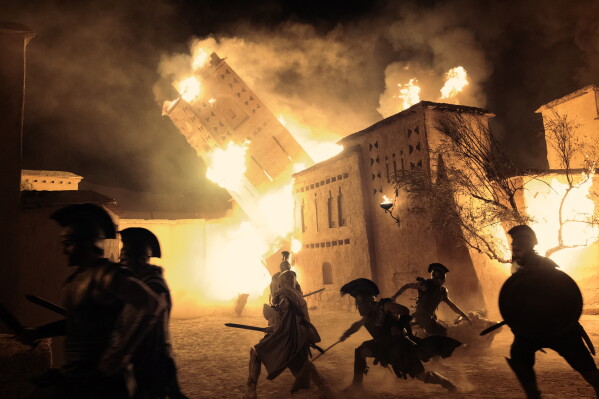
Christopher Nolan, known for films like “Oppenheimer,” “Inception,” and the “Dark Knight” series, has long cherished the dream of utilizing IMAX technology since childhood. His fascination began after experiencing nature documentaries at Chicago’s Museum of Science and Industry. The culmination of this dream is his latest feature, “The Odyssey,” the first film ever shot entirely on IMAX film.
An IMAX First
Nolan’s journey toward this accomplishment spanned many years. The challenge had been the noise of IMAX cameras, which hindered use during dialogue-heavy scenes. After “Oppenheimer,” a breakthrough came with a development called “the blimp,” which muffled the camera noise. The IMAX camera, The Keighley, was named in honor of Patricia and David Keighley, key figures in IMAX’s history. Nolan dedicated the film to David Keighley, who passed away shortly after the project wrapped up.
Filming with IMAX had its hurdles. The blimp-encased camera weighed 300 pounds, required frequent reloading, and needed a mirror system to aid actors’ interaction during scenes. All technical efforts aimed to provide viewers with “something special,” Nolan noted.
While audiences have various options to view the film in theaters, including IMAX 70 mm, 70 mm, and others, Nolan explained the significance of these formats in an interview. He shared his preferred theater seating to help audiences make informed choices without needing extensive film knowledge.
The Visual Impact
Nolan emphasized the unique experience that IMAX offers. His films, including “Dunkirk,” “Tenet,” and “Oppenheimer,” utilize large format film stock, delivering unmatched clarity and depth. Shooting in IMAX 70 mm allows the screen to “disappear,” immersing viewers without needing 3D glasses.
IMAX film’s technical superiority stands out, offering resolution nearly 10 times higher than 35 mm projection. Nolan clarified that while films are shot on 65 mm and projected at 70 mm for visual enhancement, technical advancements no longer require reserving space for soundtracks.
Shooting Techniques
Since “The Dark Knight,” Nolan’s team has employed a method called “center punching the action.” This technique ensures no loss of visual information across different formats. Cinematographer Hoyte van Hoytema takes note of frame lines suitable for various screens, maintaining the film’s integrity in diverse theatrical presentations.
Nolan’s Preferred Formats
For the most immersive experience, Nolan recommends IMAX 70 mm film presentations, available in select theaters across the U.S. and Canada. Locations like AMC Universal CityWalk in Los Angeles and AMC Lincoln Square in New York have seen significant demand. Other theaters, such as Cinemark 17 in Dallas and Regal King of Prussia near Philadelphia, also feature this format.
Despite the rarity of IMAX 70 mm, more common digital presentations remain highly satisfying. These include IMAX digital and exhibitor PLF formats, providing audiences with a quality experience across diverse screens. Nolan’s team ensures a seamless transition to digital formats, preserving the high-quality imagery.
Theater Seating Preference
Nolan shared his seating preferences in theaters. For CinemaScope ratios, he favors sitting near the front in the third row’s middle. In IMAX 1.43:1 stadiums, he prefers being slightly behind the center line, seated in the middle.
This story has been updated to note the release of “The Odyssey” and the technological advances allowing the use of IMAX film.
 Melanie Griffith Reflects on Wellness Retreat and Career Legacy
  Jennifer Aniston’s Relationship Insights from Relationship Experts
  Kim Kardashian Shares Esophagitis Diagnosis Amid Personal Concerns
  Duncan Sheik, Singer-Songwriter and Broadway Composer, Dies at 56
  Engelbert Humperdinck Reflects on Life-Saving Shoelace During Army Service
  Chad Gilbert of New Found Glory Dies at 45