
Beijing – Chinese Valentine’s Day, known as Qixi, extends far beyond gifts of flowers and chocolates. While modern couples may enjoy romantic gestures, Qixi is rooted deeply in legend, prayers, and cultural practices that remain significant. Observed on the seventh day of the seventh month in the Chinese calendar, this festival fell on August 19 in 2026. It is also celebrated in countries like Singapore and Vietnam.
Beijing’s Folk Custom Museum engaged visitors on Wednesday with activities under a program titled “Asking for Skills.” This embodies a key tradition of Qixi, where women historically prayed for skillfulness and demonstrated their abilities in crafts. Jia Juan of the museum’s Public Education Department emphasized, “We hope young audiences learn the meaning of our traditional festivals through engaging experiences.”
The museum, located in Beijing’s Dongyue Taoist Temple, has hosted Qixi-related activities for 14 years, welcoming about 500 participants each time. The day’s program began with Chinese classical music performances followed by interactive family activities based on Qixi customs.
Visitors explored dyeing fingernails with garden balsam, a natural pigment associated with beauty and blessings. Another activity involved Song brocade bead painting. This craft uses precious Chinese silk fabric combined with pearls to symbolize completeness and good fortune. Participants created their own Song brocade pearl paintings, embodying “qiqiao,” a concept focused on skill and dexterity.
Wang Xuejie attended with her 7-year-old daughter, engaging in making “qiaoguo,” a decorative pastry. She noted, “We gained an understanding of how, in ancient times, Qixi allowed girls and women to express aspirations and hopes for growth.”
A Love Story in the Stars
According to Jia, Chinese girls began practicing qiqiao during the Tang and Song dynasties, which spanned the seventh through the 13th centuries. “The history of the Qixi Festival traces back to ancient star worship and study,” she explained.
Qixi traditionally focuses on two elements. One is romantic, linked to the legend of Zhinü and Niulang. Zhinü, represented by the Vega star, fell in love with Niulang, the Altair star. Forbidden to be together, their love story concludes with an annual reunion on a magpie-formed bridge on the seventh day of the seventh lunar month.
Records of this legend date back to the pre-Qin period, before 221 B.C. During the Han Dynasty, customs related to qiqiao began evolving.
Women Carry Qixi Abroad
Researcher Lynn Wong aims to revive Qixi in Singapore with an initiative named Qixi Fest, a multi-day event initiated in 2023. The festival seeks to spark childhood memories among Singaporeans, echoing their ancestors’ experiences.
Wong recalls discovering Qixi through conversations with friends and elders, documenting their memories in a book. Qixi arrived in Singapore in the 1930s via Chinese women migrants, mainly from Guangdong. These practices and beliefs gradually faded.
As Wong observed, her generation lost cultural roots growing up with stories like the Tooth Fairy and ‘Hansel and Gretel,’ neglecting ancestral tales.
For One Family, Qixi Endures
Hor Xin Hao, of Cantonese descent, continues traditional Qixi practices in Singapore. On the sixth day of the seventh lunar month, his family sets a prayer table under the night sky, praying past midnight and making offerings to the Seven Maidens, including the Weaver Girl.
They offer incense, flowers, perfume, cosmetics, and soap, believed to enhance beauty and charm following blessings from the cowherd and maidens. Hor expressed that he believes the concept of Valentine’s Day limits the original essence of Qixi.
He sees Qixi as a celebration of values and ancestry, reflecting life’s interaction with the universe.
Associated Press video producer Olivia Zhang contributed to this report.
AP’s religion coverage, in collaboration with The Conversation US, receives support from Lilly Endowment Inc. The AP bears sole responsibility for this content.
 Baltimore Rock Opera Society Faces Scrutiny and Resignations After Director’s Dismissal
  Innovative Use of AI and Digital Technology in Restoring the Basilica of Saint Francis of Assisi
  Amir Odom: Perspectives on LGBTQ Movement and Political Identity
  The Legacy of Ken Kesey’s ‘Furthur’ Bus
 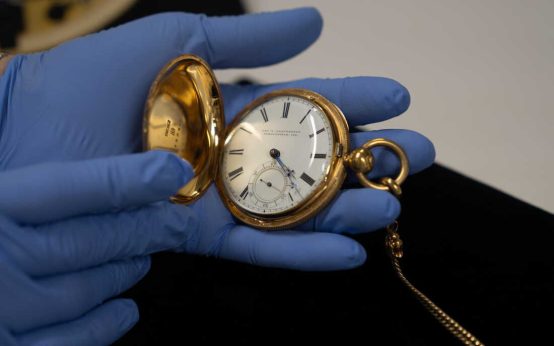 Abraham Lincoln’s Pocket Watch: A Piece of History
  Reflections on 30 Years at Fox News