
Meteorologists have recently tracked Typhoon Dolphin’s trajectory toward China, with innovative AI weather models supplementing traditional forecasting techniques. This development underscores China’s advanced role in enhancing weather prediction capabilities. Significant progress has been made with Chinese-developed AI systems, including Fengwu by Shanghai AI Laboratory, Huawei’s Pangu, and Fudan University’s Fuxi. These AI forecasting models offer quicker predictions compared to traditional methods, demonstrating comparable or superior accuracy in specific metrics.
Historically, weather forecasting relied on numerical models operating on supercomputers that simulate atmospheric physics. In contrast, AI models examine extensive histories of weather data, yielding forecasts rapidly. This technology, increasingly applied during East Asia’s typhoon season, permits enhanced preparation for flooding, organized evacuations, and management of potential transportation disturbances. AI weather forecasting now represents a new competitive field amongst tech firms, research organizations, and meteorological agencies, with China establishing itself as a prominent contributor.
Globally recognized AI forecasting tools include Google’s GraphCast and GenCast, Nvidia’s FourCastNet, and the European Centre for Medium-Range Weather Forecasts’ AIFS. Fengwu gained prominence after outperforming GraphCast in about 80% of assessed weather variables and extending global medium-range forecastability beyond 10 days.
“With more extreme weather, people need information to make decisions, both local governments, the national government, also the average person, farmers and fisherman,” said Sun Zhi, the CTO of Techwind, the company responsible for Fengwu’s industrial applications. “So we want to help provide better information so people can make decisions.”
While AI systems bring expedited and cost-effective forecasting processes, they are not poised to fully replace conventional models. According to Sun, AI models can predict typhoon paths reasonably — Fengwu accurately predicted Typhoon Dolphin’s landfall and timing within 30 minutes and 30 km — yet conventional forecasts are still preferred for storm intensity prediction and major climate assessments.
Sun expressed skepticism regarding AI systems’ capability to predict significant climate events early. Reliable forecasting of phenomena like El Niño requires long-term research to gain public trust.
As advancements continue in AI forecasting, integrating both AI and traditional methods is likely to remain crucial.
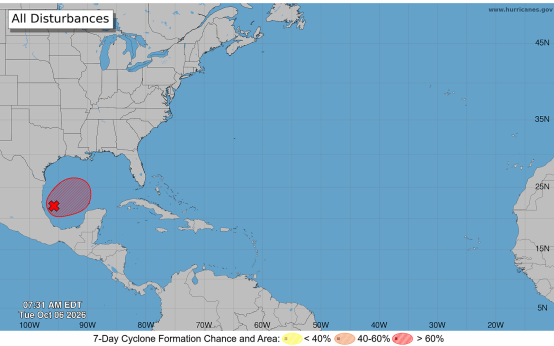 Tropical Storm Isaias Expected to Develop in Gulf of Mexico
  Coyotes Caught on Camera at Southern California Cabin
  China’s Naval Expansion and Economic Pressures
  Advancements in Nuclear Power for America’s Energy Needs
  The Evolution and Impact of Electronic Shelf Labels in Supermarkets
  CEO Perspectives: Balancing AI’s Promise and Peril