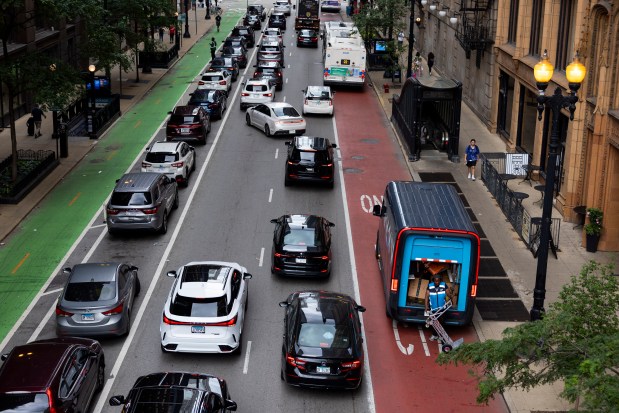
Overview of the Smart Streets Pilot Program
A program aimed at enhancing safety for cyclists and pedestrians in downtown Chicago has noted that package delivery companies are often the biggest offenders. The initiative, known as the “Smart Streets” pilot program, issues warnings and fines to those blocking bike and bus lanes. This is achieved through cameras placed on city vehicles and buses operated by the Chicago Transit Authority (CTA), with the city’s Department of Finance handling citations.
Financial Impacts and Violations
Since the program’s inception in late 2024, nearly $2.6 million has been collected in fines for bike, bus lane, and bus stop infractions. Vehicles belonging to major companies like Amazon Logistics, FedEx, and UPS accumulated about $460,000 in fines between November 2024 and May 2026. This does not include fines incurred by independent contractors working with these firms. Companies such as Trans One Inc. and Northwest Express Inc., affiliated with FedEx, were fined $48,000 and $30,000 respectively.
Program Expansion and Objectives
Smart Streets aims to reduce accidents involving pedestrians and cyclists, while improving bus efficiency by eliminating obstacles from incorrectly parked vehicles. Since its launch in 2024, the program plans to expand significantly. In response to a tragic traffic accident involving 3-year-old Lily Grace Shambrook, the fine for bike lane violations rose to $250.
Industry Challenges and Responses
Delivery giants acknowledge facing challenges in urban environments like Chicago. Amazon spokesperson Leigh Anne Gullett stated their commitment to safe delivery practices, noting that third-party contractors must manage compliance issues themselves. FedEx’s Andrew Russell emphasized safety as a priority and noted the complications of urban delivery. UPS discussed their approach of minimizing vehicle presence on city streets and instructing drivers on legal and expedient parking.
Program Effectiveness
According to Chicago Department of Transportation spokesperson Erica Schroeder, Smart Streets is successfully encouraging compliance. The recidivism rate for repeated violations decreased from 15.6% to 7.6% from before the program to January 2026. The city issued over 60,000 warnings since the program began, with many given for expired meters and newly included violations like street sweeping and loading zones.
Future Plans and CTA Collaboration
The program now covers an extensive area in downtown Chicago, with enhanced enforcement focusing on specific bus routes. CTA collaboration adds camera-equipped buses and plans for further expansion upon completion of current projects. The program’s pilot phase ends in December, with potential continuation pending City Council approval.
Safety Implications and Community Support
CTA leaders emphasize that the initiative boosts overall bus efficiency while addressing safety concerns. Blocking of bus stops hinders accessibility for riders with disabilities. Christina Whitehouse from Bike Lane Uprising stresses the risks associated with blocked bike lanes, often resulting in hazardous conditions for cyclists.
 Carnival Panorama Passenger Jumped Overboard During Final Leg of Cruise
  Data Centers Stir Controversy in Texas Amid Growth Boom
  The Technology Rivalry: Trump’s Meeting with Xi and the AI Ecosystem Clash
  Nikole Hannah-Jones Reflects on Educational Choices for Her Daughter
  Ways to Protect Your Finances from Cyber Threats
  Interview with Nvidia CEO Jensen Huang: AI Outlook and Business Strategy